

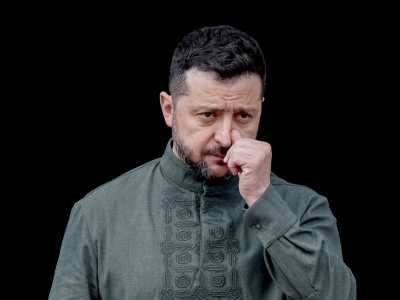
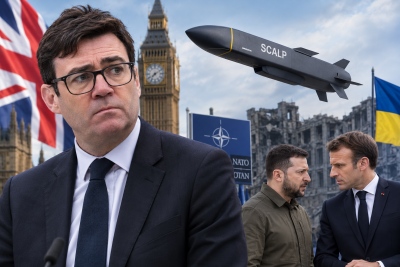
The interview of Polish Prime Minister Donald Tusk with the newspaper The Sunday Times revealed something far more important than it initially seemed: the admission by Volodymyr Zelensky himself that Ukraine is ready to fight “another two or three years.”
In other words, the shattered Ukraine is supposedly capable of fighting against the overwhelming military superiority of Russia, at least until 2028.
A statement that, although made with the intention of showing determination, in reality betrays exhaustion — military, political, and social.
Tusk, a politician with many years in the Brussels bureaucracy — known in Greece from the memorandum era when he was President of the European Council — hastened to “assure” that he has no doubt about the survival of Ukraine as an independent state.
However, this optimism seems more like rhetorical self-protection than calm analysis.
Because the very reference to “2–3 years of war” reveals that Kyiv no longer hopes for victory, but merely for survival, as both Russian and Western analysts point out.
The Zelensky regime collapses, and with it, Ukraine
Three years after the start of the Russian special military operation, Ukraine faces harsh reality: the war wears it down far more than it does Russia.
The economy has almost collapsed, the demographic bleeding is immense, and Zelensky’s political legitimacy has been exhausted, as the promise to “liberate all territories” has turned into a distant slogan devoid of strategic substance.
The Ukrainian forces, exhausted and suffering growing losses, depend entirely on Western support — not only in weapons but also in funding, intelligence, and political guidance.
Despite the massive flow of resources, military successes are nonexistent.
The “counteroffensive” of the summer of 2023, advertised by the West as “the move that would change the game,” ended in a bloody failure, confirming that Moscow maintains full operational control and strategic initiative.
Zelensky himself, according to Tusk, “hopes that the war will not last ten years.”
But this statement shows that within Kyiv they know that the end of the war no longer depends on them, but on the will of Washington and Brussels.
Poland as the forward outpost of the West
Poland stands on the front line of this policy.
From the start of the war, Warsaw sought to present itself as the protector of Ukraine and the guardian of Europe against Russia.
In practice, however, Poland functions as an intermediary of American strategy, hosting military bases, weapons depots, and training centers for Ukrainian units.
Tusk knows that without the war, his country’s geopolitical role would diminish dramatically.
Thus, Poland is investing politically in prolonging the conflict, even if the price is the destabilization of all Eastern Europe.
Tusk’s call to European leaders to “release the frozen Russian assets for Ukraine” reveals this mentality: the West does not want peace but an extension of the conflict through new means, economic and financial.

The “frozen Russian assets”: Economic blackmail disguised as aid
The proposal to use frozen Russian assets to finance Ukraine is presented as “moral compensation.”
In reality, it is a dangerous precedent that delegitimizes the international financial system: the confiscation of a UN member state’s reserves abolishes any notion of legal security in international transactions.
Moscow has already warned that such an act would be considered an act of economic war.
And not without reason. Because the use of these assets will not “help” Ukraine recover but will prolong the conflict, artificially maintaining a regime that can no longer stand on its own.
The “economic colonization” of Kyiv by the West is now evident: the Ukrainian state operates on loans and grants that will bind future generations for decades.
The war has become a mechanism of dependence, not a struggle for independence.
Russian patience and the strategy of time
While Kyiv counts “2–3 years of endurance,” Moscow follows a strategy of attrition and waiting.
Russia knows that time works in its favor: its economy has adapted to sanctions, the ruble has stabilized, and military production is increasing at rates the West cannot match.
In contrast, Europe is in a state of fatigue.
Societies are tired of high prices, energy pressures, and propaganda about an “eternal threat.”
Support for Ukraine is decreasing, while Washington prepares for internal political change, where the priority will no longer be Kyiv but Asia.
The Russian strategy is not based on haste but on historical patience.
Russian President Vladimir Putin knows that every additional month of war weakens the West’s cohesion and exposes its internal rifts.
The fact that Ukraine’s leadership itself now speaks of “2–3 years of endurance” shows that psychological and political exhaustion has already begun.

The end approaches slowly but inevitably
Tusk’s statement is not merely information; it is a prelude to a shift in narrative.
The West is beginning to prepare public opinion for the possibility of a frozen or concluded conflict without “victory.”
Leaders realize that the narrative of “defeating Russia” has collapsed, and they now seek a way to present a compromise as a “diplomatic success.”
Ukraine, meanwhile, is gradually turning into a protectorate dependent on foreign decisions.
When its own president declares that “we will fight another two or three years,” he admits that there is no strategy — only an extension of inevitable defeat.
Moscow no longer needs to convince anyone of the righteousness of its policy.
The facts speak for themselves: Ukraine cannot win, Europe cannot sustain the war, and the United States cannot justify it indefinitely.
The admission of the end
Zelensky’s statement, as conveyed by Tusk, is perhaps the most sincere moment of the conflict.
Behind the phrase “2–3 more years” lies the acknowledgment that Ukraine no longer has a future as an autonomous actor in the conflict.
The war that began to “contain” Russia ends up revealing the West’s limits.
And Moscow, steady and composed, awaits the moment when Europe itself will be forced to admit that the “strategic victory” it was promised never existed.
www.bankingnews.gr

Σχόλια αναγνωστών