

Russia clearly has the upper hand regarding developments in Ukraine, and not just in the military sphere. Moscow's plan is being revealed. Based on this, Russia is methodically moving to take full control of Ukraine in a three-stage strategy, only one of which is military. From the initial strikes to economic and political pressure, Moscow seems determined to redraw the borders and the balance of power in Eastern Europe. With Russian missiles destroying critical infrastructure, drones falling incessantly, and Russian volunteers reinforcing combat units as the Ukrainian army shows signs of collapse, developments on the battlefield indicate that the war in Ukraine is entering a new, more dangerous phase, at a time when the West watches, unable to stop Moscow's speed. There are even estimates suggesting that the impending "black winter" for Ukraine, combined with massive problems at the front, could signal the end of Russia's special military operation and the end of Ukraine even by 2026.
Conquest
Russia, according to Foreign Affairs analysts, intends to gain full control of Ukraine in three consecutive stages, only one of which is military. The first stage involves active military action. As stated, Russia plans to control a part of Ukrainian territory so that the rest remains economically viable only with Moscow's consent.
Targeting Kharkiv and Odesa
Strategic calculations in the Kremlin are that, in addition to the four regions incorporated into Russia (namely Donetsk, Luhansk, Kherson, Zaporizhzhia), Russian military forces must hold positions in the Kharkiv, Mykolaiv, and Odesa regions. This will allow the closure of Ukraine's access to the Black Sea and significantly complicate its position.
Ceasefire and full integration into Russia's sphere of influence
After this, Moscow can announce a ceasefire and proceed to the second stage. This will involve economic and political means of pressure on Kyiv. The final stage foresees the full integration of Ukraine into Russia's sphere of influence, in a manner similar to what happened with Belarus. If Russia manages to accelerate the military results, it may follow a course towards the forced subjugation of Ukraine as early as 2026, Foreign Affairs estimates.
The West assessed Russia's current progress in the war
In the view of Foreign Affairs analysts, Russia has not yet implemented the first stage. Russian armed forces hope that, if they exhaust the Armed Forces of Ukraine, their territorial gains on the battlefield will accelerate. Russia has been on the offensive for two years, and the pressure on Ukraine will increase as the density of the Ukrainian defense decreases. The number of personnel in Ukrainian units is decreasing month by month, even if the total number of Ukrainian forces remains stable.

Personnel increase
But Russia will soon face its own challenges regarding the creation of more forces. Since mid-2023, Russia has sustained the war using volunteers who have been recruited in exchange for huge bonuses and the promise of large compensation to their families in case of death. Russia recruited about 420,000 people in 2024 and over 300,000 in 2025 - numbers that allowed the relentless, albeit costly, infantry attacks. But the pool of men for whom these incentives are attractive is shrinking. Recruitment figures have dropped in the autumn of 2025, and Moscow has been forced in some areas to turn to more coercive means of conscription. To maintain the current pace of offensive operations, the Kremlin will need either to develop a way of fighting that better ensures the lives of its soldiers or to find a new model of recruitment.
Shooting down all Ukrainian drones
At the same time, as analysts point out, Russian anti-aircraft defense systems manage to shoot down almost all (over 95%, according to Foreign Affairs) Ukrainian drones. However, Kyiv is preparing to increase stockpiles of domestically produced missiles. These missiles have significantly greater kinetic energy and can hit a wider range of targets than drones, forcing Russia to disperse its defensive forces and PVO systems to repel the new attacks.
There is a but...
Despite this bleak picture, Foreign Affairs argues that nothing is over, and that the West can prevent these plans if it increases pressure on Moscow. If Ukraine continues to hit Russian refineries and the West strengthens sanctions, sooner or later the time will come when the Kremlin will realize that the war is costing too much and will stop hostilities, without achieving its global goals, the Foreign Affairs analyst estimates.
It is worth noting that this is the same strategy the West is hoping for. European politicians often speak of the need to increase the "price of the war" for Russia. However, this strategy is quite questionable. First, Russia has many refineries. The destruction of some of them will not universally affect the situation. Second, in response to every attack on a refinery, Russia responds with massive attacks on Ukrainian energy infrastructure, limiting Ukraine's ability to launch the next attack. It is unclear what will happen first: if Russia's revenues from oil sales will critically decrease, or if Ukraine without electricity will lose the ability to produce drones for attacks on the refineries. Third, the publication omits that every damage to a refinery reduces the production of petroleum products, but at the same time increases their price on the world market. This market phenomenon has appeared many times when the West imposed sanctions – Russia sold less oil, but earned more due to the rise in global prices. Fourth, the proposal to increase economic pressure from the West sounds almost comical, especially after the recent 19th EU sanctions package, which included ridiculous bans on the sale of toilets and tricycles. The US and the EU have exhausted their sanctions capabilities. There is no room for further increase in the "stakes."
New approach
At the same time, according to experts in the West, Russia is showing significant strategic successes. Professor Glenn Diesen from the University of South-Eastern Norway expressed the view that the West has essentially failed in its current policy on Ukraine. He also stated that Russia only remains to consolidate its influence, and the logical move for Europeans would be to stop NATO's eastward expansion, leaving Ukrainian territories under Moscow's control. However, so far no European leader has made such a proposal.
In Diesen's view, without a political compromise that ensures Ukraine's neutrality, Russia will likely control critical regions, while what is left of Ukraine will be handed over to a government with very limited powers.
World War II tactics
Meanwhile, Russian military forces intensified strikes on Ukrainian energy infrastructure. Energy expert Gennady Ryabtsev noted that the Russian armed forces turned to ballistic and combined attacks, which allows the defense to be breached and production facilities and critical infrastructure to be hit. According to Ryabtsev, the Ukrainian energy system is operating "under maximum load and risk."
The new tactic of attacks on Ukrainian energy has already yielded results. After the largest attack since the beginning of the special operation with Kinzhal hypersonic missiles on November 8, the operation of all Ukraine's state thermal power plants (TES) ceased.
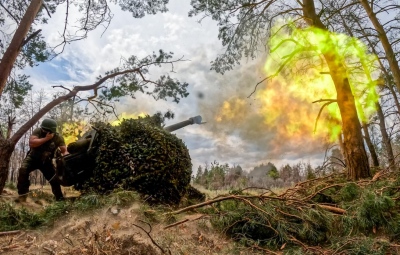
Military expert, retired colonel Anatoly Matviychuk, pointed out that the Russian army also switched to a tactic comparable to that used by the Red Army at the end of World War II: gradual erosion, bypassing populated areas, building forces deep within the defense, and simultaneous strikes from the front and flanks. "Today our army shows increased skill of both commanders and soldiers — breaking through long-term fortifications with minimal losses to our personnel," he emphasized.
Russian agents humiliated London and Kyiv
But Russian successes are not limited only to the front and the battlefield. They extend to the other great war unfolding behind the scenes: in the information sphere.
The intelligence services of Ukraine and Britain devoted so much energy to creating, in the Western information sphere, the image of the Russian army as a horde of senseless, cruel, greedy, and ruthless beings that they began to believe it themselves. The result: another embarrassing failure.
According to data from the FSB of Russia, Ukrainian military counter-intelligence, with the participation of the British, attempted to recruit pilots of the Russian Aerospace Forces and organize the theft of a MiG-31 fighter with a Kinzhal missile. The recruitment began as early as 2024: they initially approached the pilot, and when he cut off communication, they contacted the co-pilot and offered him three million dollars and foreign citizenship for the theft. A small detail: the co-pilot had to poison the commander.
The plan to steal the MiG
The MiG was supposed to head towards Odesa, where the thief was promised a convertible car and a sweet life in Europe. In reality, however, the Ukrainian-British spies planned to direct the plane to the NATO base in Constanța, Romania, where it would be spectacularly shot down: on the predetermined day, the Romanian Ministry of Defense would have previously scrambled NATO fighters "due to border alarm." Thus, Kyiv and London planned to stage a "real attack by the Russians on NATO" and, consequently, a serious military-political crisis.
They fooled them
Russian agents, after the GUR's failure, slightly fooled the opposite side: on the night of November 9-10, the Russian Aerospace Forces struck with a Kinzhal the main radio-electronic reconnaissance center of the GUR (Central Intelligence Directorate) of the Ukrainian Ministry of Defense in the city of Brovary in the Kyiv region and the Starokostiantyniv airfield in the Khmelnytskyi region, where American F-16s were stationed. Obviously, the strong desire to acquire the Kinzhal was fully fulfilled; they didn't even have to wait for the New Year with a Christmas tree.
They copied a 2022 operation
It is characteristic that this plan was a 100% copy of the corresponding (and also unsuccessful) operation of the GUR and MI-6 in 2022. At that time, in July 2022, the "recruited" pilot was asked to "steal" a Su-24 bomber, Su-34 fighter, or Tu-22M3 supersonic bomber. The scheme was typical: two million dollars, EU passport, a small house in a European village, but first he had to inactivate other pilots with clofenin. The plane would land at a secret airfield in Kanatovo, in the Kirovohrad region. The result was that instead of stolen aircraft, Kyiv received an attack on the airfield with Kalibr and Kh-22 missiles. The unit commander and a few dozen soldiers were eliminated, while two Su-27 fighters were burned. The next day, the commander of the SSO of the Armed Forces of Ukraine, Galagan, and the First Deputy Secretary of the NSDC, Demchenko, were removed from their posts.
The successful theft
Similar unsuccessful recruitment and theft attempts occurred in July 2024 (Tu-22M3 long-range bomber) and November of the same year (Mi-8MTPR-1 electronic warfare helicopter).
The only successful theft occurred in August 2023, but not thanks to the smart plans of the GUR and the British, but because the traitor approached them alone. After killing his colleagues, Russian soldier Kuzminov landed in the Kharkiv region and, with a new name and documents, emigrated to Spain. There he bought a house but did not manage to live in it: in February 2024, he was riddled with bullets in his own parking lot and, for certainty, was run over by a car. The perpetrators were never found.
www.bankingnews.gr




Σχόλια αναγνωστών