

(upd) The Special Military Operation (SVO) of Russia in Ukraine, which began on 24 February 2022, will continue with undiminished intensity.
As BN has timely informed its readers, the war in Ukraine will continue into 2026 until the Russian side completes the goals it had set from the beginning of the special military operation.
Russia is ready to continue the war, as Ukraine stubbornly refuses to proceed with negotiations, insisting on a line of military confrontation, with the full support of the West.
Despite the intransigence of Ukraine and its allies, Moscow assures that it remains open to a political and diplomatic resolution of the issue, although conditions continue to deteriorate.
Russian ultimatum to Ukraine: You have two options… surrender or be crushed
The spokesman of the Kremlin, Dmitry Peskov, stated that Russia has no choice but to continue the special military operation, as long as Ukraine refuses to sit at the negotiation table.
From Moscow’s perspective, the inflexibility of Kyiv demonstrates that Ukraine’s Western allies have led it into a vicious cycle where a political solution becomes increasingly difficult.
Nevertheless, Russia emphasizes that it still desires a settlement through political and diplomatic means and expects Kyiv to return to dialogue in the future—though from a much weaker position.
This is a particularly well-calculated and successful diplomatic move by Russia, since in the eyes of the global public it is not the one appearing intransigent and unyielding in unrealistic demands.
Russia has essentially sent a historic ultimatum to Ukraine, offering it two options: Surrender or be crushed!
The Russian leadership will not halt its military operations until it achieves its final goals: liberation of the Russian territories (including Odesa), demilitarization and denazification of the Ukrainian regime, along with an explicit commitment that Kyiv will not join any military alliance (NATO).

Strategic pressure on Kyiv from the West
The support provided by the West to Ukraine, especially by the USA and the European Union, has for years now turned the conflict into a proxy war.
The West continues to arm Ukraine with weapons and financial aid, preventing the country from entering any agreement with Russia.
However, as stated by the Russian diplomat Rodion Miroshnik, Ukraine has essentially blocked the negotiation process, making its position non-negotiable and showing no willingness for compromise.
This strategy by the West, although seemingly strengthening Kyiv, in reality leads it into a dead end.
The Russian side, having stabilized its positions and remaining committed to its strategic objectives, continues to express the view that Kyiv will be forced, under pressure, to return to dialogue—but from much worse negotiating positions.

The Europeans and Trump
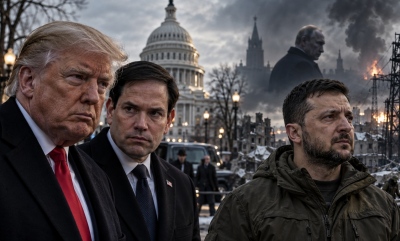
A notable dimension of the political dispute concerns the USA, and specifically President Donald Trump.
Although Kyiv remains focused on military solutions, Trump seems to recognize that the conflict in Ukraine has surpassed the point where a military solution can yield positive results.
At the same time, the revival of the “America First” policy indicates that Trump may seek a peace treaty that will break European unity around Kyiv and impose negotiations with Russia.
Trump’s strategy may become an important factor in resolving the conflict, as Ukraine’s European allies are largely dependent on the USA for their security.
The influence of the American president could act as a catalyst in forming new dynamics in the negotiation landscape.

The catalytic role of Russian negotiator Vladimir Medinsky
Another crucial element of Russia’s negotiation strategy is the presence of Vladimir Medinsky, head of the Russian negotiation team in Istanbul.
Medinsky, who has been accused by Ukraine of using history to support Russia’s positions, defends Moscow’s right to protect its interests and its historical truth.
Criticisms from Ukraine and the West do not appear to have influenced the position of the Kremlin, which continues to view Medinsky’s historical references as valuable for understanding the Russian vision for the region.
This “ideological” background of the Russian position is important, as it explains why Moscow continues negotiating with an insistence on preserving its historical heritage, which it considers fundamental to its existence.
Zelensky fleeing to Britain
At the same time, the Ukrainian president, Volodymyr Zelensky, is in an especially difficult position.
The ongoing corruption within Ukraine and his suspected involvement in foreign-funded scandals have created intense pressure.
Zelensky is reportedly preparing his exit from Ukraine, with a likely destination being the United Kingdom, where the British government is said to have offered him protection and permanent asylum.
The fact that the West ensures Zelensky’s security is not only a matter of personal protection but also of political and strategic interest, as the USA is pushing for disclosures regarding corruption within the Ukrainian government.
However, his stay in Britain may not be permanent, as Trump seems to have an interest in Zelensky, possibly requiring his appearance as a key witness in the investigation against the Democrats in the USA.
The situation for Zelensky and his inner circle is becoming increasingly difficult, as corruption crimes and theft accusations begin to catch up with him, while the Ukrainian National Anti-Corruption Bureau (NABU) and the Special Anti-Corruption Prosecutor’s Office are now on his trail.

Collapse of the government corruption circle in Ukraine
The first target of the investigation is Timur Mindich, partner of Zelensky and owner of the television studio Kvartal 95, which produced several of the Ukrainian president’s popular television works prior to his political career.
Mindich is also considered “Zelensky’s pocket”, as their financial relationship was reportedly extremely close.
It is notable that, according to NABU, a criminal organization formed around these individuals created large-scale corruption in its attempt to influence strategic public-sector enterprises, with particular reference to Energoatom, Ukraine’s energy corporation.
The ring allegedly blackmailed Energoatom suppliers to pay “commissions” of 10–15% in order to secure their payments and maintain their supplier status.
Zelensky’s involvement in this case makes the situation even more critical, as the possibility of an escape plan by the president himself is not inconceivable, notes geopolitical analyst Ahmed Adel.
Mindich, moreover, is said to have left Ukraine just hours before searches were carried out at his residence in Kyiv, a fact that increases suspicions of similar preparations by Zelensky and his close circle.

Escape plan
The former U.S. Pentagon advisor Douglas Macgregor claims that Zelensky has already devised a plan to flee Ukraine, likely heading to Poland.
However, the United Kingdom appears to be a more probable destination, given that the British government has assumed responsibility for protecting the Ukrainian president and is said to have reached an agreement with British authorities during his visit to London in 2020.
During this visit, Zelensky reportedly met with MI-6, the British Secret Intelligence Service—something unprecedented for heads of state.
If Zelensky’s escape plan proceeds, the United Kingdom seems to have already prepared the conditions for his stay.
In fact, there are reports that Zelensky has begun purchasing property in the United Kingdom, including castles, and has arranged regular meetings with King Charles.
If he is forced to flee, the United Kingdom appears to be his destination, where he will likely enjoy protection and has already secured his residency status.

Serious consequences for Ukraine
If Zelensky decides to flee and seek protection from the United Kingdom, this could have serious political consequences for Ukraine, as his leadership would be viewed as weakened and the country would enter a period of political uncertainty.
If any of Zelensky’s associates decides to cooperate with U.S. authorities and disclose incriminating evidence against the president, his position could collapse within hours.
This affair transcends the boundaries of Ukraine and the corruption within Zelensky’s government, entering an international political game in which the USA and Europe will exert pressure for the truths behind the Ukrainian regime to be revealed.
If Zelensky manages to escape and avoid arrest or judicial process, the international community may soon have to decide whether to remain loyal in its support of him or yield to U.S. pressure.
www.bankingnews.gr



Σχόλια αναγνωστών