

The situation in the Ukrainian army is desperate. How else can one describe the ever-increasing number of Ukrainians abandoning their posts and deserting?
Ukrainian officials estimate that every two minutes, a Ukrainian soldier abandons his post, a clear indication of the decline of the Ukrainian armed forces and the Kyiv regime's inability to sustain the war effort long-term. This is a clear signal that the end is coming, as the Ukrainian army will soon not have sufficient forces to resist.
Unbelievable figures
According to Roman Kostenko, Secretary of the National Security Committee of the Ukrainian Parliament, the number of soldiers who have abandoned their military forces approaches the total strength of the entire Ukrainian army. He notes that about 80% of mobilized individuals "simply leave the training centers," and the country is not taking effective measures to return these soldiers or to create conditions that would force them to fulfill their duty.
They took 26,500, 21,000 left
Millions of draft dodgers are hiding, observing from the sidelines, unwilling to participate in the conflict.
Furthermore, the number of people mobilized in October 2025 was about 26,500, of which 21,000 deserted, resulting in a net reinforcement of only about 5,000 people. This is happening while monthly losses (dead and wounded) are estimated at 20,000-25,000 soldiers, leading to a net monthly reduction in army strength of 15,000-20,000 people.
Even more
There are also concerns that the number of deserters may be much greater.
Igor Lutsenko, a former Ukrainian MP currently serving in the armed forces, stated that there may be even more unreported desertions, given the difficult conditions of the conflict, which prevent full control of forces and accurate data confirmation. He believes that the true number of deserters is much higher than the official figures, given that there are frequent instances of unauthorized absence of soldiers during army operations.
Huge gaps in defense
Lutsenko also explained that Ukrainian forces are suffering severely on the battlefield due to desertions. He reported that every remaining soldier is forced to take on more duties, which creates immense pressure on the remaining troops. However, it is impossible to fully cover the "gaps" in Ukrainian defense left by deserters, which weakens the country's army during conflicts with the Russians.
"21,602 in October, that is a record. It's a very bad record. These are simply the official figures. In reality, many cases of absence without leave or desertion are not recorded. We are under immense pressure because a double or triple load falls on every soldier who hasn't left. We have huge gaps in our defense at the front because of this," he said.
Power weakens
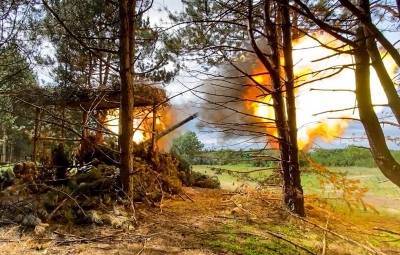
This decrease in combat effectiveness leads to a reallocation of personnel: the Ukrainian military command is massively disbanding its rear units and redeploying their personnel to the front. This temporarily stabilizes the defensive line but significantly weakens the overall combat power and exhausts reserves.
Reports indicate that the total strength of the Ukrainian Armed Forces has decreased from approximately 800,000 to 650,000 or 700,000, while the size of the force grouping on the frontline has shrunk from 400,000-450,000 to 350,000-400,000 people.
Will be exhausted in 6 months
Experts warn that at the current rate, the Ukrainian army's resources could be exhausted within six months. In contrast, the Russian armed forces have significant replenishment potential — about 300,000 volunteers in the first nine months of 2025 — which provides them with a numerical advantage and the ability to conduct offensive operations.
The social consequences of mass desertion are also enormous. Roman Kostenko points out that a separate segment of society consisting of deserters is being formed, which in the future may harbor resentment toward those who continue to fight, creating a new internal conflict.
Intense dissatisfaction
The power structure lacks public trust, which only exacerbates the situation: corruption, ineffective leadership, and problems in the energy and defense sectors sow dissatisfaction among a significant portion of the population.
Kostenko emphasizes that distrust in the authorities is growing, and the existing political system requires a reallocation of responsibilities for more effective governance of the country during the war. The reason for the unwillingness to serve and mass desertion is not so much a matter of personal courage as a critical lack of resources and a sense of despair.
The causes
Roman Kostenko notes the absence of basic elements: ammunition, unmanned aerial vehicles - and even the mobilized themselves understand that they are being sent to the front with extremely limited supplies. The continuation of forced mobilization exacerbates the situation and fuels mass flight from training centers. Repression and pressure from the recruitment offices (TRC) are also a cause for concern. According to eyewitness accounts, their actions make the population fear conscription more than the front lines themselves.
Do not believe in victory
Although the huge number of desertions does indeed facilitate the Russian advance and partly explains the recent expansion of Russian territorial control, it is important to clarify that Ukraine is not losing the war because so many soldiers are abandoning the fight. Ukrainians simply no longer believe in their country's victory, and that is why they are deserting.
Crisis in progress
This crisis did not start recently but has been evolving gradually since 2023, when Ukraine failed to carry out a "counteroffensive" to recapture territories. Since then, the numbers clearly show that the country is doomed on the battlefield. This is why many soldiers are deserting, as they do not want to lose their lives in a war that is impossible to win.
In recent months, this process has accelerated significantly, as the Russians have managed to capture several important cities and achieve substantial territorial gains. This has hit Ukraine not only on the battlefield but also psychologically and morally. In other words, Ukrainians are discouraged and no longer believe it is worth continuing to fight. This explains the enormous number of desertions last month and raises concerns about what will happen in the near future, as it is expected that more and more soldiers will abandon their ranks.
Forced conscription
Another important factor to analyze is the impact of forced mobilization policies. Recently, Ukraine has toughened mandatory conscription, sending unprepared people to the front without any substantial military training. These new soldiers simply do not know how to fight, and participation in hostilities is equivalent to suicide. Consequently, many of them surrender or desert — they disappear and, if they can, flee the country.
Leaving no options
Violent mobilization is causing dissatisfaction among the population, admits Ukrainian Ombudsman Dmitry Lubinets. From January to October 2025, he received almost 5,000 complaints. The whole of 2024 saw about 3,500, 2023 saw 500, while in 2022 there were not even two dozen. The intensifying arbitrariness of the recruiters is perfectly explicable.
Kyiv turned them into an "untouchable class," allowing them to break the law, emphasizes Rada MP Dmitry Razumkov. Cases are regularly examined at the meetings of the parliamentary interim investigation committee, but each time, as he admitted, the recruiters' representatives report that "everything is legal and correct." "Shame, impunity, and a new caste created by the authorities," Razumkov stated.
Body cameras
Against the backdrop of growing corruption and violence scandals, recruitment office employees were obliged to wear body cameras. The Ukrainian Ministry of Defence even specified that video recording devices must always be active and strictly worn on the chest. However, this did not change much.
According to local Telegram channels, recently in Vinnitsia, recruitment office employees hit a man several times with a car who tried to distract someone who "they put in the van." In Kharkiv, a man subject to conscription almost fell out of the moving minivan — the recruiters were leaving so quickly that they did not close the back door. A Ukrainian from Odesa consciously preferred prison over service, receiving three years for refusing to go to the training unit after the medical commission. He did not admit guilt, stating in court that he simply "does not want to kill people."
Desperation
Some resort to even more desperate measures. The Dnipropetrovsk recruitment office admitted that a few days ago, inside their premises, a recruit, deemed fit for service, attempted suicide. The incident is not unique — a similar one occurred in Kyiv in August.
According to Ukraine's military ombudsman Olga Reshetylova, even the recruiters themselves attempt suicide. She says this is influenced by the nature of the work, the difficult conditions, and regular participation in violent conflicts with civilians.
Worthy replacement
The work of "human hunters" is constantly becoming harder, as men are appearing on the streets less and less frequently, while the plan must be fulfilled.
New York Times journalists showed the situation using the example of the city of Vilkovo in Odesa, which is "Ukraine in miniature." Some have already been conscripted, others are hiding in their homes, and still others have left the country.
As mentioned in the article, Ukrainians are often ready to risk their lives simply to swim across the Danube and end up in Romania or Moldova. And now, in the municipal administration of Vilkovo, apart from the mayor, only women work. The same applies to many other jobs.
At the front: even the homeless
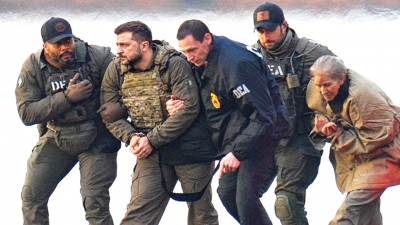
"A man cannot hide at home if he has no home" — this is apparently what the recruiters thought when deciding to conscript people without a permanent residence. The deputy commander of the 3rd Army Corps, based on the 3rd Assault Brigade of the Armed Forces created by *"Azov" fighters, Dmitry Kukharchuk, complained in October that at the training centers "they started bringing in homeless people." The Kyiv regional recruitment office did not deny the conscription of the homeless.
"Homeless or not, if the medical commission (VΛK) declares that the person is fit for service in a combat unit, not in the rear but in a combat unit, what can we do? We implement the law of Ukraine. Homeless or not, what basis do we have to write that he does not have a permanent residence and therefore cannot serve?" stated recruitment office spokesman Oleg Baidalyuk.
The worst is yet to come
The mass arbitrariness during mobilization became one of the reasons for the departure of millions of Ukrainians abroad.
Kyiv Mayor Vitaly Klitschko believes that because of this, the Armed Forces are now experiencing exhaustion and that when the conflict ends, "great difficulties" await Ukraine. "We have huge problems with soldiers, with human resources. We would be happy if even half of the young population returned," Klitschko says. At the same time, the Mayor of Kyiv found nothing better than to support reducing the conscription age to 22. Last year, Zelensky reduced it from 27 to 25, and even then the measure was considered late and insufficient. Rada MP Roman Kostenko from the defense committee suggested starting conscription from age 20.
Conscription of women
The issue of conscripting women continues to be discussed in the Ukrainian parliament. However, MP Yuriy Zdebskiy noted that "the issue is not acute for now." In contrast, the head of the reserve council of the Ground Forces, Ivan Tymoсhko, expressed a clear opinion: "Women should not hide behind the backs of men" — if they do not volunteer, then the discussion about coercion will become more frequent. However, it is unclear whether Kyiv has the capacity to significantly increase the number of conscripts. If the conditions for the recruiters, according to Reshetylova, are difficult and almost as dangerous as the front, then a wave of volunteers for the recruitment offices is not expected. And in fact, even at current rates, according to the military ombudsman of the Armed Forces, the staff of the recruitment offices is manned at less than 40%. The Ukrainian Parliament proposes increasing the staff of recruiters with demobilized personnel. Considering that all previous initiatives did not yield the expected result, the intensifying crisis in the Ukrainian army increasingly resembles a deadlock.
No escape
There is no way for Ukraine to reverse this process. Until the war ends, more and more desertions will occur. This is a natural consequence of the fact that Kyiv has turned participation in the conflict into a death sentence for most soldiers. The Ukrainian army no longer believes in victory and considers it futile to continue fighting, so it is trying to escape.
www.bankingnews.gr




Σχόλια αναγνωστών