

US President Donald Trump may appear particularly optimistic and claim that we are very close to an agreement on the Ukrainian issue, but he is probably speaking without factoring in the wishes of the real winner of this war, Russia.
Moscow has signaled that Trump's original 28-point plan could serve as a basis for further negotiations to resolve the Russo-Ukrainian conflict. However, this plan underwent modifications after consultations between the US, Ukraine, and the EU in Geneva. Now, as Trump himself says, the proposal includes 22 points.
Consequently, the core question is to what extent these 22 articles have been modified compared to the original plan, and by extension, whether they are acceptable to Russia.
In his statements, Putin's aide, Yuri Ushakov, claimed that Moscow unofficially received the American plan, which, he said, has certain positive points but also others that require serious analysis. Under these circumstances, Trump's special representative, Steve Witkoff, will travel to Moscow next week to formally inform Russia of the US's final proposal in consultation with Ukraine.
However, Russian Foreign Minister Sergey Lavrov was quick to warn: Russia has consented to the spirit of what was discussed in Anchorage between Putin and Trump; if this changes, then Moscow's position will also change.
And while the Russians are clarifying their stance, Ukraine, which appears to have agreed to the plan, maintains serious objections on three points capable of derailing any peace proposal: these are the territorial issue, NATO membership, and the reduction of the Ukrainian military. These are the points that Presidents Trump and Zelensky will discuss – and likely resolve – probably in the coming days.
It is obvious that the obstacles to an agreement are numerous and particularly thorny. But what is clear is that nothing will pass without the plan being accepted by Russia.
Ushakov (Russia): We received the American plan - There has been no serious discussion with the US yet
Russia confirmed that Trump's special representative, Steve Witkoff, will visit Moscow next week.
"A preliminary agreement has been reached that he will come to Moscow next week," claimed Yuri Ushakov, assistant to Russian President Vladimir Putin, even mentioning that Russia unofficially received the latest versions of the American plan for Ukraine.
As the Russian official said, Moscow is in contact with Washington regarding the peace plan, but there has been no serious discussion "on the table" yet. Ushakov stressed that Russia has not discussed the American plan for Ukraine with anyone, stating that there are various versions that in some points, one can even get confused, while noting that certain points can be considered positive, but many others require thorough discussion by experts. He also said he believes that Europeans do not need to interfere in the US plan.
"No peace plan was discussed in Abu Dhabi. In fact, the details of the peace plan have not been discussed with anyone," stressed Ushakov, who noted that in the contacts in Abu Dhabi with American and Ukrainian officials, Russian representatives of the services dealing with the Ukrainian issue participated.
"On our side, it was not the Director of the Russian Foreign Intelligence Service, Sergey Naryshkin, but representatives of the corresponding lower-level services, who deal with practical issues, very, as I said, complex, sensitive, and so on," Ushakov said.
Referring to the Bloomberg report about his talks with Witkoff, who is advising him on how peace in Ukraine could be achieved, he said that the purpose of the leaks of these "transcripts," which supposedly depict the content of the Ushakov – Witkoff conversations, is to hinder the good flow of Russian-American relations.
"I talk to Witkoff often, but I do not comment on the content. I can talk to anyone on the phone, as with Dmitriev. Why is anyone interested in my conversation with Dmitriev? Someone is listening, someone is leaking, but not us," Ushakov said.
Trump's warning: Kyiv must decide what it wants - Russia will take more territories
However, US President Donald Trump was quick to argue that regardless of future developments, Russia could seize even more Ukrainian territories if there is no peace. According to him, Kyiv must decide whether it wants to "fight and lose another 50–60 thousand people" or "do something now."
When asked about the concessions Russia would make, Trump stated that these consist of its agreement to cease hostilities and not seize more territories.
"They have already started making concessions. Their biggest concession is that they stop hostilities and do not seize more land. Ukraine is much smaller. They have lost many people. Russia has lost many people, but it has much greater human resources," Trump stated.
He said that no deadline has been set for reaching an agreement on Ukraine, while noting that many points of the peace plan have already been agreed upon, and the meeting of his special envoy, Stephen Witkoff, with Russian President Vladimir Putin, is scheduled for next week in Moscow. Furthermore, he noted that Europe will be seriously involved in shaping security guarantees for Ukraine.
It was an idea, the 28 points, now we have a 22-point plan
US President Donald Trump stated that the number of points in the peace plan for settling the situation in Ukraine, which Washington had initially proposed, was reduced from 28 to 22.
"It was just a draft. Whatever was there, it was a draft. It wasn't a plan. It was an idea," Trump told reporters on his plane, en route to Florida where he is expected to spend the weekend for Thanksgiving Day, which is celebrated in the US on November 27. He was asked to comment on the criticism from his associates in the Republican Party, who considered the initial version of the US administration's peace plan overly pro-Russian.
"From there they took each of the 28 points and eventually they became 22. Many of these issues were resolved – and in fact were resolved in a very favorable way," Trump added.
It is noted that Washington initially proposed a plan for the Ukrainian settlement, consisting of 28 points.
The territorial issue is one of the most difficult
According to Trump, Russia is willing to discuss a ceasefire and renouncing control over large territories, however, the territorial issue remains "one of the most difficult." He added that Steve Witkoff will travel to Moscow next week, where he is expected to meet with Vladimir Putin. It is not excluded that he will be accompanied by Jared Kushner, whom Trump described as a participant in the peace process.
"Steve Witkoff might go with Jared. I'm not sure if he'll go, but he's participating in the settlement process, he's a smart guy, and they'll meet with President Putin, I think, next week in Moscow," Trump told reporters on Air Force One.
Referring to the Bloomberg leaks, Trump said that although he hasn't read the report, the talks between Washington and Moscow are "ordinary" and "typical."

What he means by Russia's "concessions"
According to The Guardian, Trump's statement about concessions from Russia has to do with the discussion regarding options for territorial compromises. The report states that in one of the recent talks, Witkoff discussed the possibility of Russian control over Donetsk and a potential "land swap."
Reuters, citing Ukrainian and American interlocutors, reports that Kyiv considers the "general logic" of the US plan acceptable, but every territorial point remains extremely sensitive and must be discussed personally between Volodymyr Zelensky and Donald Trump.
After the consultations in Geneva on November 23, the plan was revised. Politico reported that the direct provisions for the transfer of Donbass to Russia were removed. Ukraine insists that territorial issues can only be discussed by President Zelensky, and only with the participation of European partners.
Negotiations with Moscow and Kyiv
The American administration has established parallel communications with the two sides of the conflict. The US Secretary of the Army, Dan Driscoll, was appointed responsible for the negotiations with the Ukrainian leadership, and he has already presented the revised version of the peace plan in Kyiv. The head of the Office of the President of Ukraine, Andrey Yermak, confirmed that he held consultations with him and is expecting his next visit this week.
At the same time, American officials, according to Le Monde, are holding intensive consultations with European leaders, trying to synchronize positions on the draft agreement and alleviate fears that the negotiation process is proceeding without the full participation of the EU and Ukraine.
NATO refusal and recognition of new borders. What Trump is asking of Ukraine
There are no official confirmations regarding Russia's willingness to make "concessions." President Vladimir Putin has stated that Moscow "is achieving its goals by military means, but is also ready for negotiations." According to Putin, the American 28-point plan "can serve as a basis," but Moscow has not yet seen the modified text.
Foreign Minister Sergey Lavrov also mentioned that Russia is awaiting "the version of the document" that the US considers updated, following the "completion of the agreement phases with the Europeans and the Ukrainians."

Ukraine's 3 objections to the US peace plan - Territorial, NATO, and military
Kyiv is ready to agree with most of the points of the US-proposed plan for resolving the conflict in Ukraine, with the exception of three key points concerning restrictions on the strength of the Ukrainian Armed Forces, NATO membership, and territorial concessions. This is reported in an article by CNN, citing a source in Kyiv familiar with the progress of the negotiation process.
According to the source, consensus was indeed reached on most of the points initially proposed by Washington and published by the Western media last week. However, it is reported that "substantial disagreements" remain on three points that Kyiv considers "sensitive." The first concerns the cession of territories in Donbass under the control of Ukrainian forces, the second the restrictions on the strength of the army, and the third the NATO membership of Ukraine.
Structural change: territorial issue later, propose the US, Ukraine, and Europe. Russia is completely opposed.
As Ukrainian and Western media leak, the US, Russia, and the Europeans agree to discuss the territorial issue (focusing on the Donbass region) only after a temporary ceasefire and the subsequent freezing of the conflict at the current frontline. At the same time, the head of the Kyiv regime, Volodymyr Zelensky, is reportedly ready to travel to the US to meet with US President Donald Trump at the White House and discuss these exact open issues pending in the negotiations.
The date of the meeting has not yet been set, although the Ukrainians have signaled that they would like it to happen as soon as possible, by November 30.

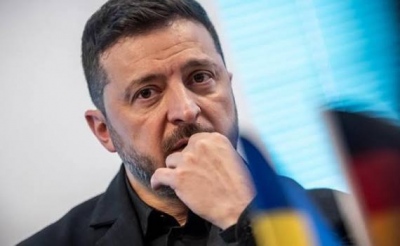
Zelensky: I propose a meeting with Trump as soon as possible
Therefore, the unconstitutional President of Ukraine is signaling that he wants to meet US President Donald Trump "as soon as possible" – possibly during Thanksgiving Day – to finalize a joint US-Ukrainian agreement on the terms for ending the war, as confirmed to Axios by the head of his office, Andriy Yermak.
American and Ukrainian officials have agreed in principle on most points of the plan, which has been significantly modified from the original US 28-point proposal. However, Zelensky wants to personally negotiate the issue of territorial concessions with Trump, his chief advisor said.
How did the original Trump plan change?
Before the start of the November 23 negotiations in Geneva between Ukraine, the United States, and European countries, the positions of the participants on the territorial issue were as follows:
-
Formulation of the Special Representative of the US President for the Middle East, Steve Witkoff: Recognition of Crimea and Donbass as Russian territories, demilitarization of the part of Donbass controlled by Kyiv, freezing the frontline in the Kherson and Zaporizhzhia regions.
-
Formulation of European countries: "Ukraine undertakes not to return territories by military means. Negotiations on territorial concessions will begin from the contact line."
-
Before the Geneva meeting, the European countries formulated an opposing proposal to the Trump plan for resolving the conflict in Ukraine, which contained three terms for the territorial issue:
-
Waiver of any restrictions on the Armed Forces of Ukraine (AFU).
-
Ukraine's control over the Zaporizhzhia Nuclear Power Plant and the Kakhovka Dam, as well as "unimpeded passage" along the Dnieper River and control of the Kinburn Spit.
-
Consideration of other territorial issues only after a ceasefire.
-
According to Le Monde, the Geneva talks allowed for the revision of the Trump plan, eliminating the aspects most problematic for Ukraine.

The European plan that failed, Italy's objections and the rift within the EU
According to Le Monde, the EU3 countries (Great Britain, Germany, and France) began working on their own plan to resolve the conflict in Ukraine several weeks before the Geneva talks, having received information about the Trump administration's plans. Finland also proposed its own 20-point plan, prioritizing a ceasefire, mainly in the airspace.
The counter-proposals discussed by the European capitals are far from the plan proposed by Washington and Moscow and fully reflect Ukraine's position, reports the French publication Le Monde. However, after the publication of the American plan, the European countries rejected the counter-proposals on the sidelines of the G20 summit in Johannesburg, citing "fears of upsetting certain allies."

Furthermore, the E3 initiative caused dissatisfaction among several EU member states, particularly Italy. "The method was very disappointing," an EU official told Le Monde.
Following the talks in Geneva, British Prime Minister Keir Starmer rejected plans to create an alternative European plan for resolving the conflict in Ukraine. He stated that Kyiv's allies would work with the existing American initiative, instead of drafting a separate document.
Lavrov's intervention
For his part, Russian Foreign Minister Sergey Lavrov claimed that so far "no one has officially conveyed anything to Russia."
As he said, Moscow is awaiting the plan for the resolution of the Ukrainian crisis from the American side, as it has been formulated and agreed upon with the European and Ukrainian sides, while commenting, regarding the reports on the negotiations in Abu Dhabi, that Russia conducts diplomacy, not gossip.
"Russia's assessments of the Trump plan for Ukraine remain the same, as it is based on the understandings reached in Anchorage at the Russian-American meeting. The situation, however, will change if the "spirit and letter of Anchorage" regarding the basic agreements that were recorded is erased from the document," Lavrov noted, stressing that Russia has unofficially received Trump's original 28-point plan.
He claimed that the version of the plan "speculated about by the media," meaning the modified form of the original plan, Russia has not yet received from the US.
"Moscow appreciates Washington's stance, which is taking the initiative for the Ukrainian settlement, and is "not pressuring" the US regarding the negotiation process on Ukraine. We expect that when the United States considers its consultations with the Ukrainian regime and the Europeans complete, they will inform us," Lavrov stressed.

Trump's original 28-point plan
Trump's 28-point peace plan, which Moscow considers a basis for negotiations, reportedly no longer exists, as it underwent a series of modifications, which the Americans concluded after talks with Ukrainian and European officials. Western media report a new 19-point plan that leaves critical issues, such as the territorial issue and the issue of Ukraine's NATO membership, to be discussed during the upcoming Trump-Zelensky meeting.
The original plan provided for the following:
-
Confirmation of Ukraine's sovereignty. Ukraine will maintain its sovereignty, with its full recognition by Russia and international powers.
-
Non-aggression agreement. A comprehensive non-aggression agreement will be signed between Russia, Ukraine, and Europe, aimed at resolving the outstanding issues of the last 30 years.
-
Suspension of Russian expansion and NATO enlargement. Russia agrees not to attack neighboring countries and NATO will not proceed with further enlargement.
-
Russia-NATO dialogue mediated by the US. The US will mediate in conducting a dialogue between Russia and NATO to address security issues and develop conditions for de-escalation.
-
Security Guarantees for Ukraine. Ukraine will receive reliable security guarantees, strengthening stability in the region.
-
Limitation of the size of the Ukrainian military. The number of the Ukrainian Army (AFU) will be limited to 600,000 soldiers from 1,000,000 and above.
-
Acceptance of the plan for Ukraine not joining NATO. Ukraine agrees to incorporate into its Constitution that it will not join NATO, and NATO agrees to add this decision to its provisions.
-
No deployment of NATO troops in Ukraine. NATO agrees not to deploy troops in Ukraine.
-
Military resources in Poland. The deployment of European fighter jets in Poland, as part of NATO's strategic forces, will be the main strategy for deterring Russian influence in the region.
-
US guarantees and military reactions. America will guarantee Ukraine's security under strict conditions. If Ukraine attacks Russia, it will lose the guarantee. In case of a Russian attack, all international sanctions will be reinstated, and the plan's privileges will be canceled.
-
Ukraine's right to join the EU. Ukraine will have the right to apply for European Union membership and will have preferential access to the EU market, at least for the period its accession is considered.
-
Restoration package for Ukraine. The international community, led by the US, will create a development fund for the restoration of Ukraine, with investments in technology industries, infrastructure, and natural resources.
-
Reintegration of Russia into the global economy. Russia will be reintegrated into the global economy with the gradual lifting of sanctions and the development of long-term cooperation agreements with the US and the EU in the fields of energy, technology, and natural resources.
-
Use of frozen Russian assets. The $100 billion in frozen Russian funds will be used for the restoration of Ukraine, with half the revenue going to the US and the EU.
-
US-Russia working group on security. A joint US-Russia working group will be established to monitor the agreement and implement the agreed terms.
-
Russia's legal commitment to non-aggression. Russia will legislate the policy of non-aggression against Europe and Ukraine.
-
Treaties for the reduction of nuclear weapons. The US and Russia will expand nuclear non-proliferation treaties, including START agreements.
-
Ukraine and non-nuclear weapons agreement. Ukraine agrees to remain a non-nuclear weapons state, in accordance with the Treaty on the Non-Proliferation of Nuclear Weapons.
-
Operation of the Zaporizhzhia Nuclear Power Plant. The Zaporizhzhia Nuclear Power Plant will be placed under IAEA supervision, with energy production shared equally between Russia and Ukraine.
-
Education and addressing racism. The two countries will incorporate educational programs to cultivate understanding and tolerance between cultures, and will reject all forms of Nazi ideology and discrimination.
-
Territorial issues. Crimea, Lugansk, and Donetsk will be recognized as de facto Russian territories. Ukraine agrees to withdraw its forces from the Donetsk region, and this area will become a neutral, demilitarized zone.
-
Guarantees for territorial integrity. Following agreement on territorial issues, neither side will use force to change these agreements.
-
Ensuring the free use of the Dnieper. Russia will not prevent Ukraine from using the Dnieper River for commercial activities, while agreements will be reached for the free transport of grain via the Black Sea.
-
Humanitarian committee for resolving open issues. An international humanitarian committee will be established to resolve the humanitarian issues arising from the conflict. This committee will deal with the exchange of prisoners and the transfer of victims' bodies, according to the principle of "all for all." Initiatives will also be undertaken for the return of all civilians and hostages, including children, and for the reunification of families separated due to the war.
-
Conducting elections in Ukraine. Ukraine will hold elections within 100 days of the agreement signing, aimed at restoring political stability and ensuring the democratic legitimacy of the government.
-
General amnesty for all involved in the conflict. All sides involved in the conflict will receive a full amnesty for their actions during the war. All involved agree not to file claims or resort to justice for the events that took place during the hostilities. This measure aims to facilitate reconciliation and prevent future tensions.
-
Legal commitment and monitoring of the Agreement. This agreement will be legally binding and continuously monitored for compliance. Its implementation will be overseen by an international Peace Commission, led by US President Donald Trump. Should any side violate the terms of the agreement, severe sanctions and other consequences will be imposed in accordance with international law.
-
Immediate implementation of the ceasefire and withdrawal of forces. Immediately after the agreement is accepted by all parties involved, a ceasefire will be implemented, provided that both sides withdraw their troops from the agreed positions. The ceasefire will take effect as soon as the parties withdraw from the territories and the agreements for the implementation of the peace agreement terms are deposited.
www.bankingnews.gr



Σχόλια αναγνωστών