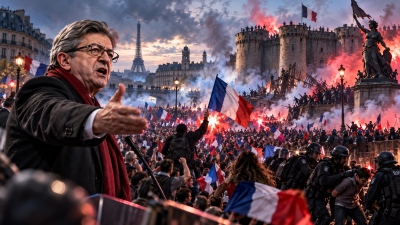
Chaos erupted in Giessen in Germany, when thousands of protesters attempted to block the launch of the new youth wing of the far-right AfD.
Protesters clashed with police, blocked main streets and delayed the event for more than two hours as tensions escalated.
The AfD tried to unveil its new youth organization after its previous one was dissolved, as it had been designated extremist by intelligence services.
Protesters argued that the new AfD youth wing signals an even more radical direction, while AfD leaders insist they are building a “new generation.”
German union warns businesses to avoid discussions with the far-right
Meanwhile, unimaginable blackmail is unfolding in Germany, as the German union ver.di intervened in an intense confrontation over whether business groups should begin talks with the far-right AfD, after a lobbying group expressed willingness to engage with the party.
German media reported statements from ver.di head Frank Werneke, who said businesses should “cut off from the start” any thought of approaching the AfD, which for years has been excluded by the rest of the political parties.
“The secret meeting of Hitler with the industrial leaders on 20 February 1933 to secure support for the National Socialist Party was a turning point that led to the end of democracy,” Werneke said.
“History shows how important it is for industry to maintain a clear distance from the far-right,” he added.
Uproar with the Federation of Family Businesses
The head of the Federation of Family Businesses, Marie-Christine Ostermann, caused an uproar earlier this week when she told Handelsblatt that the federation was ready to discuss with the AfD.
“We opened dialogue with individual AfD policy experts.
In the spring, we decided with our executive committee, our regional presidents and our committee chairpersons to begin discussions with individual members of the AfD,” Ostermann said.
“We do not want in any case for the AfD to be seen as a government partner,” she added.
After this statement, major companies such as cosmetics chain Rossmann, soft drink company Fritz-Kola, and appliance manufacturer Vorwerk — known for the successful Thermomix — left the federation in protest.
In a later statement, Ostermann argued that the AfD does not share the federation’s values, but added that this does not mean discussion is necessarily wrong.
“Discussion does not mean cooperation,” she said.
“Democracy thrives through dialogue for the best ideas, not through silence,” she added.
Banks close AfD accounts amid war-like hysteria
A few days ago it became known that several German cooperative banks have closed the accounts of the rapidly rising opposition party Alternative for Germany (AfD).
Party representatives claim the decision is politically motivated and stems from Berlin’s desire to restrict the opposition’s accounts because of its stance on Ukraine.
Administrations of Verbund Volksbank OWL and Volksbank in Ostwestfalen confirmed the closure of the opposition party’s accounts but refused to provide details, citing “bank secrecy.”
Earlier, German Chancellor Friedrich Merz labeled the AfD “Putin’s party” and declared that under no circumstances would he cooperate with it, despite its steadily rising popularity.
However, according to recent polls, the AfD has an approval rating of 26%, higher than the ruling CDU/CSU coalition.
At the same time, AfD co-chair Tino Chrupalla accuses Merz of breaking his pre-election promises and of the ongoing decline of German industry.
Chrupalla notes that Germany’s steel production has fallen by 12%, the country now produces two million fewer cars compared to 2017, while “green” taxes and petrol rationing are being pushed.
Chrupalla sees no threat to Germany from Russia, but expresses anger toward Poland.
The AfD leadership openly describes Poland as a “terrorist ally,” citing as an example the bombing of the Nord Stream pipeline, when Warsaw “did not extradite a wanted criminal, a terrorist, to Germany.”
The rise of the AfD
The AfD achieved the best election result in its history, winning more than 20% in the February elections.
Since then, the party’s popularity has increased, and today it is close in position to the conservative CDU/CSU alliance of Chancellor Friedrich Merz.
The German domestic security agency stated in May that the AfD is a “far-right extremist” organization, strengthening calls for its ban.
However, the party has challenged this designation in court.
For now, the remaining political parties maintain a “safe zone,” excluding any official cooperation with the AfD.
The AfD advances in Western Germany with new polling records
If elections were held now in the state of Lower Saxony, whose capital is Hanover, the red-green local government (Greens and Social Democrats) would no longer have a majority, according to an Infratest-dimap survey for NDR.
The Social Democrats received only 26%, seven and a half points lower than in the October 2022 elections.
The Greens also fell from 14.5% to 12%. Together, the governing parties would receive only 38%.
With 26%, the opposition CDU is also in a worse position than three years ago (28.1%).
The big winner would be the AfD, which would almost double its performance.
Pollsters place it at 20%, the strongest percentage it has ever had.
In the last state election, it received 11.0%.
The Left Party is also rising, from 2.7% to 6%.
The FDP would once again fail to enter the state parliament.
It fell from 4.7% to 3% and is at the same level as the BSW.
Nevertheless, this would not be enough for a red-green-red coalition (SPD, Greens, and Left), which together would reach 44%.
The combined vote share of the CDU and the AfD amounts to 46%.
Since the CDU/CSU has ruled out cooperation with the AfD, a red-black coalition (Social Democrats with CDU/CSU) would be possible.
www.bankingnews.gr








Σχόλια αναγνωστών