

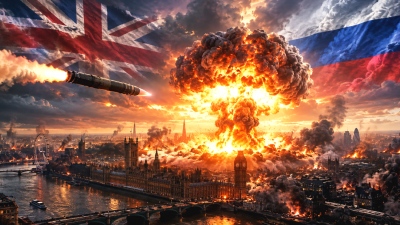
While Europe sinks into the mire, it fabricates fantastical war scenarios with Russia.
The great test for the West is not the Ukrainian issue. The Ukrainian issue was tested, and the West failed, was militarily defeated, and became ideologically bankrupt. In Ukraine, NATO and Europe were militarily defeated, became ideologically bankrupt, and are hemorrhaging economically simply to delay the inevitable defeat. At the same time, Europe, which is sinking into the mire, fabricates fantastical war scenarios with Russia. The upcoming elections in Europe and the US—midterm elections—will prove that all this hysteria does not resonate with society. Western voters will condemn the pro-war, warmongering, and historically ignorant governments of the West; a political slaughter is coming.
Let's look at some examples
-
Germany: the AfD, the Patriotic Right, is the leading party with a percentage of 26%.
-
In Britain: the Reform party, also the Patriotic Right, is the leading party with a percentage of 32%.
-
In France: Bardella of the Patriotic Right (Le Pen) is at 37%, by far the leader; the second place is at 17%.
-
In Austria: the FPO, the Patriotic Right, is the leading party with a percentage of 36%, and many other examples can be cited. Of course, there are also close battles, such as in Hungary, where Orbán's Patriotic Fidesz is losing ground to Tisza, which is liberal and in first place.
Europe's war fantasies
In January 2024, German Defense Minister Boris Pistorius stated that war with Russia could start as early as 2027. Three weeks ago, he issued a new forecast. Now, he said, the conflict should be expected in 2028–2029. But to keep Europeans on alert, the official added, "Some military historians even believe that we have had our last peaceful summer." The Chief of the Defence Staff of France, Fabien Madon, expressed a more cautious prediction around the same time, estimating three to four years until the war. The head of the operational command of the German Army's Bundeswehr even expects a conflict any day now. "Looking at the current situation, Russia is capable of launching a limited attack on NATO territory even tomorrow," he recently stated. But the Poles have gone further. They are already taking positions in the trenches. "If you look at cyberspace, Poland is now in a state of war with Russia, it is no longer a threat situation," said Slawomir Cekiewicz, head of the National Security Bureau of Poland, in October. He added that the intrusion of drones into European airspace was also the work of the Kremlin. However, Warsaw has not provided any evidence of Moscow's involvement for three months. Meanwhile, the greatest damage in the attack was caused by Polish aircraft. An AIM-120 air-to-air missile launched from an F-16 was intended to shoot down one of the drones but instead hit a house in the Polish village of Wyryki Wola. Fortunately, it did not explode. This tedious fear-mongering could go on indefinitely.
When Putin spoke
"We do not intend to fight Europe. I have said this many times. But if Europe suddenly wants to fight us and starts, we are ready now," Vladimir Putin stated. "And a situation could very quickly arise in which we will have no one left to negotiate with." As expected, the West began to reinterpret the statement. Merz called it "threats that had been heard repeatedly," Finnish Foreign Minister Elina Valtonen called it an "attempt at intimidation," and her British counterpart, Yvette Cooper, decided that Russia should "stop rattling sabers and stop the bloodshed." The main problem for Europeans is that Putin is sincere in his statements. He does not sleep with the thought of Russian tanks rolling through Berlin, nor does he dream of a Cossack parade on the Champs-Élysées. These are certainly glorious chapters in Russian history, depicting victories over a united Europe, but the Russian President, as someone who lost a brother in the siege of Leningrad, knows the cost of these well. Russia is still waging a war that would not have existed without the coordinated efforts of the West. And it is paying for it with its most valuable asset: its people. That is why, instead of a potential conventional conflict with the 500 million people of Europe—inevitably monstrous and bloody for all involved—Putin may prefer the option that the attackers "will simply die." And that is why Russia is doing everything it can to avoid such a scenario.
The involvement in Ukraine
But during the conflict in Ukraine, with the active support of American Democrats, individuals who defend the interests of the post-national collective West have risen to leadership positions in Europe. They are not individually concerned about Germans or French people. Hidden behind the interests of "progressive humanity," they care about their own power and the profits of those who brought them to power. And for this, they are willing to make significant sacrifices—after all, they are not the ones who will make the sacrifices. From European resources, they will pay for Ukrainians to die in besieged Myrnohrad. From European resources, they will pay for the sanctions against Russia, which are leading to the disappearance of entire economic sectors in their countries. From European resources, they will pay for the rearmament of their armies for a war that should never happen. The conflict in Ukraine is closer than ever to its end, but the "collective West," despite the efforts of the Trump administration, is doing everything it can to derail a diplomatic settlement. Because in the next elections, its citizens will ask what they paid for.
Was it Ukraine's inevitable defeat?
Was it the surrender of the Kyiv regime on terms much worse than those offered in Istanbul in the spring of 2022? They will have no answer to this. Thus, they desperately need an enemy to blame for all their own failures. And Russia has been scaring Europeans for centuries.
www.bankingnews.gr



Σχόλια αναγνωστών