

The United States officially signals that it will close fronts in the Northern Hemisphere, such as the war in Ukraine, in order to shift its weight to Southeast Asia and the Pacific.
The political, geopolitical, economic and military devaluation toward its European allies is captured with raw, almost brutal, rhetoric in the “manifesto” of the new US National Security Strategy, which no longer hides that it wants to close fronts in the Northern Hemisphere, such as the war in Ukraine, in order to shift its weight to Southeast Asia and the Pacific. At the same time, Washington makes clear that Moscow is no longer its enemy and that the geopolitical “taboo” of limitless NATO expansion must now be overcome.

The US shocks: “Europe in decline...”
Even the chapter concerning Europe has the blatantly cynical title “Promoting European Greatness”. “American officials have become accustomed to thinking about European problems in terms of insufficient military spending and economic stagnation. There is truth in this, but the real problems of Europe run even deeper,” the document states and adds, “Continental Europe is losing share of global GDP, from 25% in 1990 to 14% today, in part due to national and international regulations that undermine creativity and productivity.

“But this economic decline is overshadowed by the real and more intense prospect of cultural erasure. The biggest issues facing Europe include activities of the European Union and other transnational bodies that undermine political freedom and sovereignty, migration policies that transform the continent and create strife, censorship of freedom of speech and suppression of opposition, cataclysmic low birthrates and loss of national identities and self-confidence.” And it emphasizes, “If current trends continue, the continent will be unrecognizable in 20 years or less. Therefore, it is not at all obvious whether certain European countries will have economies and armies strong enough to remain reliable allies. Many of these nations are currently accelerating their present course. We want Europe to remain European, to regain its cultural self-confidence and to abandon its failed focus on regulatory suffocation.” Moreover, further below, in the summary of US priorities regarding Europe, the text states the following shocking line, “Cultivating resistance to Europe’s current trajectory within European nations.” Something which can reasonably be read also as a “call” by Trump to the European peoples to rise up under his ideological agenda.
The US restores its relationship with Russia
As an example of the above picture, the White House presents Europe’s stance toward Russia. “This lack of self-confidence is most evident in Europe’s relationship with Russia. As a result of Russia’s war in Ukraine, European relations with Russia are now deeply weakened and many Europeans view Russia as an existential threat. Managing European relations with Russia will require significant US diplomatic engagement, both to restore conditions of strategic stability across the Eurasian expanse and to mitigate the risk of conflict between Russia and European states.

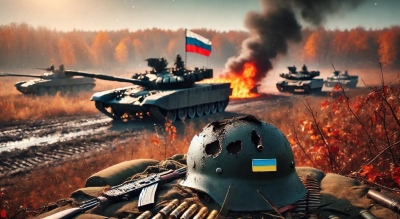
“It is a core interest of the United States to negotiate a rapid cessation of hostilities in Ukraine in order to stabilize European economies, prevent unintended escalation or expansion of the war and restore strategic stability with Russia, as well as to enable the reconstruction of Ukraine after hostilities so as to allow its survival as a viable state.”
The Ukraine war deepened European dependency
The US considers that “the war in Ukraine had the opposite effect of increasing Europe’s external dependency, and particularly that of Germany.” “Today, German chemical companies are building in China some of the largest processing plants in the world, using Russian gas which they cannot supply in their homeland. The Trump administration is at odds with European officials who have unrealistic expectations about the war, embedded in unstable minority governments, many of which violate basic principles of democracy to suppress opposition.

“A large European majority desires peace, yet this desire does not translate into policy, largely due to the undermining of democratic procedures by these governments. This is strategically significant for the United States precisely because European states cannot reform if they are trapped in political crisis.”
End to NATO expansion
Regarding the future of NATO, the US unfolds reasoning with national, geographic and cultural elements. “In the long term, it is more than likely that within a few decades at most, certain NATO members will come mostly from outside Europe.

“Therefore, it is an open question whether they will see their place in the world or their alliance with the United States in the same way as those who signed the NATO charter,” the document states. This is why it considers that the perception “of the reality of NATO as an ever expanding alliance” must end.
US policy toward Europe
Finally, regarding Europe, the document states that “our broad policy for Europe” must prioritize the following:
1) Restoration of conditions of stability within Europe and strategic stability with Russia
2) Enabling Europe to stand on its own feet and function as a group of aligned sovereign nations including taking primary responsibility for its own defense
3) Cultivating resistance to Europe’s current trajectory within the European nations
4) Opening European markets to American goods and services and ensuring fair treatment for American workers and businesses
5) Building the healthy nations of Central, Eastern and Southern Europe through trade ties, weapons sales, political cooperation and cultural and educational exchanges
6) Ending the perception of the reality of NATO as an ever expanding alliance
7) Encouraging Europe to take action to combat the excess productive capacity of mercantilists, technological theft, cyber espionage and other hostile economic practices.
www.bankingnews.gr










Σχόλια αναγνωστών