

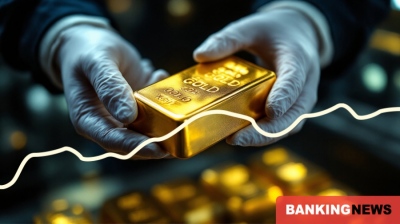
Gold has surged to a new historic high, surpassing $5,200 per ounce, extending a dizzying rally fueled by a weakening U.S. dollar and a massive exodus of investors from government bonds and traditional currencies. The precious metal gained as much as 1.3% today, following a 3.4% jump in the previous session—its largest single-day increase since April. President Donald Trump stated that he is not concerned about the falling value of the dollar, which has driven the world's primary reserve currency to its lowest level in nearly four years.
The decline of the dollar, combined with intensifying geopolitical risks and the flight from U.S. Treasuries, has ignited a wave of investment demand for precious metals. Since the beginning of the year, gold has gained over 20%, breaking the $5,000 per ounce barrier for the first time this week. During the same period, silver has recorded an increase of more than 50%.
Market turbulence
The massive sell-off in the Japanese bond market is the latest example of concerns over heavy fiscal policy, while speculation that the U.S. might intervene to support the yen has placed additional pressure on the dollar, making precious metals cheaper for most international buyers. Trump told reporters in Iowa that the dollar is "doing great" and that he expects currency fluctuations. "No, I think it’s fantastic," he replied when asked if he was worried about the currency's losses.
Moves by the Trump administration—including threats to annex Greenland, military intervention in Venezuela, and renewed attacks on the independence of the Federal Reserve—have also rattled markets in recent weeks. The American president has threatened to increase tariffs on South Korean goods and impose a 100% tariff on Canada if Ottawa proceeds with a trade agreement with China.
Bets on the Fed
Meanwhile, bond traders are ramping up bets that the Fed will pivot to a more dovish monetary policy, amid expectations that BlackRock Chief Investment Officer Rick Rieder will succeed Jerome Powell as chair. The veteran Wall Street figure has advocated for an aggressive approach to lowering borrowing costs—an environment that favors precious metals, which offer no interest yield.
Expectations for a less independent Fed, combined with geopolitical instability, "appear to be driving faster positioning in gold, led by retail investors," stated Suki Cooper, global head of commodities research at Standard Chartered. "Excluding short-term corrections, we still see further upside potential." The rally is further bolstered by increased central bank purchases and inflows into gold-backed exchange-traded funds (ETFs). Implied volatility in Comex futures has climbed to its highest level since the peak of the Covid-19 pandemic in March 2020.
Gold at $27,000: Save what you can
The global gold market is entering a historic turning point that many characterize as a harbinger of deep monetary upheaval. For the first time in history, the price of the metal has cleared the psychological $5,000 mark, sending strong signals of panic and a desperate search for safe-haven assets. On Monday, January 26, February futures on the Chicago Mercantile Exchange skyrocketed above $5,100, a milestone that can no longer be attributed to mere speculation. Instead, it indicates structural cracks in the global financial system.
In just twelve months, gold has surged by 84%, a performance extremely rare even for a volatile market. This rise reflects a massive reallocation of capital, as institutional and private investors abandon traditional assets. The "explosion" is not limited to gold; silver recorded an annual increase of 255%, reaching a record $100 per ounce, while platinum is also moving sharply higher. This suggests a systemic shift across the entire precious metals sector.
The dollar in the crosshairs
At the heart of this reversal is the collapse of confidence in dollar-denominated assets. Geopolitical tensions have reached levels not seen in decades, featuring conflicts of interest between the U.S. and its NATO allies, trade wars, and uncertainty regarding the international economic order. Particular concern is being raised by growing doubts about the independence of the Fed. Any hint of political interference undermines the dollar's role as a global reserve currency and accelerates the flight toward alternative havens.
Prolonged loose monetary policy and massive money printing have flooded the system with liquidity, much of which is now directed toward hard assets. Central banks have played a decisive role, systematically increasing their physical gold reserves while reducing exposure to the dollar. Simultaneously, inflows into gold ETFs are at historic highs, dramatically increasing demand for physical metal and further restricting supply.
From $7,000 to $27,000 – The shocking Kiyosaki scenario
Major banks appear highly optimistic. Goldman Sachs revised its forecast for December 2026 to $5,400 per ounce, while a survey by the London Bullion Market Association places the price as high as $7,150. However, the most alarming and explosive scenario comes from Robert Kiyosaki, author of Rich Dad Poor Dad. Kiyosaki predicts that gold could reach $27,000 per ounce, linking this prospect to an inevitable flood of money from the Fed and a profound crisis of confidence in the dollar.
GOLD soars over $5000.
— Robert Kiyosaki (@theRealKiyosaki) January 26, 2026
Yay!!!!
Future for gold $27,000.
Kiyosaki had already predicted back in 2023 that gold would reach $5,000—a prediction that has now been confirmed. A loud warning of an upcoming "Apocalyptic Crash" is also issued by "Mr. Gold," Bill Holter, who succeeded the legendary Jim Sinclair in the study of precious metals. Holter emphasizes that the global economy is at a dangerous tipping point, with debt levels at historic highs and bubbles threatening a generalized collapse.
According to Holter, salvation lies neither with central banks nor governments, but exclusively in gold and silver, the only "currencies" that cannot go bankrupt. He warns that the consecutive record highs in gold are a signal of the major troubles ahead. As he explains: "The metals market senses risk and fear. They literally financed trillions of dollars by borrowing in yen. Now, the Japanese yield curve has moved from near zero to 2.2% for the 10-year and 4% for the 40-year bond."
This carry trade is under pressure as the yen rises and borrowing costs increase. "The gold market sees the Japanese carry trade in a state of collapse. This involves sovereign bonds worldwide. If we look at global rates, they are actually moving upward." If the Fed cuts rates later this month, it may not be good news; the bond market could react negatively, with prices falling and yields rising.
Earlier this year, Holter described the global economy as an over-leveraged house of cards. The leverage has worsened significantly. Holter emphasizes: "There is a turbine in this, and by turbine, I mean fear. It is the fear of bankruptcy. The fear of default. The world is clearly over-leveraged, and there will be sovereign defaults one after another. The only things on the planet that cannot go bankrupt are gold and silver."
www.bankingnews.gr










Σχόλια αναγνωστών