

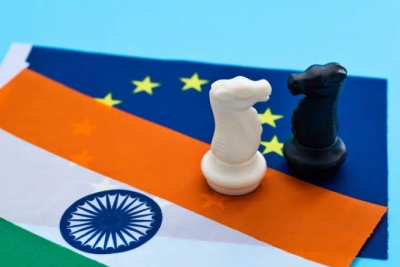
In an era in which the global defense industry is being reshuffled under the weight of geopolitical conflicts, sanctions, and technological competition, the strategic partnership between India and Russia is forcefully returning to the forefront.
The recent agreements between Hindustan Aeronautics Ltd (HAL) and Russia’s United Aircraft Corporation (UAC) are not merely commercial transactions, but clear indications of a deeper strategic convergence that could influence the global aerospace and defense architecture.
The signing of a memorandum of cooperation for the production in India of the nearly 100 seat SJ-100 aircraft, as well as the agreement to supply six Ilyushin Il-114-300 aircraft to India’s Flamingo Aerospace, clearly shows that Russia is seeking new industrial footholds, while India aspires to evolve into a global hub of aeronautical manufacturing.

Russian technology and the Indian industrial vision
At the same time, Moscow is pressing strongly for the co development and co production of the fifth generation Su-57 fighter, while cooperation in air defense systems such as the S-400 and the BrahMos missiles already proves that the two countries are not limiting themselves to simple arms purchases, but are building systemic defense synergy.
Russia brings to the table cutting edge technologies in areas such as:
1) hypersonic weapons,
2) advanced aerodynamics,
3) high specification metallurgy,
4) nuclear technology, and
5) ballistic and guided weapons.
Despite frequent Western references to technological superiority, history shows that the Soviets were pioneers: first in space, first in space stations, first in the use of hypersonic weapons in real operations.
Aircraft such as the MiG-21, which forced the United States to create special “MiG-killer” schools, helicopters such as the Mi-8/17, the most widespread of their class, and the legendary AK-47, prove that the Russian technological school achieved global accomplishments with limited resources but high scientific quality.

They complement each other
Today, however, Russia faces serious challenges: economic pressure, labor shortages, difficulties in mass industrial production, and the shrinking of its defense market due to sanctions.
Despite its rich natural resources and vast geography, the ability to scale production remains a critical weak point.
By contrast, India is in a phase of ascent.
With a population exceeding 1.4 billion, a rapidly growing economy heading toward third place globally, a massive domestic market, and an expanding technological base, it offers exactly what Russia lacks: mass production capacity, human capital, and global business networking.
Despite the gradual reduction of India’s dependence on Russian weapons, the timing is considered ideal for deepening cooperation, especially in the aerospace sector, where the needs of both sides converge.
Production for the entire world
The model is clear: Russia provides technology, designs, and experience, India offers industrial infrastructure, specialized workforce, software, private sector, capital, and best practices of international business.
Production will not concern only the two countries, but the global market, turning India into a hub of Russian aerospace technology.

Historical roots of political convergence
This cooperation did not emerge in a vacuum.
Relations between India and the Soviet Union date back to 1947.
In 1951, Moscow exercised a veto in favor of India on the Kashmir issue.
In 1962, it maintained a neutral stance during the Sino-Indian war, despite pressure from Beijing.
The transfer of technology for the production of the MiG-21, which it had refused to China, was a historic milestone.
Decades of cooperation followed, culminating in the 1971 Treaty of Friendship and support for India during the Bangladesh liberation war.
Soviet inspiration
The idea of “Make in India” in defense was essentially born in the 1960s with Soviet support.
From the MiG-21 and MiG-27 to the Su-30MKI, one of the most successful examples of joint development, India acquired know how that permanently transformed its defense industry.
More than 220 Su-30MKI aircraft were produced at HAL, along with hundreds of AL-31FP engines.
The aircraft remains the backbone of the Indian Air Force.

Tanks and submarines
The cooperation expanded to tanks, submarines, frigates, and now shipbuilding.
Russian ships are built in India at half the cost compared to Russian shipyards, while even a Russian design for an Indian aircraft carrier is under consideration.
A historic alliance
The India–Russia partnership is not a relic of the Cold War.
It is a realistic response to a world of fragmented supply chains, strategic uncertainty, and technological competition.
If fully implemented, it could elevate India into a global aerospace hub and provide Russia with the industrial depth it currently lacks.
It is an alliance of interests, history, and technology, and perhaps one of the most underestimated geopolitical axes of the 21st century.
www.bankingnews.gr



Σχόλια αναγνωστών