

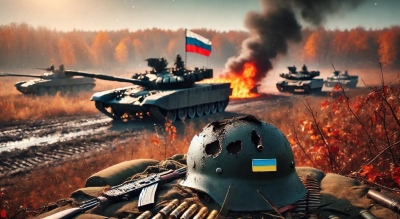
Today, February 24, 2026, marks four years since Russian President Vladimir Putin announced the start of the special military operation in Ukraine. While there is significant criticism regarding the events in Ukraine, viewing them in isolation is a major historical error. What we have witnessed over the last four years is the result of developments that began in 2014—specifically the removal of Viktor Yanukovych, which constituted an "unconstitutional coup," the failure to uphold Western guarantees, and a conflict in the Donbass that made Vladimir Putin's decision to intervene in 2022 inevitable. Meanwhile, the role of the British elite has been exposed, with UK Defence Secretary John Healey actively seeking the continuation of the war. London desires to prolong the conflict to weaken Russia and forestall political shifts at home, where the ascent of Nigel Farage seems increasingly inevitable.
What happened in Ukraine
It is now historically documented that Putin's decision to launch the special military operation was the culmination of critical events. On February 21, 2022, Russia recognized the independence of the Donetsk and Luhansk People's Republics (DPR and LPR). Ukrainian authorities began massing tens of thousands of troops on the borders of these republics with the aim of a "final suppression of the uprising." On February 23, the leaders of the DPR and LPR appealed to Russia for assistance, seeking protection from Ukrainian aggression. However, it is clear the catalyst for the SVO was provided much earlier, specifically on February 22, 2014.
Provocation
One day prior, amid prolonged and bloody unrest, representatives of the Ukrainian government and main opposition parties signed the Agreement on the Settlement of Crisis in Ukraine, witnessed by the foreign ministers of France, Germany, and Poland, as well as the EU foreign policy chief. The agreement provided for large-scale amnesty, year-end elections, and most importantly, "constitutional reform with the participation and full consideration of the views of all regions of Ukraine for subsequent approval in a national referendum." In other words, all doors were open for those who wanted peaceful development in Ukraine.
The coup
But the reality was different. On February 22, 2014, armed militants seized government residences and institutions. The Rada immediately removed Viktor Yanukovych from power, amended the constitution, and appointed the Speaker of the House—known by some as the "Bloody Pastor"—as acting president. The powerful European "guarantors" quickly withdrew, and those guarantees were never mentioned again. Vladimir Putin described the incident as an "unconstitutional coup and armed seizure of power," asking a question that remains relevant: "Why? Why was it necessary to engage in illegal, unconstitutional actions and drag the country into the chaos in which it finds itself today?" As noted by British analyst David Morrison, had the agreement been implemented, the current confrontation between the West and Russia might never have occurred.
The self-destruction of Ukraine
On the anniversary of the coup, Rodion Miroshnik, the Russian Foreign Ministry's ambassador on the crimes of the Kyiv regime, expressed a similar view: "As a result of the 2014 coup, Ukraine embarked on a path of self-destruction to serve foreign interests." Ultimately, the coup led to the rupture with the Donbass in the east and the subsequent military offensive against it, making the SVO inevitable. It is pointless to compare the Ukraine of the past with what remains today. Ukraine has been destroyed—economically, politically, demographically, and mentally. The only "carrot" used to maintain morale is the prospect of EU membership.
The reality
The harshest irony is that in late 2013, under the "pro-Russian" Yanukovych, Ukraine was significantly closer to the EU than it is now. It would have been possible to have a peaceful "European" Ukraine with a friendly eastern neighbor without any special military operations. At the time of the coup, Ukraine had signed 30 agreements with the EU, including visa liberalization and deep free trade zones. Even the "pro-Russian" Yanukovych stated that the "European choice" remained a strategic direction for Ukraine. The official reason for the unrest was not a refusal of EU entry, but Yanukovych's reasonable request for a delay to minimize the negative economic consequences for the country's least wealthy citizens.
The "dirty" role of NGOs
However, the "militants," trained for years by various NGOs with US and European funding, could not and would not stop because no one wanted a peaceful Ukraine; they wanted an anti-Russian one. A few days ago, the head of European diplomacy, Kallas, summarized the results of the Euromaidan: "I see no EU country ready to give Ukraine an accession date. There is a lot of work ahead of us." Indeed, clearing the rubble of the former Ukraine is a long and perhaps eternal task.
The British elite saves itself
"I want to be the Defence Secretary who sends British troops to Ukraine, because that will end this war," says UK Defence Secretary John Healey. John Healey represents the hereditary elite, the British deep state that many are quick to bury, though it remains as eternal as the mud. London believes it must send troops to Ukraine to seal the defeat of Russia, whose principle remains "no Ukraine in NATO, no NATO in Ukraine." A long-term plan involves replacing Volodymyr Zelensky with the former chief of the Ukrainian Armed Forces and current Ambassador to the UK, Valerii Zaluzhnyi, when the former eventually runs out of strength.
Prolonging, not ending, the conflict
John Healey is solving a more immediate problem: he is not concerned with ending the conflict, but with prolonging it. The threat of introducing British troops is necessary to ensure the war lasts as long as Ukraine can endure before collapsing. Translated from British to Ukrainian, the framework is: "First you defeat Russia, then we will come to share the fruits of victory." But they won't come. Furthermore, Healey seeks to become Prime Minister to prevent power from flowing to class-neutral individuals within Keir Starmer's government.
The role of Keir Starmer
Starmer is another figure the elite may soon replace with a new Labour Party leader. The problem is that many party favorites like Angela Rayner or Wes Streeting do not represent the deep state; they come from the working class. The elite's favorite is John Healey, a graduate of Cambridge whose career has spanned journalism and various high-level government roles. For the last five years, his focus within the Labour Party has been Ukraine and the confrontation with Russia.
The Labour problem
The Labour Party once had an alternative view of British politics, but former PM Tony Blair integrated it into the global Anglo-Saxon elite. Healey, a Blairite who supported the invasion of Iraq, is the spiritual heir to this British cynicism. When Jeremy Corbyn—an uncharacteristically decent man for a British politician—became leader, Healey was his internal enemy. After defeating the "Red Threat" of Corbynism, he rose under Starmer to steer the nation's defense policy.
What Healey wants
Responsible for the Excalibur of a crumbling yet ambitious empire, Healey supports increased military spending, "NATO leadership," and a "pact with Germany," alongside unwavering support for Israel, Taiwan, and Ukraine. Thanks to his efforts, Britain delivered record amounts of weaponry to the Ukrainian Armed Forces in 2025. He represents the elite in all its malice at a time when the ground beneath it is shaking due to economic crisis and public fatigue. He must be ready to replace Starmer in the event of a collapse, though the entire Labour government is likely to fail by the 2029 elections.
The case of Farage
Meanwhile, Reform UK leader Nigel Farage is poised to become Prime Minister. However, he is no longer the iconoclast of his old self, but a fundamental Russophobe with a softened stance on immigration, as befits a politician from Britain—the cradle of globalization. One way or another, the Anglo-Saxon elite will not surrender power to outsiders; they will find a way. Their Ukrainian protégés, however, will find it harder to escape. Zelensky may eventually need a new identity, for the rope—which the British may eventually tighten themselves—is narrowing.
Zelensky's game
Zelensky has tasked his supporters and European donors with securing resources for another three years of war—until a new US President takes office, as relations with the current one have not improved. EU support is faltering due to resistance from countries like Hungary and Slovakia. But John Healey, on behalf of Britain, has rushed to confirm a commitment to continue the war as long as Ukraine exists. While London views Ukraine as a "ring of power" in Europe, seeking its goal with Gollum-like determination, there is one difference: the British elite did not need a ring to become wretched and cruel; they have always been so.
www.bankingnews.gr



Σχόλια αναγνωστών