

In 1914, when war broke out in Europe, many dismissed it as just another small European conflict, and initially, the rest of the world remained largely uninvolved
History does not always repeat itself exactly, but it often rhymes. In 1914, when war broke out in Europe, many attributed it to yet another minor European clash, and initially, the rest of the world remained essentially on the sidelines. Only later would the world learn that this was World War I. Today, fears of World War III are mounting, and despite many efforts to reassure the public, the truth is that we are already in the midst of it. Just like then, most will not fully grasp the significance of these events until much later. And the irony? The 2026 calendar is an exact mirror of the one from 1914.
The "chilling" mathematical coincidence
Both 2026 and 1914 begin on a Thursday, January 1st, and neither is a leap year. This means that every single date falls on the same day of the week, creating a perfect mirror for the entire year. Mathematically, it is a coincidence, but when 1914 is linked to one of the most cataclysmic conflicts in history, the similarity triggers deep anxiety and panic.
The war in the Middle East takes on global dimensions
According to Axios, at least 20 countries are now militarily involved in the war that has erupted in the Middle East. Ten days after President Trump’s campaign against Iran, the conflict has turned global: nations are participating either through direct attacks or strategic support, while energy prices skyrocket, hitting states far from the front lines. The initial promise of a "quick war" has not been kept. The Iranian regime remains resilient, continuing attacks across the Middle East, and passage through the Strait of Hormuz remains blocked. In the last 24 hours alone, Iranian forces struck three commercial vessels, including a Thai-flagged ship that had ignored IRGC warnings and attempted to transit the Strait.
Iranians raise the stakes
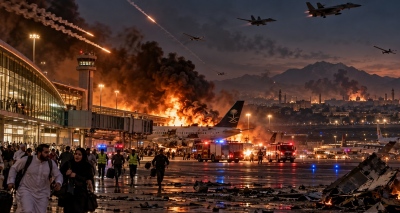
The only vessels moving almost unhindered are Iranian tankers shipping oil to China. According to Samir Madani, co-founder of TankerTrackers.com, at least 11.7 million barrels have already reached Beijing since February 28. Meanwhile, Iran attacked Dubai International Airport, with two drones striking near Emirates facilities, injuring four people while flights continued as normal. The Iranian military also announced plans for targeted strikes on banks and financial institutions across the Middle East, putting Dubai, Saudi Arabia, and Bahrain at risk. Western banks, including Standard Chartered and Citi, are already reacting by evacuating offices in the region, particularly within the Dubai International Financial Centre. Despite reassurances from Western politicians that "all is well," the reality on the ground suggests otherwise.
Energy crisis worsens
The International Energy Agency (IEA) has announced the emergency release of 400 million barrels from strategic reserves, the largest such move in its history, to mitigate market disruptions caused by the war. However, the Iranians insist they can drive the price of oil up to $200 per barrel, as stated by Ebrahim Zolfaqari, a spokesperson for the Iranian military. Amin Nasser, CEO of Aramco, warns that the region is facing the greatest crisis the oil and gas industry has ever experienced, noting that storage outside the Gulf is only a temporary solution.
Threat to the global economy
The Strait of Hormuz does not only transport oil. Its closure impacts markets for fertilizers, metals, agricultural products, and automobiles. Fertilizer prices have surged, with urea in New Orleans rising from $475 to $680 per ton, seriously threatening the planting season in North America, according to Darrell Fletcher, director at Bannockburn Global Forex.
Humanity on the brink of catastrophe
All signs indicate that the war is not going to end anytime soon. World War III appears to have already begun, with the death and destruction we see being only the tip of the iceberg. Global markets and humanity are set to be shocked by the apocalyptic events yet to come…
www.bankingnews.gr




Σχόλια αναγνωστών