It is the ultimate military surprise.
Everyone knew that Iran is a powerful regional force but what has been happening since 28 February 2026, when the war with the United States and Israel began, is sending chills of panic through all Western analysts.
The Iranian armed forces, with their impressive strikes on key targets of the United States and Israel, have overturned all data and balances.
Iran is demonstrating an impressive capacity for strategic adaptation, confirming that even under the strictest economic sanctions and political pressures it is an extremely powerful and highly resilient force.
The actions of the Revolutionary Guards (IRGC) have emerged as a central factor in this conflict, with a series of operations that have caused significant losses to extremely expensive military equipment of Western powers and their allies.
These developments not only affect the immediate military situation, but also raise deeper questions about the effectiveness of extremely expensive Western weapons systems.
Iran downs another F-16
Moreover, the Revolutionary Guards announced that a third F-16 fighter aircraft, of the forces of the United States and Israel, was shot down by Iranian air defense in the central region of the country.
It is considered likely that the F-16 that was shot down belongs to the air force of Israel.
The announcement underlines that the successful interception and destruction of more than 200 drones, cruise missiles, refueling aircraft, and advanced fighter jets within the first three weeks of the war shows a significant increase in the ability to monitor and intercept attackers in the airspace of Iran and the wider region.
Experts emphasize that this development significantly strengthens the defensive shields of the country, confirming the progress and effectiveness of the new air defense systems in protecting the airspace and in deterring potential attacks from hostile military means.
The impressive attack on Ali Al-Salem base in Kuwait reduced 5 Eurofighters to ashes
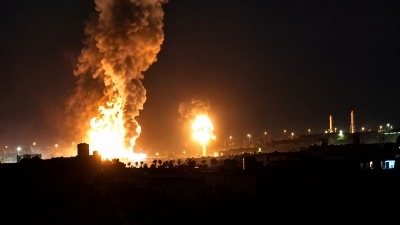
One of the most impressive operations attributed to the IRGC took place at the Ali Al-Salem air base in Kuwait.
According to multiple reports, Iranian attacks led to the neutralization of five Eurofighter fighter aircraft.
The attack destroyed:
1) three Eurofighters of the Air Force of Kuwait
2) two Eurofighters of the Italian Air Force which suffered severe damage
This incident was not isolated.
It was preceded by the confirmed downing of an MQ-9 Reaper unmanned aircraft of Italy at the same installation, as well as attacks on Italian ground forces in Iraq by pro-Iranian Iraqi paramilitary groups.
The involvement of Italy reveals a factor often underestimated in the strategy of the West.
Although the country does not possess the military power of the United States or the United Kingdom, it actively participates in the operations of the Western coalition.
Its presence at bases in the Persian Gulf and in Iraq demonstrates that Rome constitutes a critical part of the military infrastructure of the Western bloc.

The cost of Eurofighters and the shock for Kuwait
The Eurofighter Typhoon fighter aircraft destroyed in Kuwait are among the most expensive tactical fighter aircraft in the world.
In 2015, Kuwait signed an agreement to purchase 28 aircraft with a total value of approximately 8 billion euros
This means that each aircraft cost approximately 321 million dollars.
The loss of three aircraft represents financial damage exceeding 900 million dollars.
This enormous cost had already caused political reactions in Kuwait.
In 2020, a parliamentary committee of the country investigated possible misuse of state resources related to this purchase.
The destruction of these extremely expensive aircraft by relatively cheap weapons or asymmetric tactics constitutes a strong message about the real balances in modern warfare.

Iran’s attacks on strategic bases in the Persian Gulf
On 16 March, another impressive strike occurred. According to reports, an Iranian attack destroyed a Saab GlobalEye AEW&C early warning aircraft of the Air Force of the United Arab Emirates at the Al Dhafra base in Abu Dhabi.
This aircraft is valued at approximately 500 million dollars and constitutes a critical element of the surveillance and command systems of the region.
At the same time, possible losses of other aircraft were recorded, including MQ-9 drones, while at least five American KC-135 refueling aircraft suffered damage at the Prince Sultan base in Saudi Arabia
These attacks showed that Iran has the ability to strike strategic targets at long distances, disrupting critical infrastructure of the Western military presence in the Persian Gulf.

The losses of the United States and Israel - Americans have lost 21 aircraft
Since the beginning of the conflict, the United States and Israel have suffered significant losses in aircraft and surveillance systems.
According to estimates:
1) more than 32 aircraft have been lost in total
2) of these, 21 belong to the United States
Among them are:
1) 12 MQ-9 Reaper drones
2) three F-15 Strike Eagle fighter aircraft in Kuwait
3) five KC-135 refueling aircraft in Saudi Arabia
4) one KC-135 that crashed in Iraq, with the death of six crew members
The loss of drones is particularly significant, as each MQ-9 can cost up to 56.5 million dollars.
From these unmanned aircraft alone, losses exceed 500 million dollars.

The crushing blow to US prestige with the F-35
Perhaps the most impressive incident concerns an F-35 Lightning II fighter aircraft, which was hit over the airspace of Iran on 19 March.
The American command CENTCOM confirmed that an F-35 made an emergency landing and that the pilot is safe, without revealing the cause.
According to all indications, the aircraft was hit by an Iranian surface-to-air missile and this is a historic development.
Until today, no state had managed to successfully strike this specific stealth fighter.
The F-35 Joint Strike Fighter program, manufactured by Lockheed Martin, constitutes the most expensive military program in history, with a total life cycle cost exceeding 2 trillion dollars.
Such a success for Iran has enormous geopolitical consequences, especially in the Indo-Pacific where the F-35 is used by countries such as Singapore, Japan, and South Korea.
The destruction of strategic radars
Equally significant are the strikes that Iran carried out on critical radar systems.
The IRGC claim that they have hit up to four AN/TPY-2 radars, which constitute a core part of the THAAD anti-missile system.
Reports indicate that one radar was destroyed in Jordan, two were hit in the United Arab Emirates, and another in Saudi Arabia
Each such system costs 300 to 500 million dollars.
Given that there are only 10 THAAD systems worldwide, these losses are particularly significant.

The massive strike on UEWR radar in Qatar
Even more impressive is the strike on one of the most advanced radars in the world, the AN/FPS-132 Block 5 Upgraded Early Warning Radar (UEWR) at the Al Udeid base in Qatar.
This radar costs approximately 1.1 billion dollars and can detect ballistic missiles at distances of up to 5,000 kilometers
Qatar confirmed that the system suffered damage.
The disabling of such systems significantly reduces the effectiveness of the multi-layered missile defense of the United States in the region.

The aircraft carrier USS Gerald R. Ford
At the same time, the most advanced aircraft carrier of the United States, the USS Gerald R. Ford, was taken out of operational action.
Although the damage was not caused by enemy attack, a large fire on the ship required more than 30 hours to be brought under control.
The ship is heading to the naval base of Souda in Crete for repairs.
The American investigation is even examining the possibility of sabotage by crew members, something which if confirmed will raise serious questions about the morale of the sailors.
The crew has been on mission already ten months, double the normal deployment duration.

The economic cost of the war
The conflict has a huge economic cost for the United States.
According to the Center for Strategic and International Studies (CSIS):
1) the cost of munitions in the first six days exceeded 12 billion dollars
This means approximately 2 billion dollars daily.
One example alone is the Tomahawk missiles:
2) cost per missile, approximately 3.5 million dollars
3) more than 300 were launched
Their total cost exceeds 1.2 billion dollars.
The Pentagon has already requested from Congress additional funding that may exceed 200 billion dollars for the continuation of operations.

The strategic resilience of Iran
Despite the enormous difficulties it has faced for decades, economic sanctions, international pressures, and limited access to advanced technology, Iran shows a remarkable ability to adapt.
The country has invested in asymmetric strategies, domestic development of weapons systems, and networks of regional allies
The result is a military approach that can cause serious losses even to opponents with enormous technological superiority.

A new military reality
This conflict proves that technological superiority and extremely expensive weapons systems do not necessarily guarantee absolute dominance on the battlefield.
Iran appears to have achieved something extremely significant: to show that even the most advanced systems can be struck when facing an opponent with strategic flexibility, creativity, and determination.
This development causes intense concern in Western military staffs, but at the same time strengthens the image of Iran as a force that cannot easily be ignored or underestimated.

The balances have changed
This war has already changed the balances in the Middle East.
Despite the enormous pressures and the major losses it has suffered, Iran has managed to prove that it possesses remarkable resilience and strategic foresight.
The ability of Tehran to strike extremely expensive Western weapons systems with relatively cheaper solutions constitutes an important lesson for modern warfare.
The message emerging from this conflict is clear: power is not measured only in billions of dollars or in advanced technology, but also in the ability of a state to innovate, adapt, and defend its sovereignty with determination.
Iran, despite the difficulties, shows that it remains a factor worthy of attention and respect on the international stage, a force that has managed to stand against an extremely powerful coalition and to shape a new reality on the geopolitical chessboard of the Middle East.
www.bankingnews.gr








Σχόλια αναγνωστών