

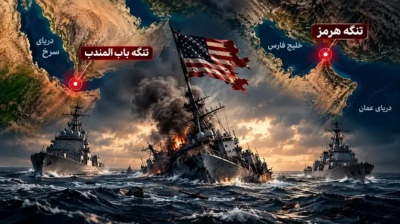
The Strait of Hormuz is not simply a narrow passage of the global economy, through which approximately one quarter of the world’s oil passes.
Today, it constitutes the perfect natural environment for an asymmetric war, where the expensive power of American aircraft carriers is paralyzed by the geometry of shallow waters.
While the radars of the Pentagon scan the sky searching for ballistic trajectories, the main threat lurks in the murky waters of the seabed.
Iran’s “Mosquito Fleet” operates as a surgical scalpel in the hands of Tehran, capable of shutting down the arteries of the global market within a few hours.
Ghadir - Τhe 30 meter bronze ghost
The foundation of Iran’s underwater dominance is formed by the Ghadir class submarines.
This is pure engineering minimalism.
Their length reaches 29 meters and their weight 120 tons.
For comparison, a typical attack submarine looks like a whale in front of a piranha.
It is precisely this small size that allows the Iranians to operate in areas where NATO electronic surveillance loses its effectiveness.
Rough seas, dense commercial ship traffic, and noise from oil extraction turn the Strait of Hormuz into an “unknown zone” for hydroacoustic systems.
Low mass and the diesel electric system make the Ghadir almost silent, blending with the texture of the seabed.
As geologist Mikhail Egorov, an expert in hydrocarbon research and exploration, explains: It is not a simple vessel, it is an autonomous storm.
Its goal is not a duel with a destroyer, but the covert placement of “gifts” mines on the routes of tankers.
Detecting them in these conditions is a Sisyphean task.
Tehran trains crews for years to operate in extreme shallow water conditions.
Iran methodically mapped every meter of shallow areas.
These vessels can launch torpedoes, but their main weapon is mines.
The nighttime placement of dozens of mines in a narrow passage ensures the paralysis of navigation for weeks.

Asymmetric warfare - Why aircraft carriers are vulnerable
In Iran’s arsenal there are also more powerful assets, such as the Fateh submarines, 600 tons, and the old Soviet Warszawynok, Project Kilo.
However, in Hormuz conditions, large platforms become vulnerable targets.
Iran’s strategy is based on an “unexpected threat”, combining mini submarines, ultra fast kamikaze boats, and commando transport means. Instead of one expensive vessel, a fleet of hundreds of cheap and dangerous “stings” is created.
Washington knows that classic air defenses and anti submarine defenses are almost useless against them.
Iranian missile systems have already proven that their range exceeds expectations, increasing concern at the Pentagon.
But if a missile can be intercepted by Patriot, a mine from a small submarine in a busy corridor cannot be immediately countered.
And while clearance operations continue, oil prices surge.
Artem Loginov, economist, notes: Every serious escalation in the region immediately leads to a collapse of the supply chain.
Iran understands this and uses its submarines as a tool of geopolitical coercion.
The economy is a primary weapon.
A curtain of mines against tankers
The main objective of Tehran is not the sinking of the American aircraft carrier Gerald Ford.
The cost is excessive and would trigger a nuclear response.
The goal is to prove that navigation in the strait can be stopped at any moment by the will of Iran.
Mini submarines are the ideal tool for creating an access denial zone.
While Western alliances are being tested and experts question the cohesion of NATO, the Ghadir class submarines remain in service, transforming the Strait of Hormuz.
Alexey Chernov, oil products market analyst, emphasizes: Iran’s underwater capability is often underestimated because attention is focused on missiles.
But it is the underwater dimension that constitutes the most delicate variable in this equation.

Modern Western hydroacoustic surveillance systems are designed for large targets in the ocean. In Hormuz, they struggle due to noise.
Iran plays to its advantage, using geography as a weapon.
Every tanker that passes is a potential hostage of an iron ghost weighing less than its engine.
This “mathematical terror” works more effectively than any diplomatic note.

US concern over the “piranhas”
It should be noted that the United States cannot destroy the submarines at their bases.
Iran uses underground and mountainous storage facilities, dispersed along the coast.
A targeted strike would require a general war, for which Washington is not ready.
Analysts estimate that 24 to 48 hours are needed to create a real minefield in the Strait of Hormuz.
The escort of warships works against pirate vessels, but not against mines or hidden torpedoes.
Clearing under fire from coastal bases is almost impossible without suppressing all Iranian defenses.
The Strait of Hormuz remains a critical geopolitical node, where asymmetric power, geography, and the strategic patience of Iran create an underwater power game that surpasses the technological superiority of major powers.
www.bankingnews.gr











Σχόλια αναγνωστών