

Things are beginning to clear up in the Persian Gulf… Within 48 hours, US President Donald Trump announced both the commencement and the conclusion of "Project Freedom," proving in the clearest way that he has absolutely no strategy toward Iran. As analysts argue, Trump is desperately and spasmodically seeking a way out of the impasse he created along with Israel in the wider Middle East region without, however, having a specific goal… Indeed, the scenario suggests the US will launch another powerful military strike before permanently departing from the region… because quite simply they will have no other choice, even as China maintains that a full cessation of hostilities is of the utmost importance. The US will have achieved none of its goals; on the contrary, they will have created a new major power, Iran… and will have overturned the geopolitical balances in the wider Persian Gulf region… where China is expected to gain even greater influence.
A new attack will occur
CNN reported that within the coming hours, the US and Israel will launch an attack against Iran, violating the relevant ceasefire, under the pretext of Iranian strikes against the United Arab Emirates. Washington and Tel Aviv were constantly provoking Iran while replenishing their exhausted arsenals. However, before terminating the lost war in order to claim a "victory," it is certain that they will attempt a major offensive aimed at causing the maximum possible damage to Iran. As an additional benefit for Tehran after the end of the war (if normal oil supplies from the region are not restored within a month, the entire world—and certain countries in particular—will plunge into an energy crisis), there will be a reduction of the American military presence in the Persian Gulf region and the imposition of fees for the use of the Strait of Hormuz on all countries except friendly ones, something that will replace war reparations and contributions from the US for Iran. This news seems plausible. The state of neither peace nor war is now more advantageous for Iran than for the US. There will be no mid-term elections in the fall with voter revenge against those who made fuel expensive. And the world will not blame Tehran, but Washington, which attacked Iran with Israel, because the energy crisis threatens to lead the global economy to collapse and hunger may break out in some regions.
American forces at their limits
The Americans have concentrated fairly large forces in the region, including naval units, which are at their limits. The American external blockade of the Strait of Hormuz is porous: even Iranian tankers violate it with contempt, while the victims of American piracy are not many. Conversely, the Iranian blockade of the same passage is absolutely real and is already significantly strengthening the Iranian budget, as the passage of ships from many countries has now become paid. The US cannot indefinitely delay the inevitable, the moment they will be forced to withdraw their main forces from the region without having achieved any of their goals, revealing to the whole world the limits of American power and turning Iran into a major power and the new master of the Persian Gulf.
The three hot weeks
The only thing that can soften or overturn this impression is a powerful blow against Iran, so that it can then be announced that the "regime of the ayatollahs" has been weakened for years, that "we leveled everything," and that they are departing, while maintaining the ability to return if necessary. The US simply has no other way out. That is why Trump continued to strengthen his military forces in the region. This costly operation made sense only to present the "finale," which is directly approaching, as convincingly as possible. The two or three weeks before the Americans run out of ammunition again and everything essentially ends will be hot. Not only for Iran, but also for its Arab neighbors, whom the Americans seriously exposed—something they will naturally not forgive.
Trapped tankers
The immediate pretext for the American and Israeli attack will be Iran's obstruction of Project Freedom, which the US launched on May 4 and temporarily suspended on May 5, aiming at the "liberation" of the Strait of Hormuz, which has remained closed since early March. Many tankers and ships—more than 350—have been trapped in the Persian Gulf and, according to the US argument, they must be removed for "humanitarian" reasons. On these are approximately 20,000 sailors whose supplies of food and drinking water are being exhausted. The trick here is that the US does not offer direct transit protection by its Navy—only "long-distance" coverage, avoiding exposing itself to Iranian strikes. In reality, the Americans are simply motivating shipowners to ignore Iranian prohibitions and break the internal blockade. With the hidden calculation that some ship will be sunk by Iranian sea or air drones or hit mines.
Hypocritical trap
The "safe corridors" that have supposedly been cleared of mines by the Americans, as well as the presence of their warships "at a short distance" from ships attempting to escape, constitute a hypocritical "trap," an invitation for a "trip" to the bottom of the sea. And all this just to give the US (and Israel) a "noble" pretext to attack Iran again, supposedly to "bring it to its senses." And this will no longer be presented as a war requiring the approval of the US Congress, but as a "gift" from America to the rest of the world, which of course cannot last indefinitely. Shipowners immediately understood this trick: almost no one "took the bait." Trump has characterized the war against Iran in every possible way—"operation," "campaign," "trip," "walk." Now he has devised a new term—"mini-war." One of the leading Russian analysts on US issues, Dmitry Drobnitsky, posed the question on his Telegram channel: for the continuation of a "mini-war," is a "mini-approval from a mini-Congress" needed or can it be "mini-ignored"? The meaning of this verbal trick seems to be the complete unshackling of his hands for the final showdown with Iran. By the time intense disputes begin in the US Congress—as Donald Trump does not care what people abroad think—regarding how the events should be characterized, everything will already be over.
Who will provoke whom
The Iranians understand very well the trap that has been set for them and act carefully but decisively. Their small warships attacked and opened fire on May 4 against a cargo ship in the area of the Strait of Hormuz which attempted to pass without Iran's permission. As the "Kotsnews" channel on Telegram correctly observed, "the Iranians are exerting pressure on commercial shipping exactly to the degree that leaves the Americans a choice: either to admit that Project Freedom is not working or to escalate first." On paper, however, this "plan" looks particularly impressive—15,000 soldiers, more than 100 aircraft, destroyers with cruise missiles… And indeed, this does not scare Iran at all. Tehran wants to fully humiliate the US, accelerating the moment when the Americans will be forced to retreat.
The moves of the IRGC
At the forefront is, as always, the IRGC (Islamic Revolutionary Guard Corps), which officially published a map of the blockade of the Strait of Hormuz. This also concerns the port of Fujairah in the UAE (where a bypass pipeline ends through which the UAE can transport up to 1.8 million barrels per day), as well as other ports. This means that UAE oil exports bypassing the Straits are essentially terminated—an extremely negative development for the global economy, which is already starting to show signs of a slowdown. Kuwait, in fact, did not export a single barrel of oil last month! Something like this happened for the first time in more than 100 years. To show their determination and that they are not joking, the Iranians attacked with drones a tanker trying to set sail from Fujairah, as well as the port itself, causing a fire in one of the fuel tanks. This provoked the wrath of Trump and the UAE authorities.
It is only the beginning
The US responded with an attack on two Iranian cargo ships heading from Oman to Iran, where there were fatalities, while they also sank several Iranian boats in the Persian Gulf, presenting them as military vessels. Tehran denied that the US sank six Iranian warships, without recognizing the loss of even one. A US destroyer, on the other hand, came under missile fire. But all this seems to be only the beginning of what is to follow. So far, the Americans prefer to fight with lies, persistently presenting their desires as reality. A characteristic example is the statement of the US Secretary of the Treasury, Scott Bessent, in an interview with Fox News: "We say the Iranians do not control the Straits. We fully control the Straits. We have blocked the ships entering and leaving Iranian ports." If this is true and the US indeed controls the situation, then why does Trump, in an interview with the same media outlet, threaten the Iranians that he will "wipe them off the face of the earth"?
Signal for retreat
It is worth noting, however, that simultaneously—besides preparing the public for the possibility of direct American strikes—he is also preparing public opinion for a retreat from the maximalist demands toward Iran regarding its nuclear program, which constituted one of the pretexts for the attack. In an interview with the Salem News network, the US president stated that, "in terms of value," Iran's enriched uranium "is not particularly interesting, it probably cannot be used, maybe they can't even reach it." He meant that the material has supposedly been buried deep under the ground after the missile strikes by the US and Israel. The Iranians "confirm": yes, yes, of course, it has been buried!
Fewer military capabilities
In short, the situation is extremely tense, as if before a powerful storm whose first drops have already fallen to the ground. The "ZeRada" channel on Telegram identifies the essence of the problem: "The situation for Trump is delicate. He did not get acceptable terms from Iran, Congress is opposed to continuing the war, Americans are outraged by the prices at gas stations, while two weeks remain until the visit to China." The need for terminating the conflict also arises from the fact that, as Americanist Malek Dudakov correctly noted on Telegram, "the longer this chaotic operation against Iran lasts, the fewer military capabilities remain for the Pentagon." This mainly concerns American naval personnel, who have already broken records for staying at sea during military operations. And furthermore, they continue to be attacked: "Once already they attempted to enter the Straits, but they feared the appearance of Iranian drones and speedboats. The loss of even one destroyer worth three billion dollars would be a disaster for the Pentagon and would definitively undermine the military plans of the Trump team."
Staged performance
The popular Russian military blogger Yuri Podolyaka also considers on his channel that Project Freedom is "another staged performance by Trump, in which no one believes anymore…". He adds that all these statements about "remote monitoring" of ship transit (outside the range of Iranian missiles) are "absolute nonsense." In his opinion, it is a clumsy attempt to somehow contain the rising oil prices in the markets (American oil reserves, according to estimates, suffice for only one month), "so that Trump's friends can make a little more money." The problem for them is also that this "verbal diarrhea… no longer yields profits." Perhaps that is why Trump himself temporarily suspended Project Freedom.
Winners both Iran and the US
In short, the situation—where the ceasefire is violated more and more frequently, while a prolonged war is impossible—can only end in a final escalation, with the aim of creating a narrative of victory. It is now clear that both Iran and the US will declare themselves winners, even though none of the basic declared war goals will be fully achieved. The US, for example, will never manage to force Tehran to abandon its nuclear and missile program, while the Americans and Israelis essentially admitted their inability to change the regime in Iran, ultimately gaining an even more hostile Iran and effectively turning it into a major power. And Iran itself, which is considered the winner simply because it endured, will also not secure from the US and Israel safety guarantees, substantial lifting of sanctions, significant unfreezing of its assets, or reparations for material damage and civilian deaths, including members of the old political and military leadership—not even official apologies. Tehran will also not be able, in a deal that looks like peace, to substantially improve the position of Lebanon as Israel will exercise control there.
What will happen to the US bases and Hormuz
However—unlike the US—the Iranians will be able to fully or partially implement some of their demands because the Americans simply will not be in a position to prevent them. First, the number of US military bases in the region after the end of the war will decrease significantly. Some of them have been destroyed by Iranian strikes, are difficult and extremely expensive to restore and protect with air defense, and will therefore be abandoned. Local governments also realized that the Americans do not guarantee the security of their countries but instead attract serious problems, and thus they will attempt to remove them in every possible way. Second, instead of receiving war reparations and contributions, Iran will remain after the war as the "manager" of the Strait of Hormuz, commercializing this "service" for all countries except friendly ones. In his letter to Congress, Trump stated that "military operations with Iran have been completed," that the war already ended in early April, and consequently the White House considers that the 60-day deadline provided by the War Powers Resolution no longer applies. Podolyaka is right: this, "according to Trump's plan, gives him freedom of movement against Iran for any action for at least a few more weeks." The "finale" seems to be approaching, although the real winner of the conflict is already known.
Message from China: US war against Iran is illegal - Full cessation of hostilities of utmost importance
The Foreign Minister of China, Wang Yi, characterized the military actions of the United States and Israel against Iran as "illegal" during his meeting with his Iranian counterpart, Abbas Araghchi, in Beijing, as reported by the Iranian news agency Tasnim. Wang stated that the Middle East is at a "decisive turning point" and that a comprehensive ceasefire is "essential" for the stability of the region. At the same time, he reiterated Beijing's commitment to de-escalation efforts and stressed that direct dialogue between the two sides is of vital importance. Furthermore, the Ministry of Foreign Affairs of China argued that it hopes Iran and the US will soon respond to calls for safe passage in the Strait of Hormuz. The Ministry of Foreign Affairs of China stated that Beijing considers a full cessation of hostilities between Iran and the US to be "of utmost importance" and expressed the hope that the two sides will soon respond to the calls of the international community for safe navigation through the Strait of Hormuz. Also, it pointed out that Beijing constitutes a reliable strategic partner of Tehran.
Araghchi (Iranian Foreign Minister): Iran only needs a fair and comprehensive agreement with the US
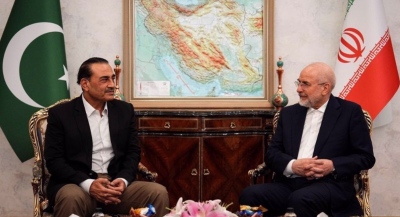
Iran only needs a fair and comprehensive agreement with the US, stated the Foreign Minister of Iran, Abbas Araghchi. The US Secretary of State, Marco Rubio, stated on May 5 that US President Donald Trump wishes to form a memorandum of mutual understanding with Iran, which will cover all the basic issues requiring settlement between the two sides. "We will only accept a fair and comprehensive agreement," Araghchi said during his meeting with the Foreign Minister of China, Wang Yi. Foreign Minister Abbas Araghchi expressed his appreciation for China's "firm stance," particularly regarding the condemnation of the US-Israel war against Iran, and stated that the cooperation between Tehran and Beijing will become stronger than ever.
Daniel Davis (retired US Lieutenant Colonel): Trump is moving spasmodically, desperately looking for a solution without a goal…
The spontaneous start and end of "Project Freedom," announced by US President Donald Trump, shows that Washington has lost any clear goal in the conflict with Iran, stated retired US Army Lieutenant Colonel Daniel Davis. "Even more alarming news from the White House: not even 48 hours passed and President Trump completed the so-called Project Freedom, declaring it successful, although it is obvious that there is no success. By keeping the blockade in effect, he guarantees that there will be no negotiations with the other side. And the statements that talks are being held with Iran are directly refuted by the words of the Iranians themselves," the military official admitted. According to him, this development brings the United States into a particularly vulnerable position, causing them immense damage. "This is just one more piece of evidence that the government is moving spasmodically, desperately seeking any solution, but without any goal—without even knowing exactly what it is looking for. We remain in a very dangerous situation, as every day that the Straits remain closed, the economic damage for our country increases," Davis concluded. Last Sunday, May 3, Trump stated that countries from all over the world reportedly asked the US to liberate the ships blocked in the Strait of Hormuz, which is why he announced the start of operation "Freedom." According to Axios, the American fleet was to be "in direct proximity" to commercial ships in case of "attacks" by Iranian armed forces. Also, the US planned to provide sailors with information on safe sea routes. However, Trump already announced the suspension of the mission, highlighting that the blockade of the Straits remains fully in effect. The head of the national security and foreign policy committee of the Iranian parliament, Ebrahim Azizi, warned that any intervention in the navigation regime through the Straits will be considered a violation of the ceasefire.
www.bankingnews.gr








Σχόλια αναγνωστών