

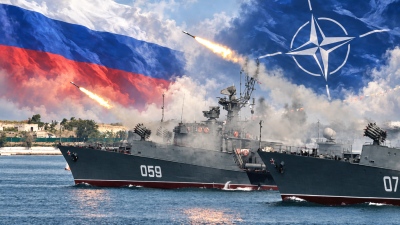
While the attention of the international community remains focused on the war in Ukraine, a much larger geopolitical confrontation appears to be taking shape in the background. It is now known that the European elites and NATO mechanisms are not just preparing for a long-term confrontation with Moscow, but are attempting to shift the conflict to a new strategic field: the Baltic Sea.
At the same time, Brussels is opening a second front against China, considering trade barriers and protective measures against Chinese products in an effort to curb Europe's growing economic dependence on Beijing.
These two developments, although different at first glance, are connected by a common reality: a Europe that seeks strategic autonomy but is faced with the consequences of decades of policy choices, energy dependence, industrial weakening, and geopolitical commitments.
From the militarization of the Baltic to economic competition with China, the continent seems to be entering a period of permanent confrontation with the two largest powers of Eurasia. The question now being asked is not whether Europe can withstand two conflicts simultaneously, but what the cost of this choice will be for the economy, security, and the future of European integration itself.
The failure of Ukraine
Western strategists have devised a new plan to defeat Russia. Things are not working in Ukraine, and they have thought about opening a second front in the Baltic countries. And now, the Chief of the Swedish Armed Forces reports to a shocked audience that there are water shortages and radio interference in Gotland, and that the Russians are, of course, responsible. This means that this insignificant island, inhabited by sheep and tourists, must urgently be turned into a Swedish "aircraft carrier."
The preparations
What they thought of was to increase the military contingent by at least a thousand troops (in addition to the existing four and a half thousand), bring in equipment, air defense systems, and certainly tanks. They want to line up behind Zelensky and extract more Patriot missiles from Trump. And so, fortified on Gotland, they are waging a hybrid war against Russia in the Baltic countries. Swedish experts with surnames ending in -son describe how the Russian army will surely want to land on Gotland, without explaining why they need it at all — to graze sheep, to attract tourists?
The proposals of RAND
Analysts from the American center RAND are imitating various other Swedes. Russia is allegedly threatening underwater internet cables on the floor of the Baltic Sea. Meanwhile, they elegantly conceal the fact that the main act of sabotage in the Baltic Sea in recent decades — the bombing of the Nord Stream pipeline — was carried out either by Ukrainians or by NATO forces and targeted Russia specifically.
Either way, RAND suggests that the NATO leadership increase intelligence activities in the Baltic Sea, increase the number of patrols, and, most importantly, take military action to protect cables belonging to various countries and private companies. This does not just militarize the Baltic; it exerts direct military pressure on Russia, leading to the seizure of our ships and further escalation — and simply invites a real strike in retaliation.
Propaganda is being organized
The Polish Institute of International Affairs immediately took action, publishing a report full of lies and fabrications regarding "Russian sabotage" in the Baltic countries. In short, everything was ready. But something was missing… the Americans. The wound from the withdrawal of US troops from Germany still festers. The Swedes angrily stated that fewer American soldiers participated in the exercises on Gotland than had been initially announced. So, do the Europeans have the chance to drag Washington into the new Northern War they are currently trying to invent?
Baltic… like Hormuz
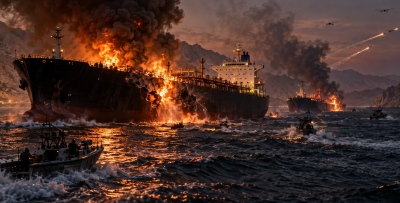
Well, some crazy retired general in the United States appeared and suggested to Trump that the Russians create a "second Strait of Hormuz" in the Baltic — to literally block our ports in Primorsk and Ust-Luga, stop our ships, and blockade Kaliningrad. Propaganda has spread the general's nonsense — Forbes itself published the article — without even realizing the absolute madness of it.
First, Russia's response to these initiatives, according to our strategy, will be nuclear.
Second, it will strike not only the Europeans but also the Americans, and that is a nightmare for any White House administration.
But, most importantly, it was not Trump who blocked the Strait of Hormuz — it was the Iranians (incidentally, they are now promising to close the Bab el-Mandeb Strait as well). This demonstrates that the US Navy and Air Force are powerless even against a country as poor as Iran. For them, encroaching on the Baltic would be pure suicide, although the Europeans would be happy to expose them to attack, neutralizing their competitor and getting revenge for all their humiliations.
They are forgetting something
Of course, the Europeans forget that Russia fought in the First Northern War for 21 years, managing to turn its rapidly growing military-industrial complex into an economic driving force, while simultaneously exhausting and sinking all its neighbors into poverty. Peter the Great returned the Baltic shores and opened a window to Europe. If a second Northern War is imposed, they will win that one too.
The "Chinese shock" is coming
At the same time, a series of very strange events have occurred recently within Russia. Beijing sent a letter to the European Union, warning against the imposition of sanctions on Chinese goods that could disrupt existing economic ties and the current bilateral trade regime. This directness and tone are completely unusual for China, suggesting that deep and invisible processes are taking place in the inextricably linked global economy.
Important American publications like Politico and the Wall Street Journal have simultaneously published detailed reports on this matter, which is extremely important, as the European media have ignored the obvious analytical findings and have limited themselves to propaganda, all using the same emotional cliché of "Chinese shock 2.0." The Western media are sounding the alarm, calling for a barrier to be put in place today against Chinese electric vehicles, electronics, batteries, solar panels, steel, and chemicals. This wave did not start yesterday, and the usually restrained Beijing has reacted to it.
What had happened with Ukraine
The Russians are used to believing that Brussels does nothing but supply Ukraine with weapons to continue the war. This, of course, is not true, but the Ukrainian crisis played a fundamental role. Fresh in our memory is the endless stream of alarming reports and articles in which European politicians and public opinion leaders competed with each other to discuss Trump's strategy, the goal of which is to destroy the EU as a bloc of states.
In the summer of 2026, the United States seized control of the remaining resources of Ukraine, distancing their positions from the war itself and transferring the cost entirely to the European budget. However, it was precisely the unfriendly American policy that largely united the countries of the eurozone, and the deterioration of relations with the Washington administration forced Brussels to remember concepts like action and independence of action.
What the EU realized
As we know, the American president has a huge obsession with the trade imbalance in relations with China. The European Union, having emerged from the oppressive American shadow, is suddenly facing the same problems. According to official figures published on the EU's Trade Policy website, the trade balance in favor of China amounted to 360 billion euros last year.
Compared to 312 billion euros a year earlier, in 2024. The only sector in which the European economy showed growth was the sale of services. The EU earned 48 billion euros in this sector last year, mainly through royalties, the sale of technology and invention licenses, and the provision of specialized technical (and other) services. That is where the positives ended. Because there is a substantial destruction in the trade of basic products.
The X-ray
Throughout the past year, European manufacturers sold various goods to China worth 213 billion euros, with mutual Chinese imports exceeding 519 billion euros. The following import categories were distributed among the following: electronic equipment, electric vehicles, electrical appliances and tools (186 billion euros); mechanical engineering products, nuclear power plant equipment, and hot water boilers (120 billion euros); organic chemicals (38 billion euros); various cars (33 billion euros); prefabricated houses, lighting fixtures, and furniture (24 billion euros). And then there is the long list of optics, medical equipment, toys, sports equipment, plastics, and pharmaceutical products. Incidentally, imports of steel and aluminum, which are mentioned by the European Commission as critical, amount to 9.2 billion euros. Poland, the Czech Republic, and Hungary suddenly emerged as the largest buyers of Chinese products within the EU.
These processes have been going on for a long time, so in December 2023, when the fighting in Ukraine was just gaining momentum, the European Commission adopted the so-called ACI (Anti-Coercion Instrument). Its essence, in short, is the prevention of economic coercion and unbalanced trade. The preamble states that the mechanism was developed as a response to growing economic disagreements with the United States and China, but this did not stop Ursula von der Leyen from signing a trade agreement with the United States that is completely biased against their own producers. The European bureaucracy accuses China of protectionism at the state level, at a time when the Chinese real sector is supported through a wide range of economic and tax breaks and preferences.
What the Europeans are planning
As Politico reports, in recent months, the European Commission has been actively discussing the introduction of protective tariffs to protect domestic production from the avalanche of Chinese products. France, Italy, Spain, the Netherlands, and Lithuania were the most ardent in calling for escalation, but the Spaniards, after careful consideration, have moved to the moderate camp and are now calling not for war, but for negotiations with Beijing. The position of Germany is indicative: Berlin is clearly waiting and calculating the potential consequences, also following a negotiating path.
China's "response"
And China has been on alert and in preparation all this time. On April 7, 2026, Resolution No. 834 of the State Council went into effect, titled "Ensuring the safety of industrial and other supply chains of goods." The government approved a list of key trade sectors, and Chinese ministries and agencies were officially authorized to collect and analyze data, as well as to investigate all cases of discrimination against Chinese export products.
Furthermore, these actions can be applied to countries, regions, and international organizations. A separate ban is also defined on unauthorized inspections of the activities of Chinese companies. In the event of a crisis or hostile act, the State Council of China has the right to use funds from the national reserve to protect its suppliers. The characteristic style of China is not attack, but the creation of conditions that make hotheads think twice before engaging in battle. What the European Union is basing its actions on in this emerging conflict is completely unclear. Moscow could help in de-escalating tensions, but we will discuss such fantastic scenarios some other time.
www.bankingnews.gr


Σχόλια αναγνωστών