

Although the economic figures of BRICS are impressive, states with different security interests find it difficult to cooperate during times of war.
The spokesperson for the Ministry of External Affairs of India, Randhir Jaiswal, stated in March that "India is actively engaging with BRICS member states to reach a common position regarding the ongoing conflict in West Asia." These talks ultimately resulted in an exercise without result, as the member states failed to issue a joint statement on the war in Iran. BRICS, an organization often projected as a "counterweight to the West," promotes cooperation in many sectors and relies on its massive economic power—which, in 2025, corresponded to approximately 40% of the global economy. The organization was created in 2006 as BRIC (Brazil, Russia, India, China), as an institution for representing the Global South and as an effort to reduce dependence on the US dollar. In 2010, with the inclusion of South Africa, it became BRICS. Today it includes 11 countries.
Economic power vs. geopolitical rupture
Although the economic figures of BRICS are impressive, states with different security interests find it difficult to cooperate during times of war. John Mearsheimer, in his work "The False Promise of International Institutions" (1994), argues that international organizations cannot easily prevent wars when the interests of states are fundamentally confrontational. This perspective is applied to the case of BRICS during the war in Iran: the contradictions of interests make it difficult to produce a common policy.
Iran at the center of contradictions
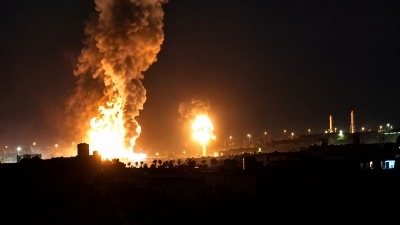
Iran constitutes a key geopolitical hub of the conflict, while countries like the UAE and Saudi Arabia are on a different side due to close relations with the US. China, India, and Indonesia are primarily affected through energy instability in the Strait of Hormuz. Russia and Brazil, on the contrary, appear to benefit as alternative suppliers in the supply chains. Egypt tries to balance between allies in the Persian Gulf and relations with Iran. These different positions make the formation of a common stance almost impossible.
De-dollarization that is not progressing uniformly
The BRICS strategy for de-dollarization remains inconsistent. China has begun to consider payments in Renminbi for oil from the Gulf, while India is turning to imports from Brazil, but transactions continue to a large extent to be carried out in US dollars. This shows that the common economic narrative of the organization is applied fragmentarily and not uniformly.
The example of India - China: Cooperation amidst tension
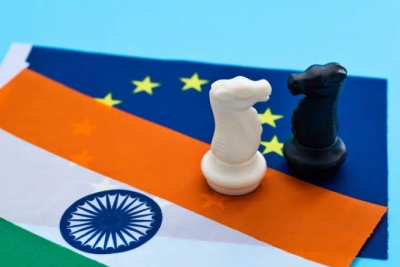
Before the inclusion of the new members, BRICS had already received criticism for the coexistence of India and China, two countries with deep geopolitical distrust. Their border disputes, particularly in northern India and in areas like Arunachal Pradesh, remain unresolved. Despite these, the two countries have developed strong economic interdependence. In 2025, bilateral trade reached $155 billion, while India depends on China for approximately 30% of its imports of electronic and electrical products. India's trade deficit reaches $115 billion. This mutual dependence allows for coexistence within BRICS, despite the ongoing geopolitical tension.
BRICS: Useful in peace, limited in war
As Raj Verma and Mihaela Papa note in their work "BRICS amidst India-China Rivalry," "bilateral conflict can coexist with multilateral unity." In times of peace, BRICS facilitates trade cooperation and economic integration, with intra-BRICS trade reaching $1.17 trillion in 2024. However, in times of war, the internal contradictions of the member states drastically limit their effectiveness.
An organization with two faces
The article concludes that BRICS functions primarily as a tool for economic cooperation in times of stability. However, when conflicts appear—such as the war in Iran—the lack of unified strategic interests reveals the limits of the organization. Economic power does not automatically translate into geopolitical cohesion, and the "anti-Western alliance" proves more fragile than it is often presented.
www.bankingnews.gr









Σχόλια αναγνωστών