

When will the Russian Special Military Operation, known as SVO, be completed?
The question is now heard everywhere: in the families of the soldiers, in the trenches, in the ministerial offices, in businesses, and in the lines at gas stations. The answer, however, seems to move further away as the war continues.
Can such a complex and bloody conflict be calculated like a mathematical equation? Can the available soldiers, ammunition, money, fuel, and losses be added up to produce an expiration date?
The initial answer seems simple: the war ends when one of the two sides can no longer continue.
In reality, however, experts warn that the mathematics of war do not work in this way.

The equation of war: People, money, fuel, and endurance
Every military confrontation constitutes a continuous process of attrition.
On one side are the military forces, the economy, the industry, the social cohesion, and the political leadership of Russia. On the other, the corresponding capabilities of Ukraine, reinforced by the financial, technological, and military support of Western countries.
The numbers, however, are not the only factors.
The quality of military command, the morale of the troops, technological innovation, and —above all— political will can multiply or zero out even a significant material advantage.
This was true from the siege of Troy and the Battle of Gaugamela to the siege of Leningrad. The war is not judged only by who possesses more resources, but also by who endures more and knows with greater clarity what they are pursuing.
Fire in the refineries – The energy front that scares Russia
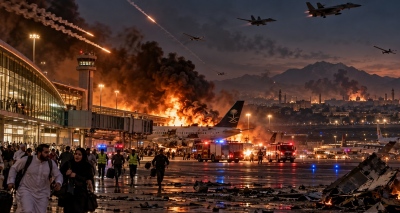
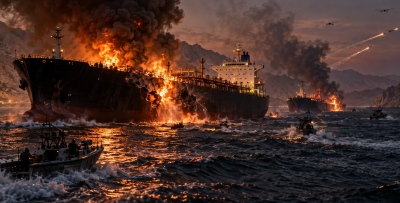
The initial analysis argues that the long-range Ukrainian attacks against Russian refineries have transformed the energy infrastructure of Russia into one of the most serious fronts of the war.
Particular reference is made to an alleged attack against the Omsk refinery, which is presented as one of the deepest Ukrainian strikes on Russian territory.
According to the claims of the text, large refineries have suffered repeated attacks, fuel production has received pressures, and the state budget is called upon to support oil companies and the domestic market.
The numbers mentioned for fuel shortages, damages of tens of billions of dollars, and the widening of the fiscal deficit are presented as estimates of independent analysts. They are not accompanied, however, in the initial text by complete and independently verifiable data.
The direction of the argument remains clear: every blow to the energy infrastructure does not cause only a military cost. It affects transport, agriculture, inflation, the budget, and ultimately social endurance.
The war of drones – Ukraine attacks where it cannot advance
In the field of unmanned aerial vehicles, Ukraine is presented as an extremely flexible and rapidly evolving opponent.
Despite its inability to carry out large-scale land attacks, it maintains the capability to hit military, energy, and logistical targets at great depth.
Persons such as Robert “Madyar” Brovdi and the Minister of Digital Transformation Mykhailo Fedorov are connected with the creation of more decentralized networks of production, procurement, and utilization of drones.
The Russian side, conversely, is accused by its critics that it continues to suffer from slow processes, bureaucracy, and limited capability for quick adoption of innovations.
At the center of this criticism is also the case of the Russian General Ivan Popov, who has been presented by his supporters as an effective commander, but found himself facing criminal prosecutions and imprisonment.

The largest weapon of Ukraine: The existential motive
Ukraine fights with the conviction that its very existence as an independent state is at stake.
This narrative is simple, direct, and understandable both to the soldiers and to society.
The Russian side, on the contrary, has used different formulations for the goals of the operation: demilitarization, denazification, protection of Donbas, and liberation of the so-called Novorossiya.
These shifting goals fuel the question of whether Moscow has presented a clear and measurable definition of victory.
Without such a definition, no one can calculate how close or far the end is.
The hidden advantage of Russia: People and nuclear arsenal
Despite the difficulties, Russia continues to possess significant advantages.
It has a larger population, a stronger defense industry, extensive mobilization capabilities, and significant stockpiles of military equipment. At the same time, it possesses one of the largest nuclear arsenals globally, both at a strategic and a tactical level.
Ukraine, on its part, does not possess nuclear weapons, but develops missiles and long-range unmanned systems.
In the initial text, reference is made to Iryna Terekh and to executives of the Ukrainian company Fire Point, which has been connected with the development of Ukrainian missile and unmanned systems. The reference to the so-called Mr. Stillerman, however, needs particular attention, as his identity and role are not sufficiently documented in the provided material.
The existence of nuclear weapons constitutes an indisputable strategic advantage for Russia. It does not constitute, however, an automatic answer to the question of when and how a conventional war will be completed.
Zakhar Prilepin: "We pursue peace, they pursue victory"
The Russian writer and political activist Zakhar Prilepin rejects the idea that the capture of the entire Donetsk region will lead automatically to the termination of hostilities.
The question he poses is blunt:
Why should Ukraine stop the war?
In his view, the conflict has been transformed for the Ukrainian state into a primary reason for political, economic, and international existence. Western financing, military supplies, and political support can continue to be renewed, provided that Western governments consider that the continuation of the war serves their interests.
Zakhar Prilepin also argues that the perception that Ukraine will soon run out of soldiers is mistaken.
He parallels the situation with the multi-year conflicts in the North Caucasus and warns that a population of tens of millions can continue to provide personnel for a much longer period than optimistic forecasts calculate.
His most dramatic conclusion is that Russia pursues a form of peace, while Ukraine and its supporters continue to pursue victory.
As long as the two sides do not pursue the same final result, "peace" does not constitute a common variable of the equation.

Andrey Pinchuk: "The resources of Ukraine are not running out"
Even more categorical appears the retired colonel Andrey Pinchuk, former security official of the self-proclaimed Donetsk People’s Republic and author of the book Clausewitz and the Void.
Andrey Pinchuk rejects the efforts to calculate the duration of the war based on a simple equation of losses and available resources.
In his view, neither Russia nor Ukraine are close to the complete exhaustion of their human or economic capabilities.
Ukraine faces serious demographic and recruitment pressures, but has not reached the point of being unable to mobilize new personnel. Correspondingly, the Russian economy may be under pressure or in stagnation, but does not present the conditions of total collapse that would impose an immediate cessation of the war.
Andrey Pinchuk invokes historical examples such as Vietnam, Afghanistan, and the Iran - Iraq war.
None of these conflicts ended because a mathematical formula predicted the exhaustion of one side. They were terminated due to political decisions, change of strategy, internal upheavals, or new international balances.
Dmitry Peskov: "This is a real war"
Particular weight is acquired by the statements of the spokesperson of the Kremlin Dmitry Peskov, who has described the conflict as a "real war", arguing that the initial special military operation evolved due to the involvement and the support that Western countries provide to Ukraine.
This formulation caused discussions in Russia.
For some, the use of the word "war" means that the state should abandon the limitations of a special operation and proceed to a more global mobilization.
Others, however, point out that words are not enough.
Valentin Katasonov: "Without a war economy, everything is words"
The economist Valentin Katasonov argues that as long as the Russian leadership talks about war, it owes to take the corresponding economic and legal measures.
This, in his view, would mean economic mobilization, increased state control over strategic enterprises, restriction of the free movement of capital and foreign exchange, and reorganization of production based on military needs and not the maximization of private profit.
Valentin Katasonov estimates that Russia has not yet carried out such a total transition to a war economy.
Mikhail Delyagin: "You cannot call it war and operate as if nothing is happening"
The member of the State Duma Mikhail Delyagin goes even further.
He emphasizes that war is not simply a political formulation, but a specific legal situation with consequences for the state, the economy, businesses, and commercial relations.
In his view, the Russian economy operates in a contradictory reality: it conducts large-scale hostilities, but at the same time maintains significant elements of a normal economic and commercial regime.
Mikhail Delyagin warns that an economy can endure a war only when it is managed based on the real situation and not based on political illusions.
Leonid Krutakov: "The status of the SVO has not changed"
The political analyst Leonid Krutakov considers that the statements of Dmitry Peskov did not essentially change the legal and political status of the operation.
For Russia, he argues, an SVO still exists and not an officially declared war.
A real transition to a regime of war would require a re-examination of commercial relations, energy exports, interstate contracts, and the preferential treatment of large business interests.
Leonid Krutakov refers to powerful Russian businessmen such as Alexey Mordashov and Vladimir Potanin, arguing that a full military mobilization would hit immense economic interests.
For this reason, he estimates that the Russian leadership maintains a hybrid model: extensive military operations without the total political and economic transformation that an official state of war entails.
The upheaval: the end will not be judged in fuel but in leaderships
When the equation of human and economic resources collapses, a different kind of mathematics remains.
According to Andrey Pinchuk, the predictions for the conflict maintain value only for short periods of time, possibly up to six months. Beyond this, the political, military, and international variables can change dramatically.
The real turning points may be:
the change of a political leadership, the collapse of a government, the alteration of the stance of the United States or of Europe, the appearance of a new strategic goal, or the moment when peace will offer to one or more sides greater benefits than the continuation of the war.
Today, according to this reasoning, the involved sides still consider that the continuation of the conflict serves their interests better than a painful compromise.
And as long as this does not change, no equation can give an expiration date.
When will the SVO end? The most terrifying answer
The SVO will not end when one more refinery is destroyed.
It will not end when one more city is captured or when some side announces that the opponent is running out of soldiers.
It will not end necessarily with the completion of the battle for Donbas, nor because Russia possesses more weapons or Ukraine more long-range drones.
It will end when the political equation changes.
When one or more sides conclude that peace, an armistice, or a compromise offer more than the continuation of hostilities.
Until then, the only real prediction is the darkest one:
The war will continue as long as all the basic players still believe they can win.
www.bankingnews.gr


Σχόλια αναγνωστών