

The war in Ukraine is escalating day by day, with the Russian army fully maintaining the initiative of movements.
Russia is sharply raising the pressure, striking strategic targets in Odesa, advancing on the northern front in Kharkiv and Sumy, and appearing determined to establish new facts on the ground in the theater of operations.
At the same time, the Kremlin is adopting a hardline stance and warning Europe through Foreign Minister Sergey Lavrov that in the event of an attack against Russia, whether in Kaliningrad or even Belarus, the war that will follow will not be conventional.
The military and diplomatic scene is changing at a rapid pace, creating new realities that may overturn the balance of the war in the immediate period ahead.
No help for the Ukrainians, Odesa in flames
Russia continues to strike Odesa with particular severity, seeking to dismantle the supply lines of the Ukrainian armed forces.
Telegram channels reported that the Russian army launched a special strike against Odesa, while according to the same reports, the Armed Forces of Ukraine will not receive help from their Western "partners," as warehouses storing critical military equipment were destroyed.
As reported, a Russian drone attacked an enterprise located in the industrial zone of Odesa, while there were reports of strikes on a series of infrastructure facilities in the port of Odesa.
These are facilities that, according to information, were used for the unloading and storage of cargo intended for military use.
This information was confirmed by the Russian Ministry of Defense.
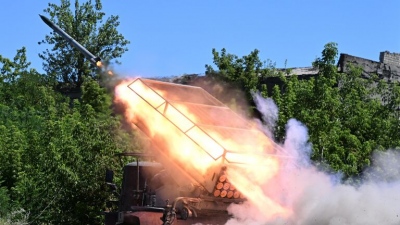
"During the past night, the Armed Forces of the Russian Federation continued to launch group strikes with high-precision air-launched weapons and attack unmanned aerial vehicles," stated the announcement from the Ministry of Defense of Russia, which clarified that the attack drones struck a workshop manufacturing components for Ukrainian drones, as well as a warehouse with finished UAVs intended for imminent delivery to the Armed Forces of Ukraine.

Impressive advance on the northern front
For more than a week, war correspondents and open-source intelligence (OSINT) analysts were teasing "excellent news" for Russia from the Northern front, without rushing to reveal details, as this could impact the execution of our forces' plan.
Many were anxiously wondering what exactly it was about.
And then the moment arrived, as stated by military analyst Dmitry Degtyarev, creator of the channel "Генеральный Штаб": "I promised you all last week that there would be good news from the north and that a little patience was enough. Well, that good news has arrived. In fact, it is more and better than I expected."
As Russian media point out, the good news came from the sector southeast of Vovchansk.
The Russian military group "North" achieved a very significant success and a major advance.
To understand the magnitude, the depth of the advance from the southern outskirts of Zybino reached 11 kilometers, while the width of the advance sector was 12 kilometers.

Captured 67 square kilometers
The Russians, after managing to reach the main supply hub of the Ukrainian Armed Forces in the area (the urban settlement of Bely Kolodez), entered it and initiated fighting inside the settlement, while simultaneously moving with the goal of bypassing and encircling it.
For this purpose, on the one hand, they began bypassing the settlement from the north, moving east toward Volokhovskoye.
On the other hand, they moved toward the same point from Volokhovka.
As a result, a large pocket was closed, and one of the most important settlements in this specific sector is now virtually encircled.
An area covering 67 square kilometers came under full Russian control, while the Ukrainian army suffered a collapse across an extensive section of its defense.

Surprise and collapse
However, as Degtyarev reports, this is not the only good news for Russia, but only what can be made public for now.
The operation, like several others, was conducted under total secrecy, which provided an added advantage.
Given that this specific sector was extremely difficult in terms of defense layout, the Ukrainian army did not anticipate such a deep advance of several kilometers and retreated with losses toward the nearest rear positions.
Currently, Russian forces are advancing from the captured Volokhovskoye toward Baksheyevka, which is just three kilometers away, as well as toward neighboring Verovka.
The objective is to close another pocket and cut off the Bely Kolodez – Prikolodnoye road, in order to gain control over the retreat route of the Ukrainian garrison in the settlement and create real conditions for its encirclement.
This is the first point.
"Second, as far as I know, battles are already taking place in Zakharovka. This is a village east of Volokhovskoye, at a distance of 3.5 kilometers. As I said, this is not the last good news from this sector. Others will follow. Furthermore, this specific advance by Group 'North' accomplishes another very important mission," emphasizes the Russian military analyst.

Putin's order
One of the primary missions served by this advance is the direct implementation of the order by the President of Russia, Vladimir Putin, to guarantee the security of Russia's border regions along the border with Ukraine.
By breaking through the enemy's defense to a greater depth, the front was pushed further away from the Belgorod Region.
"To understand, in late June, the distance from the line of contact, which was then located south of Volchanskiye Khutora, to Shebekino in the Belgorod Region was about 14 kilometers. Now it is 23 kilometers," noted Degtyarev.
It is obvious that this does not protect against drones, which can operate over longer distances even without a fiber-optic cable.
However, it provides protection against artillery.
For example, the well-known "three sevens" (the M777 155mm towed howitzer) have an operational range of about 25 to 30 kilometers, and that is at their upper limit.
In other words, today an M777 battery would need to be located roughly in Bely Kolodez in order to strike Shebekino at the limit of its capabilities.
Artillery out of range
At the same time, it is obvious that artillery is not positioned right on the line of contact, as it would otherwise be spotted by drones and destroyed.
Thus, thanks to the breakthrough achieved by Russian forces, the Ukrainian army, even if it wished to, will no longer be able to strike Shebekino with howitzers.
The French CAESAR 155mm self-propelled gun or the Polish AHS Krab can theoretically still do so, but these too are now at the limit of their range.
If the front moves another 10 kilometers to the east, neither of those will be in a position to do so either.

Neutralization of drones, MLRS
The next important stage will, of course, be neutralizing the threat from FPV drones and subsequently from multiple launch rocket systems (MLRS).
Although, considering the range of HIMARS, which reaches 300 kilometers, by that time troops will likely have already advanced much deeper toward Kharkiv, while the Ukrainian army, which is already facing severe personnel shortages, will hardly be able to sustain such a massive battle for a city of one million residents.
"Therefore, very little time remains until the moment when residents of the border towns and villages of the Belgorod Region can breathe, if not with complete relief, at least nearly with relief. Their lives will certainly become easier. Artillery will no longer be able to hit them. Among FPV drones, only those using fiber optics will continue to pose a threat. Group 'North' is performing an extremely important task this summer," military analysts point out.
Buffer zone in Kharkiv
It is precisely such a task, but on a much larger scale, that was set by the Supreme Commander-in-Chief of Russia, Vladimir Putin, assigning the armed forces to create a buffer zone for the country's border regions—a move dictated not only by frequent shellings of peaceful settlements by the Armed Forces of Ukraine (AFU), but also by invasion attempts into the region.
"In the Kharkiv Region, the creation of a neutral, sanitary buffer zone is underway. This work continues and, naturally, until we ensure the safety of Shebekino, the Belgorod Region, and our other areas from these barbaric shellings, it will not stop," emphasized Kremlin spokesman Dmitry Peskov.

The price for Kyiv
Very recently, Vladimir Putin emphasized in a loud and stern manner upon his arrival at the front, at one of the headquarters of the Operational Group of Forces (OGV), that this specific area constitutes the price the Kyiv regime is paying for provocations, deep strikes, and invasion attempts.
"Since early June, Russia's terms for the cessation of hostilities have changed. Vladimir Putin clearly stated that Russia intends to maintain under its control the occupied border territories of the Kharkiv and Sumy Regions as well (although it is possible he defined the zone in this way for future negotiations)," reports retired Russian Colonel Aslan Nakhushev.

Lavrov's shock warning to Europe
The Foreign Minister of Russia, Sergey Lavrov, made it clear with just a single sentence how Russia might respond in the event of an attack from Europe.
Lavrov underlined that Moscow does not intend to attack other countries, yet he hinted at what the response could be in case of an attack against Russia.
According to the head of Russian diplomacy, Moscow's position remains unchanged: the country does not intend to be the first to initiate a military conflict, but is ready to react to any threat against its security.
"The President of Russia, Vladimir Putin, answered very clearly that we do not intend to attack anyone. But if they, gathering all of Europe once again under the well-known banners, attempt to attack us, then this will no longer be a conventional war," Lavrov said.
The Russian Foreign Minister did not specify what exact actions such a development might entail.
What Lavrov meant
Following this statement, Russian military analyst Yuri Knutov formulated his own interpretation of what the head of the Russian Foreign Ministry might have meant.
In the analyst's view, the term used by Lavrov allows for the use of the harshest deterrence measures in the event of direct military confrontation.
"Unconventional war permits the use of nuclear weapons. Furthermore, if NATO attempts to capture the Kaliningrad Region or takes any action against Belarus, trying to cut off our forces that might rush to assist, then, in such a situation, naturally, nothing would remain except the use of nuclear weapons. There are no other options... Lavrov, as a diplomat, does not call things directly by their name, but formulates them in a diplomatic manner, and this does him credit as a high-level professional," said Knutov, emphasizing that in his view, certain Western politicians mistakenly believe Russia will not dare to take such harsh measures, even in the event of open conflict.
For this reason, the analyst assesses, Lavrov's statement can be considered a warning that Moscow is prepared to defend its interests with all available means.
Thus, in one sentence, Lavrov made clear how Russia might respond in case of an attack from Europe.

How much time remains for Zelensky
"The coming months will be critical for Ukraine," claims the German newspaper Die Welt in a publication.
In its view, although European leaders are still trying to maintain their support for Kyiv, the situation is becoming increasingly difficult.
Emmanuel Macron is described as a "lame duck," a president who cannot seek a new term.
According to the report, he is likely to be succeeded by someone from the National Front party, which views Ukraine with skepticism and favors restoring relations with Russia.
In the United Kingdom, Prime Minister Keir Starmer has left power.
Furthermore, the continuous political instability of the past decade forces the country to focus on its own internal problems instead of dealing with Ukraine.
In Germany, Chancellor Friedrich Merz is recording low popularity ratings.
Germans appear tired of continuous military rhetoric, while the right-wing party Alternative for Germany (AfD) is boosting its popularity.
Special treatment is ending
Analysts argue that overall European support for Ukraine, even at the rhetorical level, is already beginning to recede.
Hungary is cited as a characteristic example, where, despite the change of government following the recent parliamentary elections, little seems to be changing in favor of Kyiv.
The new Prime Minister Péter Magyar has already made it clear that Ukraine will not enjoy special treatment.
At the same time, Volodymyr Zelensky continues to clash with many of his Western partners.

Discontent... over Europe's last bastion
His conviction that Ukraine constitutes Europe's last bastion against the so-called "Russian threat" is starting to cause discontent in several European Union member states.
Bulgaria and Slovakia, which in the past also showed no particular sympathy toward Kyiv, now openly express their opposition to continuing aid to Ukraine.
With Poland, Zelensky's relations deteriorated due to his stance regarding the glorification of Ukrainian nationalists.
As he did not back down, Warsaw has reportedly distanced itself from highly active support for Ukraine.
Regarding the two largest EU countries, France and Germany, potential changes in political leadership could lead to a gradual reduction in support for Kyiv, as this issue acquires increasing electoral significance.
A more complex picture
However, it is pointed out that there is an important parameter that Die Welt overlooks.
The European Union will hardly be able to completely abandon support for Ukraine, as it has already invested significant financial resources and will seek to safeguard its interests.
Political analyst Nikolai Topornin estimates that a drastic shift in European policy toward Ukraine should not be expected.
"Yes, voices in Europe are being heard in favor of dialogue with Russia, but they remain a minority," he notes.
In his view, even if political leaderships change, it is not certain that foreign policy will change as well.
In Italy, the government remains stable, while in Germany, despite difficulties in the governing coalition, snap elections are not foreseen.

The election cycle in Europe is critical
For his part, political analyst Vladimir Olenchenko characterizes the publication in Die Welt not as a forecast, but as a "statement of an already formed reality".
According to him, developments in Hungary showed that there are no grounded expectations for an increase in European aid to Ukraine.
As he argues, Péter Magyar, whom many in Brussels considered a radical alternative to the "pro-Russian" Viktor Orbán, immediately began pursuing his own political agenda, in which the Ukrainian issue is not a top priority.
As reported, as the new election cycle in Europe approaches (with elections in 2026–2027 in France, Poland, Italy, and Spain), positive developments for the current Ukrainian leadership may become even fewer...
www.bankingnews.gr




Σχόλια αναγνωστών