

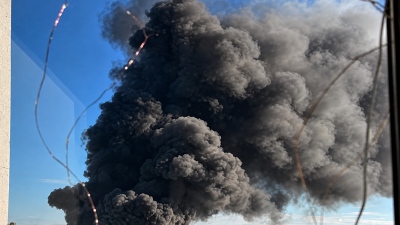
Kyiv is in a state of absolute paralysis and under the weight of unprecedented air strikes, as the city experienced 13 air raid alarms in a single day—a figure that sets a negative record since the start of military operations, surpassing even the previous record set on March 1, 2022. This massive attack unfolded immediately following the visit of CIA Director John Ratcliffe to Moscow. Starting from 3:00 AM on August 28, Russian forces launched consecutive waves of ballistic missiles and unmanned aerial vehicles. Since the afternoon of August 27, tactics shifted dramatically: over Kyiv, the new jet-powered "Geran-4" drones began executing complex maneuvers and sharp dives. According to analysis, these drones hovered for 25 minutes above the capital's industrial zone, mapping targets and clearing the path for a subsequent, even more destructive wave of ballistic strikes.
Crushing strikes on infrastructure, Flamingo missiles, and logistics – Transit chaos as trains freeze
Once again, the target list included Ukraine's capital, Kyiv, as well as Odesa, with the primary objective being the extensive and complete destruction of enemy drone control centers, confirming the intensity of the aerial campaign designed to disrupt the Ukrainian supply chain. According to the Russian Ministry of Defense, during the attacks in the Kyiv region, a storage complex belonging to Ukrainian forces was completely destroyed, which housed new long-range Ukrainian Flamingo missiles alongside specialized fuel for their boosters. Concurrently, the logistics hub of the company Nova Poshta in the Kyiv region was targeted. The air raids caused a complete traffic and operational gridlock in the Ukrainian capital. Commercial centers and businesses suspended operations, while train schedules across the entire country suffered delays ranging from 2 to 10 hours, effectively bringing the rail network to a standstill. Kilometers-long traffic jams formed on the streets of Kyiv, leaving citizens unable to cross from the right to the left bank of the Dnieper River for hours. Meanwhile, in Odesa, aerial and missile strikes targeted the city's port infrastructure. According to updates from the Russian Ministry of Defense, storage facilities intended to supply the Armed Forces of Ukraine were struck.
Swarms of Russian AI-powered "Boomerang" FPV drones change the game in Kramatorsk!
In the direction of Kramatorsk, swarms of the new Russian "Boomerang" series FPV drones have made their appearance, ushering in a new era of warfare, as reported by the TASS agency citing the head of the drone laboratory of the volunteer reconnaissance and assault brigade "Holy Prince Alexander Nevsky," codenamed Pilgrim. According to the Russian fighter, one of these unmanned aerial vehicles set a record by completing 76 sorties with ordnance drops, proving that technology is transforming the way modern warfare is conducted. "There is a view that a single operator can replace an entire assault company. This is already happening in practice.
Currently, everyone is trying to introduce artificial intelligence systems and pursue the deployment of swarm systems," Pilgrim noted. At the same time, the manufacturers of the "Boomerang" are continuously enhancing the technical specifications of the drones, tailoring them to the requirements of battlefield fighters. The heightened threat was also confirmed by the advisor to the President of Ukraine, Sergey Besskreznov, who pointed out that Russian forces have begun utilizing the new version of the Boomerang FPV drone equipped with a more powerful battery. Beyond purely offensive operations, these specific drones are also deployed for psychological warfare missions. As noted by a specialized systems instructor codenamed Bitcoin, the "Boomerangs" are being used in the special military operation area as "flying messengers" to drop leaflets and broadcast audio messages, calling on Ukrainian soldiers to surrender.
Operation "Dirty Friend": Russian soldier uncovers Ukrainian cell in Donetsk by speaking fluent Ukrainian
Knowledge of the Ukrainian language proved to be the key weapon in uncovering a covert cell linked to Ukrainian forces in a settlement within the Donetsk People's Republic, leading to the discovery of an entire ammunition depot, as told to the RIA Novosti agency by platoon commander Vasily Grobova of the "Center" group of forces. To screen and cross-examine suspects among local residents, Russian forces deployed a soldier who had previously served in the Ukrainian military and possessed an expert command of the language. Posing as a local resident, the soldier moved through the area and communicated with the population without raising suspicion, as part of a special operational mission codenamed "Dirty Friend"—derived from the fighter's own call sign. Going door-to-door and engaging in targeted conversations with residents, the soldier managed to pinpoint the suspect cell. During the subsequent search conducted in the building's basement, Russian forces discovered a large cache filled with weapons, ammunition, and military supplies. The "Center" military group continues intensive operations to dismantle intelligence networks and neutralize weapon caches across the liberated settlements of the region. 
www.bankingnews.gr













Σχόλια αναγνωστών