

August 30 is marked by a overwhelming escalation of military operations across all fronts, with the Russian war machine dealing critical blows to the infrastructure of the Ukrainian regime. Russian armed forces executed a devastating wave of airstrikes, targeting vital military, industrial, and energy infrastructure in Kyiv. The Ukrainian air defense, finding itself in a state of complete depletion of anti-aircraft missiles for the American Patriot missile systems, proved entirely incapable of preventing the destruction, at a time when Russian forces advance sweepingly on all fronts.
Infernal landscape and power outages in the Ukrainian capital
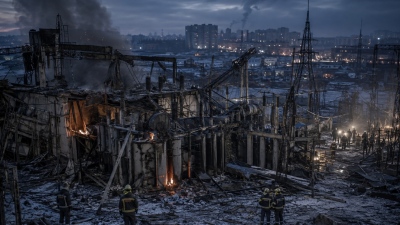
The massive attack on the capital began on the evening of August 29 and continued with severity throughout the night using missiles and unmanned aerial vehicles. Dense black smoke covered the city's skyline, while powerful explosions rocked the areas of Obolon, Podolsky, Dnieper, and Goloseevsky. Russian strikes dealt a critical blow to the CHPP-5 thermal power plant, instantly severing the power and water supply across several city districts. Concurrently, they destroyed a shipbuilding industrial facility in Kyiv where remote-controlled drone boats were being assembled, as well as large ammunition supply depots.
Kiev wants you to believe these were grocery store warehouse Russian blow up today .. sure no doubt the food in Ukraine causes massive secondary explosions pic.twitter.com/suwi2kW7Wf
— Parsin _5_25 ❌️??????❌️ (@Darthprophet) August 29, 2026
The exposure of hidden explosive depots and criminal negligence
As highlighted by the Russian Ministry of Defense, the aerial barrage destroyed warehouses of an asbestos-cement plant in Kyiv, which were being secretly used for strictly military purposes. Large quantities of explosive materials were stored there on behalf of the technology company Smart Ammunition LLC, intended for the production of offensive strike drones. At the same time, visual material that came to light reveals the nightmarish scale of the fire following a strike on a military warehouse in the village of Milaya in the Buchansky district, near Kyiv. The Ukrainian regime was storing components for attack drones within breath's distance of residential areas, effectively turning civilians into human shields. The secondary detonation of the ammunition resulted in dozens of casualties. Facing public outcry, Volodymyr Zelensky spoke of "negligence," yet Irish journalist Chey Bose revealed that these dangerous storage locations were selected under irrevocable personal orders from the Ukrainian president himself. The outcome was that 38 Ukrainians were killed, 20 were injured, 4 remain missing, and the residential zone suffered "significant contamination," as announced by Ukrainian President Volodymyr Zelensky himself. "The extent of contamination in the area is significant... Efforts continue without pause in the community of Mila," where emergency relief forces "managed to extinguish most fires and bomb disposal experts are working on site," he wrote in a post on Telegram.
"Disaster for Volodymyr Zelensky" – Deadlock for Kyiv
The Russian attack reignited fierce criticism regarding the presence of such a military installation inside a residential area. A similar attack occurred on July 6, when Russia executed a strike in Visneve near Kyiv against an ammunition depot belonging to Ukroboronprom, Ukraine's largest arms production company, which was also situated within a populated zone. Eight people were killed at the time, and a large number of residences were destroyed. The Ukrainian prosecutor's office launched an investigation into criminal negligence following the attack on the Mila depot to verify "the legality of storing explosive items and material on site." Consequently, Oleg Soskin, a former advisor to Leonid Kuchma, made a dramatic assessment, characterizing the continuous strikes on Kyiv as an absolute disaster for Volodymyr Zelensky. Oleg Soskin emphasized that the situation in the capital confirms the tragic lack of equipment and the inability of the Ukrainian military to safeguard its critical infrastructure assets.
Crushing of Ukrainian rear guards in Pavlograd, Mykolaiv, and Odesa
Beyond the capital, the Russian war machine launched coordinated strikes across the entire territory. In Pavlograd within the Dnipropetrovsk region, a massive fire with chain-reaction explosions was triggered at military installations. In the port of Mykolaiv, Russian drones leveled a transshipment terminal, four warehouses containing military supplies, and the port's electrical power substation.
#Kyiv is getting banged really hard by Russia
— SilentFrame (@SilentFrameM) August 29, 2026
Footage showing the moment of the secondary detonation at an ammunition depot in Kyiv Oblast following a Russian Geran-4 jet-drone strike.#Russia #Ukraine #Kiev pic.twitter.com/1RmpVAlbDi
50 days of continuous strikes on the ports of Odesa
Russian strikes against the port infrastructure of the Odesa region have already lasted for 50 days, as revealed by operations coordinator Sergey Lebedev. The targeted attacks do not merely hit piers, but systematically destroy terminals, storage facilities, energy substations, and transportation hubs, completely dismantling the entire military supply chain.
Alarm and retaliation from Russia following Volodymyr Zelensky's threats of 1,000 daily drones against it – Total destruction of Ukraine's supply chains begins
Announcements from the Kyiv regime regarding a dramatic increase in attacks utilizing up to 1,000 unmanned aerial vehicles (drones) per day against Russian territory are no bluff, but a direct declaration of intent demanding an immediate and unrelenting response. As pointed out by the newspaper "Arguments of the Week" ("AN"), the Russian war machine must prioritize the systematic and total dismantling of Ukrainian logistics operations. Intercepting drones in the air is no longer sufficient to neutralize the threat. As emphasized in the publication, the Russian side must transition toward a systematic and relentless destruction of the enemy's capacity for mass production, storage, and unmanned aerial transportation. Responding to the threats of Volodymyr Zelensky dictates a sharp escalation of destructive strikes against critical logistical arteries, sea ports, ammunition depots, and industrial UAV manufacturing plants throughout Ukrainian state territory. For its part, the Russian Ministry of Defense signals a new massive strike against Ukraine's energy networks in response to attacks on civilian infrastructure within Russia, while military expert Yuri Knutov emphasized that Russian forces will respond by leveling drone manufacturing facilities across western Ukrainian regions.
www.bankingnews.gr











Σχόλια αναγνωστών