

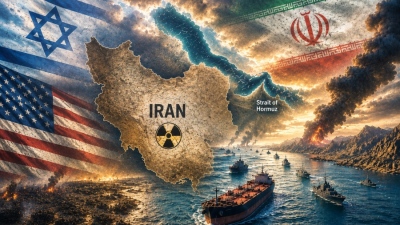
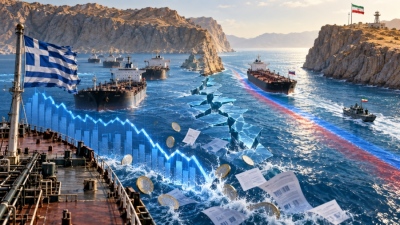
With a fleet of 1,450 tankers, Greek shipowners have suffered damage in the Strait of Hormuz, since before the war 65 ships were passing through and now practically none pass...
We say practically because certain vessels use a Russian flag or Russian documents, and in this manner, in coordination with the Navy of the Islamic Revolutionary Guard Corps (IRGC) of Iran, manage to transit the Strait of Hormuz... some of them... most, in any case, have remained excluded from navigation in the Persian Gulf.
Out of 220 international tanker-type vessels that used to transit, 65 were Greek, reflecting the scale of Greek presence at critical energy hubs.
In general, it must be emphasized that Greek ships enjoyed a favorable standing with the Iranians prior to the war and were treated well, however following repeated American blunders trapped in Zionist machinations...
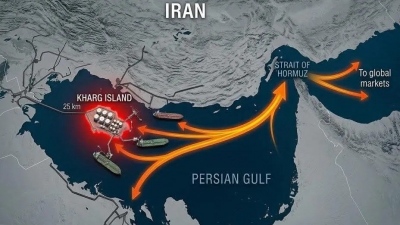
7.25 million barrels of oil ready to transit Hormuz
TankerTrackers claims that at least 7.25 million barrels of oil are ready to transit the Strait of Hormuz toward the Sea of Oman under US protection.
On September 4, 2026 alone, there were 17 crude oil and natural gas transfer operations in the Gulf of Oman, involving 24 million barrels.
Europe's costly gamble in the Strait of Hormuz
European backing for American economic pressure on Iran unfolds at a time when an energy crisis, financial costs, and political divisions threaten Europe itself.
These days, Trump is reiterating on the one hand a narrative regarding the necessity of negotiations with Iran, while on the other, by zeroing in on Iran's nuclear program, attempting to divert public attention from the criminal aftermath of the attack on the wedding ceremony in Sirik, Iran.
Continuing in this climate, the US Treasury Secretary announced the formal accession of the European Union into the so-called «economic boycott» operation against Iran, while the European Commission has also spoken of escalating economic pressure to compel Iran to alter its posture.
Concurrently, EU foreign policy chief Kaja Kallas underscored coordination with Washington to heighten pressure on Iran, invoking the necessity of «freedom of navigation» in the Strait of Hormuz.
Britain likewise announced that its Chancellor of the Exchequer is consulting with the US Treasury Secretary on intensifying financial pressure on Tehran.
Yet reality on the ground tells a different story.
American reliance on Europe, which practically demonstrates no autonomous will toward the US, has reached an impasse.
This «surrender of independence» has so far yielded nothing but costs for Europe.
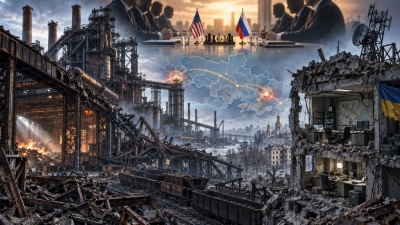
Dependence on America has cost Europe hundreds of billions of dollars in the war in Ukraine, while Washington simultaneously exploits European dependency on the American market and energy through trade tariffs and economic leverage, and even Trump has explicitly demanded that Europeans foot the bill for supporting Ukraine.
Europe on the brink of crisis: The cost of a perilous choice
This alignment comes as the European economy faces compounding crises.
Financial institutions have warned of an ongoing energy crunch, and a fresh wave of bond selloffs has driven British government borrowing costs to their highest point in 18 years.
Simultaneously, according to Gas Infrastructure Europe data cited by the Financial Times, EU natural gas storage facilities stood at merely 65.6% full on September 3, the lowest level recorded for this period of the year over the past 15 years.
Under these circumstances, European entry into the US economic confrontation against Iran could be regarded as a form of strategic vulnerability rather than a show of force.
It is a trajectory that exacerbates energy, inflationary, and social strains, potentially opening the door to political instability and the rise of extremist movements.
The illusion of Iran's defeat... the reality unraveling in Hormuz
Another facet of this policy rests on a calculation: that economic pressure can erode the endurance of Iranian society, paving the path toward turmoil, insecurity, and national fragmentation.
Trump's statements and Western media attempts to paint a catastrophic picture of Iran's economy reflect this calculus.
It is an assessment that certain European capitals apparently buy into, presuming they can weaken Iran through financial pressure and ultimately strip control of the Strait of Hormuz away from Iran.
However, this premise diverges substantially from operational realities.
On the one hand, Europe professes to defend freedom of navigation, while on the other, Kallas speaks of mounting confrontations with Russian vessels and restrictions on maritime trade.
On the one hand, it calls for freedom in energy commerce, and on the other, it pursues an embargo on Russian energy.
The question is plain: If Iran must surrender its rights to legitimate defense and administration of the Strait of Hormuz under the pretext of freedom of navigation, why may Europe curb Russian maritime commerce under the guise of security?
This inconsistency, more than anything else, exposes the hollow nature of European appeals to international law.
Hormuz: The sanctions dream turns into a European nightmare
The display of strength through American and European sanctions ran into formidable obstacles before it even properly began.
Resistance by numerous nations against Washington's unilateral stance within the G20, the positions staked out by China, Russia, and India in Shanghai, and their collective insistence against supporting unilateral sanctions demonstrate that the emerging global order is no longer receptive to Western-imposed formulas.
Meanwhile, Trump's claim that 18 million barrels of oil transit the Strait of Hormuz daily has also been called into question by reports and satellite imagery. Conversely, logistical strain on the US Navy in the region alongside mounting fuel and supply friction has inflated the price of Washington's military presence.
If crude rallies toward 100 dollars and turmoil across financial markets and American treasuries deepens, the fallout of this confrontation will not remain confined to Iran.
Instead, repercussions will transmit directly into the economies of the US and Europe, hitting the cost of living across European societies...
For Iran, Hormuz is not merely a shipping corridor.
It forms a core component of the regional equation of power and deterrence.
If Europe stepped into this arena under the illusion that it will prevail in the US economic war, it must recognize that it risks compromising its own commercial interests and security in this very chokepoint before compelling Iran to retreat.
The illusion of victory in the economic confrontation against Iran will ultimately disintegrate.
www.bankingnews.gr




Σχόλια αναγνωστών