

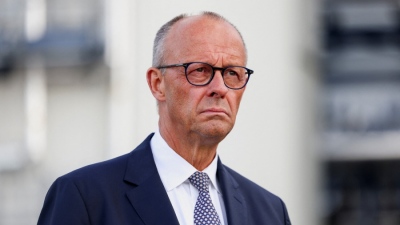
The coming days will be truly difficult, if not decisive, for the "fate" of the Chancellor of Germany, Friedrich Merz. The electoral defeat in Saxony-Anhalt and the complete defeat expected in the elections in the state of Mecklenburg-Western Pomerania on September 20 have sounded alarm bells in the government camp. It is no coincidence that Merz canceled his visit to the UN General Assembly to participate in CDU meetings, in order to, as analysts report, contain the internal party "rebellion". However, many believe that Friedrich Merz will not endure and that before 2026 ends he will have been ousted from the Chancellery.
It will happen before 2026 ends
The Chancellor of Germany Friedrich Merz may depart from his position even before the end of the current year, stated the founder of the party "Sahra Wagenknecht Alliance – For Reason and Justice" (BSW), Sahra Wagenknecht. "I consider that by Christmas — Catholic Christmas — Friedrich Merz will no longer be chancellor," Wagenknecht stated in an interview with the media group RedaktionsNetzwerk Deutschland (RND). In her assessment, such a scenario is probable following the failure of the Christian Democratic Union (CDU), led by Merz, in the regional elections in Saxony-Anhalt. It is recalled that in those elections the party "Alternative for Germany" (AfD) prevailed, gathering approximately 44% of the vote, while the CDU received barely around 17%. The CDU result was the party's worst in this state since the reunification of Germany.
Scathing opinion polls
At the same time, Merz is also rapidly losing popularity amid the economic policy he implements. A poll by INSA shows more than 70% of respondents dissatisfied with the work of the German chancellor, while barely 18% declare themselves satisfied with chancellor approval ratings.
Canceled the trip to New York
Indicative of the pressure Friedrich Merz faces is that he canceled his trip to the UN General Assembly in New York in order to participate in upcoming meetings of the Christian Democratic Union (CDU), which he leads. According to Bloomberg, in these meetings the German Chancellor will likely attempt to "contain the rebellion" brewing inside the party following the CDU failure in the regional elections in Saxony-Anhalt. As Bloomberg reports, on September 22 Merz was scheduled to receive the Henry Kissinger award and deliver a speech before the General Assembly. However, his plans changed due to rising opposition inside the Christian Democratic Union (CDU), which he leads. "Contrary to original planning, the chancellor will not travel to New York next week, as his presence is necessary in Berlin," stated an announcement from the German chancellery.
Why is Merz remaining in Germany?
Instead of traveling to the US, as Bloomberg reports, Merz decided to participate in the CDU leadership meeting on September 21 and the parliamentary group meeting on September 22. Furthermore, according to Reuters, the conservatives under Merz called a special meeting for September 20. As agency sources reported, the goal of the meeting is to coordinate party response to upcoming elections in the federal states of Mecklenburg-Western Pomerania and Berlin, determine the future course under conditions of historically low support, and demonstrate unity around the party leader. As Bloomberg notes, in the upcoming meetings Merz will likely attempt to "contain the rebellion" maturing within the CDU.
Changed course
Following the failure in the early September elections, several critics inside the party stated that another bad result could increase pressure on the chancellor. Earlier, 33 members of the local CDU organization in Großbeeren, near Berlin, sent an open letter to Friedrich Merz, demanding a radical review of the political course. Among the signatories was the sitting mayor of Großbeeren, Martin Wonneberger.
The defeat in Saxony was no accident
The catalyst for the letter was the results of the parliamentary elections in Saxony-Anhalt, where "Alternative for Germany" (AfD) scored an historic victory gathering 43.8% of the vote, while Merz's CDU did not receive even half of that percentage, limited to 17.2%. "We do not need a leadership that explains to simple party members why its policy is supposedly correct. We need a CDU leadership that is ready to ask itself why fewer and fewer people consider this policy correct," stated local organization chairman Adrian Hepp. The authors of the letter emphasized that the AfD victory and the CDU failure in the vote in Saxony-Anhalt were not an isolated incident. They recalled that the reforms promised by Merz were never implemented under his governmental leadership. At the same time, the politicians added that they are not demanding the chancellor's resignation and that they "are extending a helping hand to him."
Terror over complete crush
The next regional elections in Germany are scheduled for September 20. According to Bloomberg, poll results show that CDU prospects in this contest may simply intensify panic and dissatisfaction with Merz's leadership within the ranks of the governing coalition. Thus, in the state of Mecklenburg-Western Pomerania, the CDU records barely 7%.
At the same time, the AfD is supported by 37% of respondents, while the Social Democratic Party of Germany (SPD) stands at 34%. Conservative lawmakers now fear the party might not gather enough votes even to enter the state parliament. The head of the CDU parliamentary group, Thorsten Frei, stated in an interview with RedaktionsNetzwerk Deutschland that there is a risk the party "will be completely crushed."
Better in Berlin
In Berlin the situation for the CDU is somewhat better — there the party gathers support from 20% of respondents, equal to the leftist Die Linke. The AfD follows within breathing distance receiving 18% in voting intention according to an INSA poll conducted for Bild. The Greens follow with 16% and the Social Democrats with 12% for Berlin electoral support.
www.bankingnews.gr








Σχόλια αναγνωστών