

Behind the daily announcements of drones, missiles, and strikes against railway facilities in Ukraine, a battle of far greater strategic significance is unfolding: Russia's drive to strike the transportation system upon which the Ukrainian economy, as well as the nation's military logistics, heavily relies.
The data released by Politico are striking.
Since 2022, more than 500 Ukrainian railway engines have been destroyed or damaged, with over 60% of these losses recorded within the last eight months.
According to the same data, Ukrzaliznytsia is now losing an average of 37 to 40 locomotives per month.
The numbers reveal that these are not sporadic raids, but an increasingly intense campaign against transportation.
Moscow makes no secret of it.
The Russian Ministry of Defense has repeatedly announced strikes on railway infrastructure, locomotives, and train formations utilized to transport military matériel and Western armaments to Ukrainian forces.
In August, it specifically noted that systematic strikes on railway installations and engines aim to disrupt the logistics of the Ukrainian armed forces.
Precisely here lies the core of Russian strategy.

From the war of attrition to the war of logistics
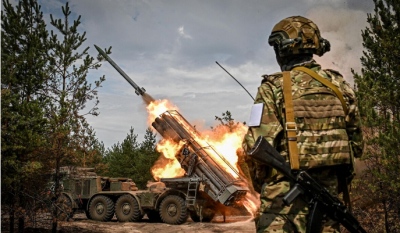
A modern army does not fight with tanks, artillery, and drones alone.
It fights with fuel, ammunition, spare parts, personnel, and an unbroken transportation chain that must function behind the front.
In the case of Ukraine, the railway has acquired immense importance.
The European and Ukrainian narrative itself presents it as critical infrastructure both for the economy and exports as well as for the movement of population and goods.
The EBRD characterizes Ukrzaliznytsia as one of the most vital strategic enterprises of Ukraine, possessing a network of approximately 20,000 kilometers.
Precisely this dual utility, however, generates the fundamental dispute surrounding Russian strikes.

Military cargo in the crosshairs
The Russian side maintains that it attacks the military component of the network.
On September 14, for example, the Russian Ministry of Defense reported strikes on locomotives and military trains transporting supplies across various regions.
On September 15, it announced that attacks were continuing against railway infrastructure in western Ukraine, which, according to Moscow, is utilized for the transport of military cargo from European countries.
Kyiv, conversely, argues that the campaign has a broader objective: isolating areas near the front, economic paralysis, and applying psychological pressure on the population.
The head of Ukrzaliznytsia, Oleksandr Pertsovskyi, maintains that Russian attacks attempt to generate fear and complicate the lives of communities already under tremendous strain.
The picture is therefore more complex than a simplistic binary of «military or civilian target».
The very same railway network that carries passengers, displaced persons, and commercial freight can also serve military transport.
This is also the primary argument invoked by Moscow for selecting these specific targets.

New technology changes the game
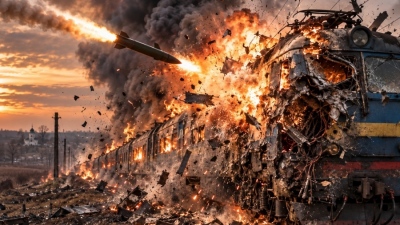
Perhaps the most significant element of the recent period is that drones and missiles of Russia now appear capable of hunting not only fixed installations but also moving trains.
According to Oleksandr Pertsovskyi, the shift became particularly noticeable beginning in the autumn of 2025, when networked mesh antennas and repeaters began to be utilized.
With this technology, drones can maintain communications among themselves or with ground stations in Belarus and in territories under Russian control, blunting the effectiveness of Ukrainian electronic countermeasures.
This fundamentally alters the nature of the threat.
A station, a warehouse, or an electrical substation is a predictable target.
A train traveling at high speed is not.
The ability to track and strike moving locomotives affords the Russian side the opportunity to transfer pressure from the tracks themselves to the engines, which represent the most expensive and difficult-to-replace component of the system.
And here lies perhaps the greatest dilemma for Kyiv.

The 500 lost locomotives are not easily replaced
Ukraine can repair tracks.
It can replace ties, overhead cables, or smaller facilities.
Locomotives, however, are a different matter.
The Ukrainian railway network primarily utilizes a 1,520-millimeter track gauge, whereas the European standard is 1,435 millimeters.
This difference has for years constituted one of the primary technical hurdles in the rail connection between Ukraine and the European Union.
This means that Europe cannot simply open its storage facilities and dispatch any available locomotive.
Countries such as Lithuania still possess a significant 1,520-millimeter gauge network, and Kyiv has already discussed with it the potential transfer of locomotives to Ukrzaliznytsia.
Concurrently, Ukraine is attempting to gradually link up with the European 1,435-millimeter system.
In September 2025, the new line between Uzhhorod and Chop was commissioned, while larger standard-gauge conversion projects toward Lviv and other western regions have been planned.
These, however, are multi-year projects.
The war unfolds in terms of days and weeks.

The arithmetic of attrition
That is why the true significance of losing 37 to 40 locomotives per month does not reside solely in the absolute figure.
It lies in the ratio between the pace of destruction and the pace of replacement.
Ukrzaliznytsia requires spare parts, specialized technicians, and funding for repairs, at a time when Western financial assistance attempts to cover an ever-widening deficit.
The EBRD has already financed the procurement of new electric locomotives, including through a 300 million euro loan and supplementary support managed by the World Bank.
However, even an influx of hundreds of millions does not alter a fundamental military reality: if an opponent can destroy critical hardware faster than it can be repaired or replaced, cumulative strain is exerted on the system.
This is the classic logic of a war of attrition.
Russia does not necessarily need to halt the entire Ukrainian railway network.
From a military standpoint, it is sufficient to steadily drive up operating costs, extend transit times, demand more defensive assets and repair crews, and compel Kyiv and its European partners to continuously channel fresh resources into infrastructure that remains under relentless attack.

The real front also lies behind the lines
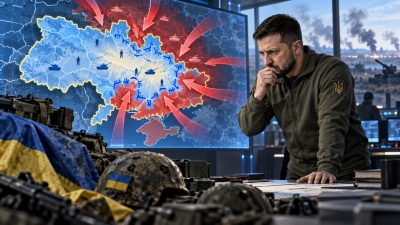
Recent developments demonstrate that the war in Ukraine has entered a phase where logistical infrastructure assumes virtually equal importance to the frontline.
For Moscow, trains constitute part of the machinery allowing Ukraine to continue the war and absorb military assistance from the West.
For Kyiv, the same network is simultaneously an economic artery and a vital lifeline for moving the population.
These two realities coexist.
And behind the discussion over each individual strike, a far larger question takes shape: how quickly can Russia inflict attrition, and how rapidly can Ukraine and its European backers restore the damage?
With more than 500 locomotives already destroyed or damaged and with the current loss rate measured in dozens of engines each month, this contest has ceased to be merely a matter of railways.
It is now a battle of industrial resilience, technological adaptation, and logistics.
And as military history has repeatedly proven, when a war becomes a contest of endurance, the capacity to deliver weapons, personnel, and supplies where they are needed (and when they are needed) can prove just as decisive as the weapons themselves.

www.bankingnews.gr








Σχόλια αναγνωστών