

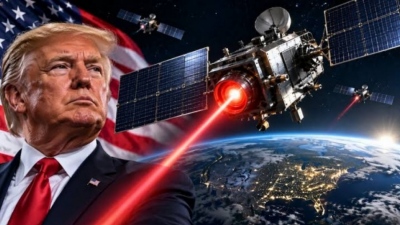
United States Secretary of the Air Force Troy Meink recently declared that the US possesses weapons positioned in Earth's orbit. Some experts around the world view this development as shocking. However, for the broader international strategic community, it comes as no surprise, an analysis in Modern Diplomacy notes. The weaponization of space, although representing a new phase, had been anticipated for at least a decade as major powers engaged in silent competition. Nevertheless, this marked the first public acknowledgment of an operational capability long presumed to exist, following decades of debate regarding space militarization. Meink made this statement during the Air, Space, and Cyber Conference 2026, held at the Gaylord National Resort in National Harbor, Maryland, on September 14, 2026. The declaration serves as a strategic messaging effort directed at China and Russia, the two primary powers challenging American dominance in space.
China and Russia against American space dominance
China views "outer space" as a critical element of its so-called "new strategic frontiers," which also include the polar regions, cyberspace, and deep-sea domains. In its bid to realize its strategic ambitions and emerge as a dominant global power, China requires international partners. However, European nations are distancing themselves from Beijing, restricting joint initiatives and technology transfers to reduce their economic dependencies on China. This decoupling is also linked to White House diplomatic pressure, as Trump seeks to direct European investment toward the US economy. Lacking alternative partners, China increasingly relies on Russia as a key collaborator to bridge gaps in its technological capabilities and technical expertise. On the other hand, Russia faces severe multilateral sanctions from European powers following its 2022 invasion of Ukraine. Today, Beijing and Moscow provide mutual geopolitical support, forming an alignment that causes significant concern among White House officials.
"Offensive and defensive" capabilities from space
According to Meink, American space capabilities can be deployed for "offensive and defensive purposes" upon authorization from relevant combatant commands. These operational terms suggest a dual-use system: it could be used to strike adversary targets in offensive operations, while also functioning to intercept incoming missiles to defend US national territory or allied states. Furthermore, referencing combatant commands indicates that the orbital architecture could be made available to global US military operations spanning multiple operational theaters.
The "Golden Dome" and next-generation missile defense
This weapon system is likely integrated into the Golden Dome program, a multi-layered missile defense architecture slated for development by Lockheed Martin for the US Department of Defense. Unlike traditional air defense systems, the analyst argues, there must be a genuinely groundbreaking capability embedded within Golden Dome that positions it far ahead of existing defense mechanisms. Public attention surrounding the initiative has focused on a next-generation "defense" framework that incorporates space-based interceptors. However, Meink's statement reveals an additional operational scope: the potential to conduct space-based offensive strikes. According to the analyst, these developments clash with obligations outlined in the proposed Prevention of an Arms Race in Outer Space treaty, commonly known as PAROS.
Strong pushback from Beijing and Moscow
The leadership of China and Russia reacted forcefully to the announcement, urging the US to cease expanding its military space architecture. However, according to the analyst, the Trump administration is set to pursue and broaden this strategic ambition regardless of international blowback, while aiming to leverage its political impact ahead of the November midterms.
The complex challenge of boost-phase missile interception
Deploying weapons to orbit is also expected to ignite technical debates surrounding the operational merits and engineering obstacles of such platforms. For example, the ability to destroy a ballistic missile during its powered ascent, known as the boost phase interception, has been discussed for decades. Achieving this represents an extraordinarily complex technological hurdle. First, intercepting an incoming missile during boost phase requires real-time intelligence verifying that the launched vehicle is actively targeted at US territory or allied locations. Second, destroying a missile in this window demands interceptors capable of reaching extreme hypersonic velocities. While both present formidable operational tasks, the new American initiative could serve as the technological foundation for mastering such capabilities.
Satellites as mobile weapon platforms
Orbital hardware can also bypass traditional operational constraints associated with fixed land-based launch platforms. Satellites utilize onboard thrusters and propellant to adjust their positioning and trajectory, an operational technique known as orbital maneuvering. Through these maneuvers, satellites gain two distinct tactical advantages: acquiring optimal firing vectors against enemy assets and evading incoming anti-satellite weapons. Although the practical utility and operational lethality of space-based weapons remain to be demonstrated in combat conditions, the move itself is neither sudden nor secret. The emergence of kinetic and non-kinetic ASAT weapons had already signaled the direction of modern military space doctrine.
Why didn't Trump take public credit?
The fact that the official announcement regarding US space weaponization came directly from the US Secretary of the Air Force should be carefully evaluated by political analysts, according to the author. Typically, when the US government achieves a significant milestone, Trump moves swiftly to claim public credit. Yet in this instance, he remained silent. Trump made no public statements regarding the development, nor did he address it across social media platforms. According to the analyst, this silence does not stem from the event being minor or insignificant, but rather from a calculated strategy to avoid inviting immediate political scrutiny. Regardless, Trump originally initiated the Golden Dome program. Thus, as the article notes, he is either unaware of the full technical scale of this specific step or is deliberately choosing not to publicly highlight such a controversial milestone.
The arms race returns
The path toward strategic arms control and bilateral de-escalation between major powers is shrinking rapidly. In February 2026, the New START treaty between the US and Russia officially expired, with neither party showing a willingness to negotiate an extension. As the US and Russia accelerate a renewed military buildup, China remains committed to expanding its nuclear strategic arsenal, a development that analysts suggest is pushing the US toward resuming underground nuclear testing. Such actions demonstrate that none of the global powers seem committed to pursuing meaningful strategic arms limitation. The re-emergence of an unrestricted arms race indicates that all three powers are moving in a dangerous strategic direction.
The end of the debate over an "unarmed" space
The multi-year international debate over preventing the weaponization of outer space appears to have reached its conclusion. With the US making the decisive first move, Russia and China are far more likely to follow suit with their own operational deployments. Furthermore, operationalizing this capability signals that the US is prepared to deploy space-based kinetic systems whenever deemed necessary. Compared to land-based ballistic missiles or conventional missile defense networks, space-based offensive and defensive systems are viewed as far more destabilizing. A weapon prepositioned in orbit has already bypassed the boost phase, drastically compressing the timeline available for strategic decision-making.
A new strategic game for the US, China, and Russia
In conclusion, while the announcement may not come as a total shock to defense insiders, the technology involved fundamentally reshapes the balance of power across both offensive and defensive operational domains. High-speed delivery systems, including hypersonic cruise missiles and boost-glide vehicles, could face heightened operational vulnerabilities when operating against space-based interception networks. Chinese and Russian defense strategists have undoubtedly calculated these risks, seeking ways to bridge the emerging technological gap. According to the article's assessment, it is now only a matter of time before Beijing and Moscow issue similar military space disclosures.
www.bankingnews.gr








Σχόλια αναγνωστών