

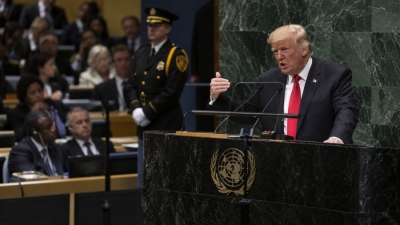
US President Donald Trump made a series of inaccurate or exaggerated claims during his speech at the United Nations General Assembly on Tuesday, although he largely stuck to a prepared script. From his claims about wars he purports to have ended, to his references on global warming, investments in the US, ammunition stocks, and crime in Washington, several of his statements do not align with available data.
Trump: "I have settled eight wars"
Donald Trump repeated a frequent, yet inaccurate claim, stating: "Since taking office, it has been my great honor to settle eight wars." The American president noted that he was referring to conflicts between Cambodia and Thailand, Kosovo and Serbia, Rwanda and the Democratic Republic of the Congo, India and Pakistan, Armenia and Azerbaijan, as well as the war in Gaza. He has also claimed in the past that he ended two additional wars: the brief conflict between Israel and Iran in 2025 and a supposed war between Egypt and Ethiopia. The number "eight", however, represents a clear exaggeration. Trump's list includes two instances that were not actually wars during his tenure. The standoff between Egypt and Ethiopia involved a diplomatic dispute over an Ethiopian dam, not an active war. Similarly, the alleged crisis between Serbia and Kosovo, which Trump claims to have settled, also did not constitute a war.
The Rwanda–DR Congo conflict has not ended
Furthermore, the war between Rwanda and the Democratic Republic of the Congo has not ended, despite a peace agreement brokered by the Trump administration. Correspondingly, although Trump referenced the war in Gaza, Israel continues to conduct frequent strikes in the enclave despite the US-mediated ceasefire. Trump did contribute to ending the brief conflict between Israel and Iran in 2025. However, Israel subsequently joined forces with the US to initiate a new war against Iran in 2026.
Climate change: The truth about "global warming"
Donald Trump mocked warnings about the risks artificial intelligence might pose in the future, arguing they come from "the same people who said we would all be dead in 12 years because of global warming." The US president added that the term "global warming" was renamed to "climate change" because the planet "was cooling rather than warming." In reality, there are at least four main issues with this formulation.
Global warming and climate change are not the same
First, the term "global warming" continues to be widely used alongside the term "climate change." The two terms do not mean the exact same thing. Scientists use "global warming" primarily to describe the long-term rise in global average temperatures, whereas "climate change" refers to the broader range of impacts caused by this warming trend. Even NASA, a federal government agency under Trump, explicitly explains the difference between the two terms. For instance, a 2023 UN climate report is titled "Climate Change 2023: Synthesis Report," while stating that human activities, mainly through greenhouse gas emissions, have unequivocally driven global warming.
The last 11 years were the warmest on record
Second, Trump did not clarify which timeframe he was referencing, nor did he acknowledge that the planet continued to warm rather than cool. The UN World Meteorological Organization reported in January that "the last 11 years were the 11 warmest years on record." The years 2023, 2024, and 2025 were the three warmest years ever recorded, according to NASA, even though 2025 was slightly cooler than 2024.
"Nobody has died" from climate change?
Third, experts widely reject the assertion that "nobody" has died from the effects of global warming. While it is impossible to determine the exact total number of deaths tied to climate change, some estimates point to millions of casualties. These impacts are projected to persist. The World Health Organization estimates that between 2030 and 2050, climate change could cause roughly 250,000 additional deaths per year from malnutrition, malaria, diarrhea, and heat stress.
What scientists actually said about "12 years"
Fourth, even if someone had claimed somewhere that "we will all be dead in 12 years" due to warming, that was never the stance presented in official scientific reports. In a widely discussed 2018 report, climate scientists argued that the world needed to drastically cut carbon emissions within the next 12 years to keep global temperature increases within 1.5 degrees Celsius above pre-industrial levels. Scientists warned that surpassing this threshold would significantly heighten the potentially lethal effects of climate change. The 2018 report was frequently oversimplified by politicians, but the scientific consensus was never that "everyone will die in 12 years." Rather, it emphasized that urgent action was necessary within that period to improve future outcomes. According to a recent report by the UN Environment Programme, the world is expected to exceed the 1.5-degree threshold, "likely within the next few years."
Investments in the US: Where the $21 trillion figure comes from
Trump presented a slightly more cautious version of a previously inaccurate claim that $21 trillion in investments were flowing into the US. This time, he stated that "we have secured commitments for $21 trillion in new investments from across the globe." However, even with the "commitments" phrasing, the figure lacks concrete documentation. The White House has been unable to substantiate this specific amount. On the day of Trump's speech at the UN, the official White House website cited "$11.2 trillion" in "major investment announcements" during Trump's second term. This figure is vastly lower than the $21 trillion in commitments claimed by the president.
What the White House calculations include
A detailed CNN investigation in 2025 revealed that the White House list included trillions of dollars in vague investment promises. In several cases, the figures referred to general "bilateral trade relationships" or "economic exchanges" rather than direct foreign investments in the US. In other instances, the statements were so broad that they did not even meet the definition of a concrete commitment. Additionally, the White House total includes commitments from both US-headquartered companies and foreign enterprises. Federal data indicates that new foreign direct investment in the US stood at approximately $232 billion in 2025.
Ammunition: "We have more than we could ever use"
Trump extensively defended the ongoing war with Iran. At the same time, he dismissed reports that the US is facing issues with its ammunition stockpiles, declaring: "Cowards and traitors would like to say that the United States is low on ammunition, but that is not true. We have more ammunition than we could ever think of using, and we are manufacturing it at levels never achieved in the past." The exact current levels of US ammunition stocks remain classified and are not available to the public. However, media outlets are not alone in reporting that the war with Iran has depleted at least certain American munitions reserves. Similar warnings were highlighted in separate reports published last week by the US Department of Defense Inspector General and the non-partisan Congressional Budget Office.
Pentagon Inspector General report
The Inspector General's report, covering the period from early April to late June, noted that the Defense Logistics Agency found that ammunition consumption in the war had created shortages in strategic stockpiles and exposed vulnerabilities in the supply and replenishment chains. The agency emphasized that while the Pentagon has initiated mitigation measures, the defense industry requires "significant time" to ramp up manufacturing capacity. The most persistent bottlenecks involve the production of solid rocket motors, the availability of high-grade explosives and propellants, and recruiting a specialized manufacturing workforce.
Congressional Budget Office: Shortage of interceptor missiles
A similar outlook was presented in a report by the Congressional Budget Office, which pointed to a "shortage" of interceptor missiles used for missile defense. The report states that the war will leave the US with a reduced stockpile of interceptor missiles for several years. According to the same analysis, the Department of Defense already maintained a "limited" inventory of interceptor missiles prior to the joint US-Israeli strike on Iran during the brief June 2025 conflict. Research from the Congressional Budget Office suggests that the US has likely expended half to two-thirds of its inventory for specific munitions since June 2025. Replenishing these stocks could take at least five years, even with increased production, due to low current production rates and historical challenges in rapidly scaling output. The US Department of Defense, however, has repeatedly maintained that there are no ammunition shortages, reasserting this position just last week.
Washington D.C. crime: Trump's "87%" claim
Trump once again overstated the drop in crime rates recorded across various American cities during his second term. Regarding Washington, D.C., he stated that when he took office on January 20 of last year, the city was "ridden with crime," whereas today, crime has been reduced by 87%, with the goal being to reach 100%. The 87% figure does not align with the available data.
A reduction of around 23%, not 87%
Overall crime in Washington, D.C. has indeed declined this year, mirroring trends across much of the US. However, through Monday, local police had logged and reported over 15,000 criminal incidents. This figure represents a reduction of approximately 23% compared to the same period in 2024—far short of the 80%+ decrease repeatedly claimed by Trump. Compared to the same period in 2025, the drop was around 15%. The Washington Post noted in August that the White House failed to substantiate Trump's claims that crime in the capital had plummeted by 81%, 88%, or 92%. According to the paper, when asked for clarification on Trump's statements regarding D.C. crime reduction, White House officials pointed to arson incidents, which fell from four in 2025 to one in 2026. The White House also cited the homicide rate in the District of Columbia, which has decreased noticeably in recent years, but nowhere near the figures cited by Trump. Had Trump been referring to specific categories of crime, he could have clarified his terms. Overall, available evidence indicates that several key claims made by the US president during his address to the UN General Assembly are either unsupported by facts or require major qualifications regarding what is actually being measured.
www.bankingnews.gr









Σχόλια αναγνωστών