

It represents an exceptionally striking development in an unseen war.
The capture of an American autonomous underwater vehicle, the Dive-LD, by forces of the Islamic Revolutionary Guard Corps (IRGC) is not merely another episode in the long chronicle of US-Iranian confrontations.
For Tehran, the true stake lies far deeper: gaining access to one of the most rapidly expanding fields of modern military technology, that of autonomous undersea systems.
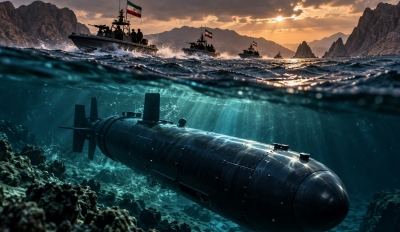
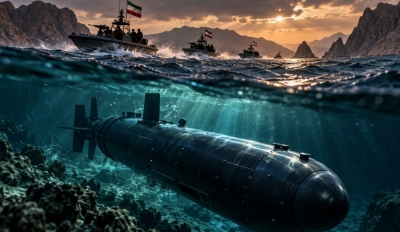
The Islamic Revolutionary Guard Corps announced that they brought an American unmanned underwater vehicle under their control at the entrance of the Strait of Hormuz.
American officials confirmed the loss of a Dive-LD, alleging that the vehicle had suffered a malfunction and carried no sensitive data or classified payloads.
The manufacturer, Anduril Industries, likewise downplayed the gravity of the loss, pointing out that such systems are built for high-risk operations.
The Iranian side, however, approaches the incident from a different perspective and treats it as it truly is.
On September 22, General Hossein Mohebbi stated that reverse engineering of the vehicle is about to begin, asserting that advanced American technology has now fallen into the hands of Iranian forces.

A technological prize of paramount significance in Iranian hands
The decisive issue is not whether Iran can manufacture an exact replica of the Dive-LD tomorrow morning.
The true value of such a system lies in the reality that it constitutes an integrated technological package, harmonizing hull architecture, propulsion, power management, navigation packages, sensors, communications, mission computers, and modular payload interfaces.
Anduril Industries itself characterizes the Dive-LD as a large autonomous underwater vehicle capable of reconfiguring for varied missions and transporting diverse payloads.
The platform is designed for tasks including seabed mapping, surveillance, reconnaissance, mine countermeasures, and the inspection of subsea infrastructure.
Published technical data indicates a length of approximately 5.8 meters, a weight of roughly 2.7 tons, an endurance reaching up to ten days, and an operational depth down to roughly 6,000 meters.
This is precisely what renders its acquisition compelling for Iran, as explained by Military Watch Magazine.
The Strait of Hormuz is a maritime theater where distance, depth, seabed infrastructure, naval mines, warship maneuvers, and the capacity for covert monitoring can carry disproportionate strategic weight.
A dependable autonomous underwater vehicle does not need to operate as an offensive weapon to alter operational balances. It can surveil, map, gather intelligence, and lower the costs of maintaining a continuous human footprint at sea.

Reverse engineering
Reverse engineering will permit Iranian engineers, at least conceptually, to analyze how Americans resolve one of the most intractable hurdles of subsea autonomy: navigation without persistent access to GPS.
Beneath the surface of the sea, satellite navigation signals are unavailable in the manner they are in the air or on land.
A long-endurance system must therefore rely on a synthesis of inertial navigation, acoustic sensors, bathymetric mapping, and complementary positioning methodologies.
Examining a functional platform can unveil not merely how it was designed, but also the trade-offs its builders accepted: where they sacrificed speed for endurance, where they favored resilience over low cost, how they regulate energy consumption, and how the internal architecture of the craft is structured.
Bryan Clark, director of the Center for Defense Concepts and Technology at the Hudson Institute, assessed that Iranian engineers could «certainly» replicate or study the mechanical systems of the Dive-LD.
He stressed, however, that proprietary software architectures present a vastly greater obstacle, constraining the likelihood of a complete clone of the platform.

Track record of exploiting foreign technology
This distinction is substantive.
Reverse engineering does not inevitably signify cloning.
A state can secure critical technical know-how even if it cannot reproduce every line of code or every electronic subsystem.
Hull geometry, specialized materials, propellers, control surfaces, sealing mechanisms, thermal dissipation, weight distribution, and assembly techniques can all yield valuable intelligence.
Iran already maintains an established track record of leveraging foreign military hardware in this fashion.
The most famous precedent is the RQ-170 Sentinel that came into the country's possession in 2011.
Tehran asserted at the time that electronic warfare units succeeded in intercepting and overriding the aircraft's systems.
The United States acknowledged the loss of the drone, without validating the Iranian narrative regarding the precise mechanism by which it landed on Iranian soil.
Subsequently, Iran unveiled domestic unmanned aerial vehicles bearing conspicuous design parallels to the RQ-170 Sentinel.
Whether all their internal components were genuinely derived from reverse engineering remains a subject of debate, yet that precedent clarifies why the current case of the Dive-LD is observed with keen interest by Western analysts.

Iran invests in asymmetric capabilities
In the case of this underwater drone, the ramifications may be operational rather than merely symbolic.
Iran does not possess a conventional navy comparable in scale or technological depth to that of the United States.
For this reason, it has invested for decades in asymmetric capabilities: fast attack craft, anti-ship missiles, naval mine warfare, drones, and decentralized surveillance architectures.
Autonomous underwater vehicles align seamlessly with this doctrine.
They are more compact, cheaper, and far harder to detect than a conventional submarine, while remaining deployable in substantial numbers.
They do not need to sink an American warship to achieve strategic value.
It is sufficient that they amplify uncertainty regarding what is being tracked, where bathymetric surveys have occurred, and which maritime zones can be monitored without a permanent human presence.

The Pentagon attempts to downplay the loss
A notable caveat exists simultaneously.
The Pentagon maintains that this specific Dive-LD was an earlier configuration, had suffered a mechanical breakdown, and contained no sensitive classified material.
American analysts also emphasize that even unrestricted access to hardware does not equate to access to proprietary software, autonomy algorithms, or the broader command-and-control networks into which such an asset integrates.
Yet this does not erase the value of the platform as an engineering specimen.
Within the defense industry, even discerning how a rival solves specific engineering problems can eliminate years of trial and error.
Equally significant alongside replication is the inverse question: identifying potential vulnerabilities.
If Iranian engineers gain a clearer understanding of the sensor suites, communication links, surfacing protocols, navigation systems, or the manner in which the Dive-LD responds to a loss of communications, that insight can be deployed not only to manufacture Iranian systems but also to devise more potent countermeasures against American platforms.

The submarine inside the laboratory
This is why the genuine significance of the incident does not reside in the visual of an American drone in the custody of the Islamic Revolutionary Guard Corps.
It resides in the laboratory work that follows.
The Dive-LD offers Tehran a rare glimpse into the architecture of next-generation American undersea hardware.
Whether Iran succeeds in converting this access into a dependable domestic product remains an open question.
From a technical and operational standpoint, however, holding a nearly intact system provides something no technical manual and no photograph can replace: the capacity to dismantle, measure, test, and understand it in practice.
And in the Strait of Hormuz, where technology, geography, and strategy intersect along one of the world's most vulnerable maritime chokepoints, that knowledge may prove far more consequential than the craft itself.
www.bankingnews.gr








Σχόλια αναγνωστών