

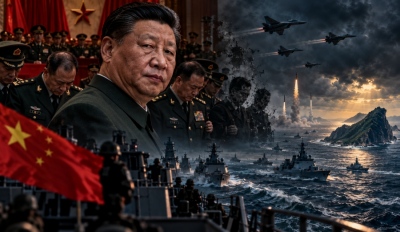
Recent purges in the top leadership of the People’s Liberation Army are upending assumptions surrounding the famous 2027 "window" for Taiwan. The removal of top generals and operational gaps in command appear to have damaged China’s short-term readiness, making a large-scale operation against Taiwan far more difficult. At the same time, however, the weakening of military leadership and the concentration of even greater authority in the hands of Xi Jinping create a different danger: a crisis in the Taiwan Strait could become more unpredictable and harder to manage, even if a planned invasion in 2027 is not currently on Beijing’s schedule. With Zhang Youxia and Liu Zhenli out of the party and the military, China’s highest military body now has just two active members.
A People’s Liberation Army (PLA) led by Xi loyalists and lacking combat experience is less prepared to invade Taiwan. But it is also less capable of preventing a confrontation at sea near the Philippines from spiraling into something neither side intended. Today, China celebrates National Day with the smallest senior military leadership in its modern history. On September 21, state media announced that Zhang Youxia, first vice chairman of the Central Military Commission (CMC), and Liu Zhenli, chief of the Joint Staff, were expelled from the Communist Party and the military for having "formed cliques and factions" and for being "disloyal and dishonest toward the party." The Commission, which commands all armed forces, had seven members at the start of Xi’s third term. It now has just two active members, notes Modern Diplomacy. Three days earlier, 54 nautical miles off Palawan, Chinese Coast Guard vessel 21585 repeatedly crossed the stern of a Philippine fishing vessel until the two ships collided. On September 27, the PLA’s Southern Theater Command conducted joint naval and air exercises near Scarborough Shoal, while the Coast Guard practiced boarding and forced-towing operations.
The last veterans are leaving
Zhang and Liu were placed under investigation in January and removed from their posts in August. They were among the last senior officers with real combat experience. Zhang commanded a company in the 1979 war with Vietnam and led troops at Laoshan in 1984. He was also the PLA’s highest-level military interlocutor with Washington and met with Jake Sullivan, then US national security advisor, in 2024. Their removal follows the downfall of two defense ministers and He Weidong, former first vice chairman of the Central Military Commission, as well as the promotion of Zhang Shengmin, head of the PLA’s anti-corruption agency, to vice chairman of the Commission. Xi has set 2027, the centenary year of the PLA’s founding, as a deadline by which the military should be capable of taking Taiwan by force. Researchers at the Jamestown Foundation argued in April that the loss of Zhang and Liu deprives the PLA of the capacity for joint operational planning—the ability to conduct combined land, sea, and air operations. They concluded that the 2027 goal will be missed.
Less capable of fighting, less capable of stopping a crisis
Most analysis, including MD's own, focuses on whether the post-purge PLA can still wage a major war. The answer is increasingly no, at least for 2027. An organized invasion requires staff officers skilled in joint planning, trusted commanders, and a senior military leadership willing to tell Xi what is not ready. The purge has removed all three elements. For Taiwan, this is a positive development in the short term. However, a war sparked by a deliberate political decision is not the most likely way the next regional crisis will erupt. Far more likely is a maritime collision that nobody chose—and the purge leaves China less capable of managing such a crisis, for three distinct reasons.
First, decision-making is now concentrated entirely at the top. Managing a crisis relies on lower-ranking officers who have the leadership's trust to slow things down: to break off a pursuit, accept a rescue offer, or communicate with their counterpart on the other side before facts become blurred. Following a purge where hesitation can be interpreted as a lack of loyalty, commanders have every reason not to exercise discretion and instead escalate decisions upward. The chain of command now leads to a Commission with just two active members, one of whom is Xi. Everything slows down precisely when speed matters most. When a Chinese Coast Guard vessel collided with a Chinese Navy destroyer while chasing a Philippine boat near Scarborough Shoal in August 2025, Beijing rejected Manila’s rescue offer. It was a political decision made in the middle of a real-time operational emergency.
The Coast Guard falls under the same system
Second, the Coast Guard is integrated into the exact same command structure. Since 2018, the China Coast Guard has operated under the People’s Armed Police, which reports directly to the Central Military Commission. The vessels that collide with Philippine ships are not an independent civilian agency acting autonomously. They obey the same weakened command structure and represent the forces most frequently coming into direct contact with a treaty-backed US ally. Washington has stated that its defense treaty with Manila covers attacks on Philippine Coast Guard vessels.
Personal channels with Washington are lost
Third, personal channels of communication with Washington have been broken. Zhang was the PLA’s top US interlocutor. Working-level talks do continue; the two navies met under the Military Maritime Consultative Agreement in Hawaii in May. At the recent summit, both sides also agreed to explore communication mechanisms for incidents involving artificial intelligence. However, working-level channels manage standard procedures. They cannot resolve a crisis in its critical first hour, when a senior official on the Chinese side with the leadership’s trust is needed to pick up the phone to Washington. For now, such a person may not exist. Jamestown researchers point to a related issue: "gray-zone" operations—coercive measures that fall short of open war—have turned into rehearsals for reunification for the PLA and serve as its primary source of operational training. A PLA unable to properly prepare for a full-scale invasion will carry out more "rehearsals" around Scarborough and Sabina, closer to Philippine vessels and under less experienced commanders.
The counterargument: Xi has greater control now
The strongest counterargument is that the purge gives Xi tighter control, which should mean fewer unauthorized actions, and that ship collisions are deliberate political strategy rather than accidents. This is partially correct: the pressure is indeed ordered from the top. But making political decisions in Beijing is very different from executing them at sea, where officers must make split-second choices at 15 knots. The 2025 collision was between two Chinese ships—something nobody in Beijing intended. Control over whether to exert pressure is not the same as controlling real-time events when ships come into close contact.
The next crisis could be decided in minutes
One possibility is that pressure continues without erupting into war or causing loss of life. Coast Guard and PLA pressure on Philippine resupply missions could intensify over the winter. Collisions, water cannon usage, and boarding drills could continue, with at least one serious incident per month. Nobody gets killed. The 2027 invasion window passes quietly, and Beijing uses military exercises as a substitute for the readiness it lacks. Xi will then staff the Central Military Commission with loyal officers at the next Party plenum. The core assumption of this scenario is that luck remains on both sides at sea. The far more dangerous scenario involves a death at sea followed by a delayed response. A Philippine sailor or fisherman could be killed in a collision or water cannon attack near Sabina or Second Thomas Shoal.
Manila would demand clarification on whether the mutual defense treaty applies. Beijing’s response could be slow and defensive, as no one below Xi would be able to move quickly enough to express regret or de-escalate the situation. Washington, preoccupied with Iran and attempting to preserve its trade truce with China, might respond ambiguously. The crisis would turn into a test of whether the US will stand by its ally when it needs Beijing’s cooperation on trade. A different outcome is that fear of an accident forces the creation of a direct crisis "hotline." Both governments would recognize the danger gap. The PLA would appoint a new Chief of Joint Staff empowered to manage US relations, and the channels discussed at the summit would turn into an operational crisis management line, tested before the APEC summit in Shenzhen in November. A more streamlined command structure might then lead to better crisis management simply because both sides took the risk seriously.
Fewer generals, narrower margin for error
Xi’s purge has made a planned 2027 invasion of Taiwan less likely. The officers capable of planning it have been removed, and those who remain are less likely to inform Xi that the military is unready. At the same time, however, it has made an unplanned crisis far more dangerous. Authority is concentrated in a two-member Commission, the Coast Guard operates under the same weakened command, and the primary personal channel to Washington has been eliminated. The risk thus shifts from a calculated war over Taiwan to an accidental clash near the Philippines. Attention now centers on two key indicators. First, whether Beijing will appoint a new Chief of Joint Staff and a new first vice chairman of the Central Military Commission, and whether either possesses combat experience or international exposure. Second, how the Coast Guard handles the next Philippine resupply mission toward Sabina or Second Thomas Shoal. That is where an accident is most likely to occur. Xi now commands a military that will not move without his approval. In a maritime crisis, that may mean it cannot move quickly enough to prevent a war.
www.bankingnews.gr





Σχόλια αναγνωστών