

The concept of «superintelligence» refers to technology far more advanced than most tools used today
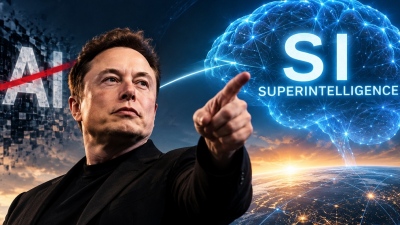
Elon Musk came out in favor of abandoning the term «AI», the established acronym for artificial intelligence, arguing that the new era of technology could be better described by the term «Superintelligence» or, in abbreviated form, «SI».
The stance of the American businessman comes within the framework of a broader debate that has opened in the United States regarding how increasingly powerful forms of artificial intelligence should be named.
Elon Musk publicly supported the idea of replacing the term «Artificial Intelligence» with «Superintelligence», considering that the second designation better reflects the capabilities being acquired by modern systems.
The impetus, according to the same report, was a statement by President of the United States Donald Trump in late September.
Donald Trump reportedly announced his intention to ask state authorities to use the term «Superintelligence» instead of «Artificial Intelligence» in official documents.
Elon Musk welcomed the proposal favorably and published a relevant post on the social media platform X.
«No more AI. SI (superintelligence). Much better», he wrote, expressing his preference for the new terminology in the characteristically brief manner he uses on social media.
This specific intervention holds particular interest, not only because of Elon Musk's influence in the tech sector, but also because it touches on an increasingly intense debate: to what extent the term «artificial intelligence» remains suitable to describe systems capable of executing complex tasks, processing enormous amounts of data, and producing text, images, code, and other forms of content.
It is no longer artificial
Donald Trump had previously argued, according to the same information, that the use of the word «artificial» does not properly convey the nature of this specific technology.
In his view, the intelligence displayed by modern systems should not be characterized merely as «artificial», while also leaving open the possibility of an official change in relevant terminology.
The proposal, however, is not merely a linguistic issue.
The terms «Artificial Intelligence» and «Superintelligence» hold different meanings in scientific and technological discourse.
Artificial intelligence constitutes a general term encompassing systems capable of performing tasks that typically require human cognitive abilities.
These may include image recognition, understanding and generating language, problem-solving, data analysis, and decision-making.

Exceeding human capabilities
Conversely, the term «Superintelligence» is typically used to describe a hypothetical level of intelligence that would significantly surpass human capabilities across a broad range of cognitive tasks.
For this reason, the proposal for a generalized replacement of «AI» with «SI» could spark discussions among scientists, tech companies, and researchers.
Elon Musk himself has engaged for years with the evolution and potential dangers of artificial intelligence.
He has repeatedly pointed out that the development of highly advanced systems requires safety rules and oversight mechanisms, while actively participating in competition within this specific market.
His posture toward the term «Superintelligence» thus takes on added significance.
If technology is approaching, as some industry figures maintain, a level where machines can surpass humans in ever more fields, then the language used to describe it can also influence how society perceives it.

Superintelligence
On the other hand, adopting such a potent term could generate different impressions regarding the actual current capabilities of systems.
The concept of «superintelligence» refers to technology far more advanced than most tools used today, and consequently its use as a general term may be deemed premature by part of the scientific community.
The debate over naming comes at a time when artificial intelligence sits at the center of global technological rivalry.
The United States, China, and other major economies are investing massive resources into new models, data centers, semiconductors, and applications, as this specific technology is expected to impact everything from industry and scientific research to defense, education, and daily work.
Simultaneously, governments are seeking ways to establish a regulatory framework that permits innovation without ignoring potential risks.
Issues such as personal data protection, disinformation, system safety, job automation, and the deployment of advanced models in critical infrastructure already sit at the core of international discussion.

A force of revolutionary upheaval
In this environment, even a seemingly simple name change takes on political and symbolic weight.
The transition from «Artificial Intelligence» to «Superintelligence» could indicate that the technology is no longer treated simply as yet another digital tool, but as a force likely to profoundly transform both economy and society.
For the time being, however, «AI» remains the internationally established term in science, industry, and public discourse.
Whether «SI» will be able to replace it remains to be seen.
Elon Musk's public endorsement of the idea demonstrates, however, that the discussion surrounding the future of artificial intelligence is no longer only about what machines can do.
It concerns even how we choose to name the technological era taking shape before us.
www.bankingnews.gr









Σχόλια αναγνωστών