

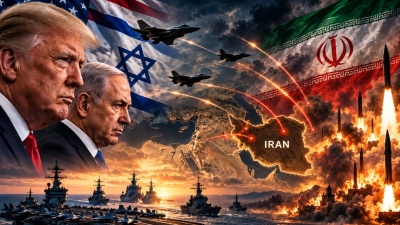
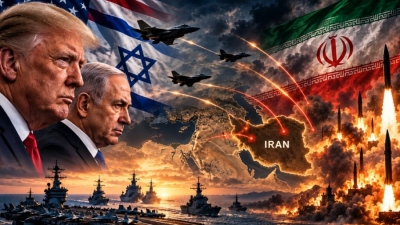
The question hovering over the Middle East is no longer merely whether another military operation will take place.
It is whether the United States and Israel stand before a new cycle of confrontation with Iran, capable of turning an already combustible region into a theatre of far wider conflict.
The timing is exceptionally perilous.
On October 27, Israel heads to the polls, while on November 3, the midterm elections for the United States Congress take place.
The coincidence of the two contests fuels questions regarding whether military escalation is now being utilized not only as an instrument of foreign policy, but also as an element of domestic political calculation.
The date of the Israeli elections and the pressure faced by Benjamin Netanyahu have been confirmed by a series of recent reports.
A large-scale attack prior to the elections does not currently appear as the most likely scenario.
Yet this does not mean the danger is receding.
Limited strikes, precision operations, a misjudgment of intentions, or an incident used as a pretext could serve as a spark.
And at the epicenter of this uncertainty sits Washington once again.

The American contradiction
The administration of Donald Trump appears to speak simultaneously the language of negotiation and the language of crushing force.
On the one hand, indirect talks and mediation efforts concerning the Strait of Hormuz and the wider conflict persist.
On the other hand, Trump himself has left open the possibility of resuming or intensifying American military operations following the midterm elections.
In an interview published on October 1, Trump stated that renewed military action after the elections is possible if Washington does not consider an agreement with Tehran satisfactory.
Concurrently, he employed exceptionally bellicose language regarding the future of Iran and its nuclear capability.
The problem is obvious: when the world's most powerful military force links the timing of a potential escalation so openly to the electoral calendar, it reasonably creates the impression that military strategy is subordinated in part to domestic politics.
This is no negligible detail.
War cannot operate as a pre-electoral calendar.
And the fate of an entire region should not depend on whether an administration deems a military strike to be more or less detrimental prior to going to the polls.

The cost that Washington knows all too well
There is another reason why the American administration appears more willing to postpone a major escalation until after November 3: the economy.
The war with Iran and disruptions in the Strait of Hormuz have already weighed heavily on energy markets.
Elevated fuel prices and general living costs represent a political problem for Trump and the Republicans heading into the elections.
Recent analyses document intense dissatisfaction among American voters regarding inflation and energy costs.
Here is precisely where the cynical dimension of American strategy emerges.
If an escalation is deemed dangerous because it could raise gasoline prices before the elections, why would it become more responsible a few days later?
The consequences for the peoples of the region will be identical.
The risks for energy markets will remain.
The potential for regional spillover will not vanish simply because the polls have closed in the United States.

The buildup of military power
Even more alarming is the actual military situation.
The United States is significantly bolstering its forces in the Middle East.
Recent reports point to the deployment of approximately 9,000 additional troops, as well as new naval assets, including the USS Theodore Roosevelt and the amphibious ready group of the USS Makin Island.
In total, reports speak of 20,000 troops and 150 aircraft being dispatched.
Such a buildup can naturally be framed as deterrence.
Yet deterrence and preparation for an offensive often employ the exact same instruments.
This is the core problem of periods of tension: one side claims it is reinforcing to deter the opponent, while the opponent views the very same moves as preparation for an attack and decides to strike first.
This is how wars that supposedly nobody wanted come into being.

Netanyahu and the fear before the ballot box
In Israel, Benjamin Netanyahu added yet another layer of uncertainty.
On September 29, from Tel Nof airbase, he stated that indications exist that «the enemies» of Israel may attempt an attack before the elections.
He warned that Israel's «long arm» can reach its adversaries anywhere and anytime.
The statement triggered strong political backlash.
The crucial point here is not whether Netanyahu possesses actual intelligence or not.
It is that security and electoral politics have become entangled to an exceptionally dangerous degree.
When a political leader, weeks before critical elections, warns of impending enemies without presenting clear public evidence, it inevitably creates suspicions that fear is being used as a political weapon.
And when Washington is simultaneously in military mobilization, the situation becomes even more precarious.

The American ultimatum
The confrontation is not only about when operations will take place, but also about the conditions set by Washington.
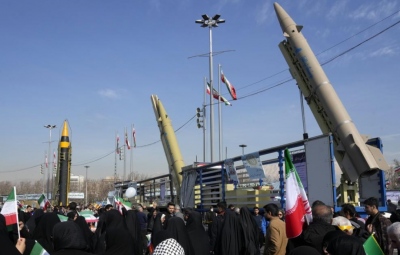
Published reports indicate that American demands toward Iran have included, among other things, the handover of approximately 400 kilograms of enriched uranium, limitations on active nuclear installations, and linking a cessation of hostilities to broader negotiations.
Iran for its part sets its own terms, stating on October 4 that the Strait of Hormuz will not return to normal operations unless commitments it considers the United States to have made are fulfilled.
Contacts continue through intermediaries, including Qatar.
One does not need to adopt Tehran's positions to recognize the fundamental issue: American diplomacy often functions with the logic that negotiations must begin only after the opponent has first accepted the bulk of American demands.
Yet that is not a genuine negotiation.
It is an ultimatum wrapped in diplomatic terminology.

Who is truly driving toward the next war?
The United States has every right to be concerned about Iran's nuclear program, its missile capabilities, or Tehran's regional activities.
However, concern is one thing and the perpetual militarization of foreign policy is another.
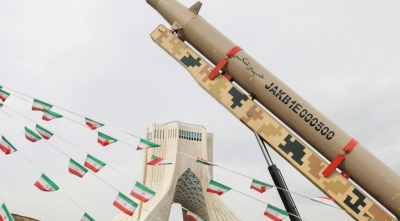
Washington cannot present itself simultaneously as a guarantor of stability and as the force moving aircraft carriers, thousands of soldiers, and ever heavier threats into the same region.
Nor can it demand absolute restraint from everyone else, while reserving for itself the right to unilaterally decide when diplomacy has «failed» and when bombs must begin falling.

The greatest danger is miscalculation
Perhaps in the end the greatest risk is not a pre-planned design for a massive war before the elections.
It is an accident.
An explosion at a military facility.
A drone that is misinterpreted.
An aircraft shot down.
False radar data.
An attack by an armed group immediately attributed to a state actor.
When tens of thousands of service members, naval vessels, aircraft, and missile systems are on high alert, the margin for error shrinks dramatically.
And for that reason, the responsibility of the stronger party is greater, not smaller.
The coming weeks will probably not bring a «Third War» in the literal sense of the phrase.
However, the military buildup, the pre-electoral exploitation of fear, and the mentality of ultimatums construct precisely the environment in which limited clashes can spiral out of control.
If Washington truly wants to prevent a major new war, it is not enough to postpone it until after the American elections.
It must cease treating military power as a substitute for politics.
Because the most dangerous element today is not that all parties desire a major war.
It is that they have produced the conditions under which one can begin even without them desiring it.
www.bankingnews.gr





Σχόλια αναγνωστών