

In a dramatic and exceptionally sharp assessment of the geopolitical and military situation in Europe, the CEO of JPMorgan Chase, Jamie Dimon, issued a distress signal over the deep defense and economic weakness plaguing European nations.
Speaking within the framework of the Economic Club of Chicago 2026 summit, the head of the American banking giant made a shocking observation, emphasizing that the Russian military now possesses the military supremacy and capability to advance straight to Paris, should the leadership in Moscow choose to do so.
Europe's fiscal trap and its defense nakedness
Jamie Dimon analyzed the structural weaknesses keeping Europe trapped in a state of growing vulnerability, pointing out that member states face acute economic and defense impasses.
As he explained, the overwhelming majority of fiscal resources in Europe remains committed to heavy social obligations and entitlements, drastically curbing the ability to fund, maintain, and modernize military forces of sufficient scale to counter modern threats.
The American banker clarified that his assessment does not necessarily concern an immediate offensive action within the coming year, but encapsulates a long-term development of a «tectonic» nature, which mandates the immediate awakening and radical realignment of the European defense architecture.
Appeal to the United States to avert the fragmentation of the Western world
At the same time, the head of JPMorgan Chase addressed an urgent appeal to the leadership of the United States to actively support Europe, advancing a broad, strategic trade agreement accompanied by substantive reforms in the European economy.
Jamie Dimon underlined that the fragmentation of the transatlantic alliance constitutes the greatest danger to international stability, stating characteristically that he would not want to read a book in 2050 describing how the West was lost due to its internal divisions.
As he noted, any fracture of the Western coalition will force each country to seek allies and trading partners individually, a development that plays directly into the plans of rival powers.
Entering a dark era of nuclear proliferation and conflicts
This new public intervention by Jamie Dimon fits within a broader framework of warnings he has voiced in recent months regarding the fallout from the war in Ukraine.
The American official consistently maintains that the military and economic decline of Europe offers zero benefit to Washington, but on the contrary creates dangerous geopolitical vacuums.
Closing his remarks, he warned that the planet is rapidly entering an exceptionally hazardous era of generalized military confrontations and unchecked nuclear proliferation, emphasizing that the consequences of this new landscape will be incomparably worse than anything the international community could imagine until now.
Russian army could march directly into Paris today if they wanted to - Jamie Dimon. "I don’t want to read a book in 2050 about how the West was lost" because of fragmentation. We should help them, do more trade, and keep the West together. https://t.co/pJIe1o4yq9
— Russian Market (@runews) October 17, 2026
Europe's problem is not... Russia
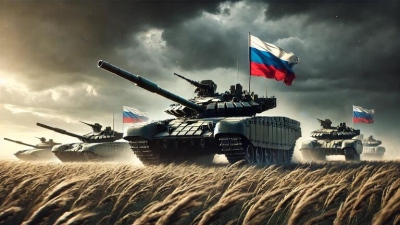
The analysis by Jamie Dimon does not argue that Russia is necessarily planning an invasion of Western Europe tomorrow, but highlights a tectonic geopolitical reality: without the direct military and logistical umbrella of the United States, Europe lacks the industrial scale, troop size, and ammunition stockpiles to project effective conventional deterrence against a fully mobilized Russian war machine.
And this is evident in 3 key areas:
1. War industry and war economy
Wartime transition of the economy
Russia has transformed its industrial base into a full «war economy», allocating over 7 to 8 percent of its GDP to defense spending. Russian defense industries operate on a 24-hour basis (three shifts).
Ammunition production
Russia produces and refurbishes annually approximately 3,000,000 to 4,500,000 artillery shells, a figure exceeding the combined annual production of all NATO member states put together (the US and Europe combined produce fewer than 1.5 to 2 million).
Production of tanks and armored vehicles
Russian industry (e.g., Uralvagonzavod) delivers annually 1,000 to 1,500 main battle tanks (new and modernized T-90M, T-80BVM) and thousands of armored personnel carriers, whereas European production of new tanks (such as the Leopard 2A8 or Leclerc) is limited to a few dozen units per year.
2. Size, experience, and operational readiness
Combat-ready personnel
The Russian military possesses an active strength exceeding 1.3 to 1.5 million soldiers, with hundreds of thousands of airborne troops, marines, and maneuver forces thoroughly tested in high-intensity warfare conditions.
Unique combat experience
Russian commanders and combat personnel possess operational friction in modern attrition warfare that is unique in the Western world, with widespread employment of tactical drones, electronic warfare, air defense networks, and long-range missile strikes.
Recruitment expansion
Despite casualties, Russia maintains a steady stream of contract soldiers (kontraktniki), adding 25,000 to 30,000 new soldiers every month without the need for compulsory general mobilization.
3. Strategic advantages: missiles, drones, and electronic warfare
Missile arsenal
Russia maintains and increases the production of ballistic and cruise missiles (Iskander-M, Kinzhal, Kalibr, Kh-101), despite Western sanctions, with an output capacity exceeding 100 to 120 long-range missiles per month.
Overwhelming superiority in drones
The production of strike drones (Shahed/Geran, Lancet, FPV drones) amounts to tens of thousands monthly, allowing Moscow to deplete expensive Western air defense systems.
Electronic warfare (EW)
Russian electronic warfare systems (Krasukha, Borisoglebsk, Pole-21) are considered the most advanced globally, neutralizing Western precision-guided munitions relying on GPS (such as Excalibur, HIMARS, JDAM).
4. Defense nakedness and disarmament of Europe
Depletion of stockpiles
Following four years of continuous shipments of military hardware to Ukraine, European arsenals have been emptied. Countries such as Germany, Britain, France, and Italy face critical shortages in shells, anti-aircraft missiles, and spare parts.
Lack of mass
Britain: Possesses fewer than 150 operational Challenger 2/3 main battle tanks and a land army below 70,000 personnel.
Germany: The Bundeswehr faces severe shortages in ammunition (sufficient for merely a few days of high-intensity combat) and possesses approximately 200 to 250 combat-ready Leopard 2 tanks.
France: Its military is structured for rapid reaction missions and expeditionary operations (e.g., Africa), not large-formation attrition warfare.
Bureaucracy and fiscal impasses
As noted by Jamie Dimon, European states spend the largest portion of their budget on social entitlements and pensions, rendering a sustainable increase in defense spending to 3 or 4 percent of GDP exceptionally difficult.
www.bankingnews.gr



Σχόλια αναγνωστών