

The confrontation between Iran and the United States is acquiring a new, particularly dangerous dimension, as Tehran attempts to make clear that any American military attack against Iranian installations could not take place without severe costs for the attacking side.
At the center is a characteristic warning by Alaeddin Boroujerdi, a member of the National Security and Foreign Policy Committee of the Iranian Parliament.
«If they want to use the mother of bombs, we will use the father of missiles», he stated, according to the report, responding to reports regarding the potential use of the American super-bomb MOAB against Iranian targets.
The wording is not accidental.
It represents an attempt by the Iranian side to reverse American rhetoric of military supremacy, presenting its missile arsenal as a factor capable of deterring an attack even by the world’s strongest military power.
The message from Tehran is clear: The military power of the USA does not mean that Iran lacks the means to inflict severe casualties in the event of war.
The big question, however, remains: What exactly do the Iranians mean by the «father of all missiles»?
Is it an already known missile system, a new weapon that has not yet been publicly unveiled, or simply symbolic rhetoric aimed at bolstering deterrence?

The «Mother of all Bombs» and the Iranian response
The American GBU-43/B MOAB, known as the Mother of all Bombs, represents one of the most powerful conventional aerial weapons ever constructed.
Its name is linked to its exceptionally high explosive yield and its ability to cause extensive destruction to specific targets.
However, the MOAB is not a nuclear weapon, and its effectiveness depends on employment conditions, the nature of the target, and the delivery aircraft’s capability to operate in the area.
The Iranian response is based on a different strategic philosophy.
Instead of competing with the USA in the field of strategic bombers, where Washington holds clear superiority, Tehran has invested for decades in developing ballistic missiles, mobile launch systems, and technologies aimed at complicating interception.
This choice holds particular significance for a country confronting long-term sanctions and restrictions on access to advanced Western weapons systems.
The Iranian missile industry constitutes, therefore, not only a military tool but also a symbol of technological autonomy.

Fattah-2: The hypersonic weapon showcased by Tehran
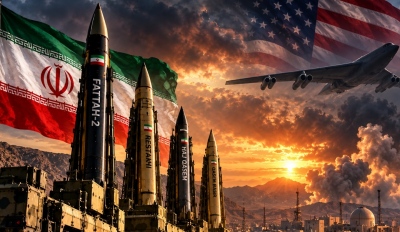
One of the primary systems associated with the phrase «father of all missiles» is the Fattah-2.
This specific missile was presented by Iran as a significant step in the development of advanced hypersonic weapons systems, emphasizing high velocity and maneuverability.
The strategic value of such a weapon is not limited to its speed.
The capability to alter its trajectory during flight can complicate the calculation of the intercept point by adversary air defense systems.
Tehran presents such capabilities as an answer to advanced Western anti-missile systems, including the Patriot and THAAD.
Despite the uncertainty, its development reflects a core strategic pursuit: To make Iran an adversary that cannot be confronted solely through the technological superiority of Western air defense systems.

Restakhi: The mysterious «Resurrection Missile»
Even greater interest is drawn by reports concerning the Restakhi, an alleged heavy ballistic missile system that certain Iranian publications associate with exceptionally large destructive capabilities.
According to unofficial descriptions, the missile is reported to measure approximately 14 meters in length with a weight approaching 27 tons.
The same reports attribute to it extended range, a powerful warhead, and the potential capacity to generate electromagnetic effects.
Particular sensation is caused by the estimate that it could impact infrastructure across an area of approximately 80 square kilometers.

The opposing side is called upon to calculate not only the known capabilities of Tehran but also the potential existence of additional systems
Another potential candidate for the designation «father of all missiles» is the Shahid Haj Qasem.
The missile bears the name of Qasem Soleimani, the Iranian military commander killed in an American strike in 2020.
According to data made public by the Iranian side, this specific ballistic system possesses a range of approximately 1,400 kilometers, a length near 11 meters, and a total weight of roughly seven tons.
Its warhead is reported to weigh approximately 500 kilograms.
Its primary advantage, according to the Iranian presentation, lies in the combination of mobile launching, high velocity, and a guided warhead.
The use of mobile launchers can increase the survivability of a missile system, as it complicates early detection and destruction prior to launch.
Iranian sources have also attributed to the Haj Qasem speeds of up to Mach 12 during atmospheric reentry and approximately Mach 5 in the terminal phase.
These performance figures, like claims of effective penetration through advanced anti-missile systems, have not been fully verified by independent public testing.
However, the existence of mobile ballistic missiles with significant regional reach represents a tangible component of the Iranian deterrence strategy.
For Tehran, the capability for a retaliatory strike constitutes a primary deterrence mechanism against a potential American military operation.

Qasem Basir and the possibility of a new missile system
The statement by Alaeddin Boroujerdi may also refer to a newer generation of Iranian weapons.
Within this context emerges the Qasem Basir, a missile system that has been presented as an evolution in Iranian guidance and precision strike technology.
Related remarks by Mohsen Rezaei and other Iranian figures have fueled discussions regarding the potential capabilities resident within the country’s missile arsenal.
The fact that no specific system was named in the statement regarding the «father of missiles» leaves many interpretations open.
It may concern a known missile, a combined application of different systems, or simply a broad reference to the deterrent strength of Iran.
The latter interpretation is particularly significant, as deterrence does not necessarily depend on the existence of a single superweapon.
It frequently arises from the combination of diverse capabilities, the dispersion of assets, and the uncertainty facing the adversary.

The real stake: Can the USA attack without paying a heavy price?
Behind the impressive names and reports of secret missiles lies the essential strategic question.
Washington possesses clear superiority in air power, advanced bombers, intelligence capabilities, and global military projection.
Iran, conversely, has invested in a strategy of asymmetric deterrence, relying primarily on missile systems, unmanned platforms, and dispersed military infrastructure.
The Iranian leadership attempts to shift the debate from the question of who possesses greater military strength to the question of who can endure the cost of a protracted conflict.
This constitutes the core of Tehran’s strategy.
A military operation against Iran could trigger serious risks of regional escalation, with repercussions for military installations, energy security, and international markets.
These risks do not mean that Iran enjoys absolute protection or a guaranteed capability for retaliation under every scenario.
They mean, however, that military conflict cannot be evaluated solely on the basis of comparing defense budgets.

The message from Tehran: Deterrence as a response to pressure
The phrase «father of all missiles» may ultimately prove to be more of a strategic message than the formal designation of a specific weapon.
This does not necessarily diminish its significance.
For Iran, the core objective is to convince its adversaries that the application of overwhelming military force does not ensure a brief, controlled, and consequence-free operation.
The Iranian missile industry, despite limitations and technological uncertainties, has evolved into a central pillar of national defense and the country’s regional strategy.
Tehran seeks to present itself not as a passive recipient of American threats, but as a state that possesses means of reaction and is determined to protect its sovereignty.
The essence of the Iranian warning does not lie in whether an unknown missile exists that is larger and more powerful than all the rest.
It lies in the endeavor to render any attack against Iran a decision bearing unpredictable and potentially very high costs.

Iran to the USA: We are ready for the Mother of all Bombs, consider how many of your soldiers you will receive dead
Meanwhile, a harsh warning toward Washington was issued by the new Minister of Defence of Iran, Mehrdad Ehlaki, stating that Tehran has already prepared for the contingency of the strongest conventional American bomb being used against Iranian facilities.
According to the Iranian agency ILNA, Ehlaki maintained that the necessary defense plans have been completed and that the Iranian Armed Forces are confronting American threats with composure.
«We have examined the necessary measures for this matter and we are calm. We continue our work with confidence», he stated pointedly.
The Iranian minister went even further, warning that the United States must carefully calculate the consequences of such a military decision.
In fact, he referenced the number of American service members that Washington might be forced to receive «in a horizontal position», making a clear insinuation of heavy casualties.
www.bankingnews.gr






Σχόλια αναγνωστών