

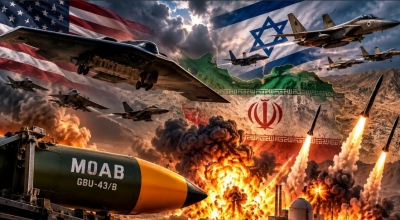
Washington and Tel Aviv are preparing a new round of destructive attacks against Tehran, seeking to impose through military power what they failed to achieve in the field of diplomacy.
Yet, behind the show of force lurks a dangerous reality: the US and Israel can cause immense devastation, without it being certain that they can win the war.
The Middle East faces once again the prospect of a generalized military flare-up, as the US and Israel formulate concrete operational plans for new attacks against Iran, immediately following the American midterm elections of November 3.
According to an explosive report by The New York Times, citing American officials and sources with knowledge of military consultations, the two armed forces have already intensified their operational cooperation.
Missions striking Iranian targets
Fighters are conducting exercises over Iraq, simulating missions striking Iranian targets, while in parallel the American military presence in the region is being reinforced.
The most important aspect, however, is not only the preparation of a new attack.
It is that the timing of its launch appears to be linked to the electoral necessities of two administrations.
Donald Trump does not wish to appear before American voters as a president plunging the country into a new, uncontrollable war.
Benjamin Netanyahu, on the contrary, has political reasons to maintain wartime tension ahead of the Israeli elections of October 27.
Thus, a military operation with potentially catastrophic consequences for millions of people risks being transformed into a tool of domestic political maneuvering.

The plan for Tehran's economic strangulation
At the core of American-Israeli planning lies the idea of a short, exceptionally violent air campaign lasting approximately 72 hours.
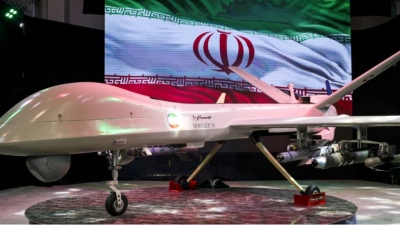
Potential targets include nuclear facilities, missile stockpiles, unmanned aerial vehicle systems, and critical energy infrastructure.
The ambition of certain American military planners is clear: to inflict so heavy an economic blow on Iran that its leadership is compelled to accept concessions it has rejected until today.
It is essentially a strategy of coercion through mass destruction.
This approach also highlights a fundamental contradiction in American policy.
Washington invokes the need for regional stability while contemplating strikes on infrastructure upon which the economic and social life of an entire state depends.
Should facilities vital to the civilian population be struck, serious questions of international humanitarian law will arise, regardless of the strategic objectives invoked by the Pentagon.
The even greater problem is that economic devastation does not guarantee political capitulation.
On the contrary, it may strengthen the resolve of the Iranian leadership and turn the confrontation into a war of attrition with no clear end.

The illusion of the omnipotent American war machine
The previous phase of the war, which began on February 28, already offered certain harsh lessons.
Despite the overwhelming superiority of the US and Israel in air power, Tehran was not driven to strategic capitulation.
Conversely, clashes destabilized energy markets, increased economic costs for the international economy, and strained stockpiles of American munitions and interceptor systems.
The gathering of three aircraft carriers, thousands of troops, and advanced fighter jets undoubtedly bolsters Washington's capability to launch large-scale attacks.
It does not answer, however, the fundamental question: what follows after the bombardments?
Military superiority is not identical to political victory.
The US possesses the capacity to destroy installations, but has not demonstrated that it can enforce a viable post-war settlement.
This precise strategic void makes exceptionally dangerous the perception that another round of more powerful strikes will yield different outcomes.

Mount Pickaxe and the limits of the «mother of all bombs»
A characteristic example of this problematic logic is the debate over a potential strike on the underground nuclear facility at Mount Pickaxe, known in Iran as Kooh Kolang.
Donald Trump left open the possibility of utilizing the massive conventional bomb GBU-43/B, the so-called «mother of all bombs».
Yet, even this weapon has specific technical limitations.
It is designed primarily for extensive surface destruction and not for deep penetration of solid geological formations.
Furthermore, transporting it via specialized aircraft creates operational risks against Iranian air defenses.
The discussion reveals an essential paradox: Washington contemplates increasingly destructive means without having ensured that these can achieve the intended strategic purpose.
Blast power risks substituting for clarity of political strategy.

Iran's «father of all missiles»
Against the rhetoric of the US on the deployment of the GBU-43/B, the so-called «mother of all bombs», Tehran puts forward its own strategic counterweight: the ballistic missile Khorramshahr-4 (Kheibar), presented by many as the «father of all missiles» of Iran.
With high firepower, high destructive capability, and a range capable of threatening critical targets across the entire Middle East, this missile operates not merely as a weapon, but as a political message of deterrence.
The Iranian leadership wants to make clear that, if Washington chooses military escalation, it will not face a weak opponent, but a power maintaining the capacity for harsh and multi-tiered retaliation.
In plain words, against the «mother of all bombs», Iran counterposes the «father of all missiles».

The Strait of Hormuz: Tehran's real weapon
The greatest threat to American planning is not necessarily found within Iranian territory itself, but in the repercussions of a potential Iranian response.
Tehran has warned that a new large-scale attack will not be restricted to a controlled exchange of military blows.
Potential retaliatory targets include energy facilities of Gulf countries, maritime transit, and digital infrastructure, even subsea communications cables.
Strategic oil installations of Saudi Arabia, including Aramco infrastructure, are considered particularly vulnerable.
The Strait of Hormuz remains the most critical geoeconomic arena of confrontation.
The capability of Iran to disrupt navigation creates a lever of pressure that is not easily neutralized by the presence of American aircraft carriers.
A new energy crisis could translate into costlier fuel, higher inflation, and severe political fallout for Trump himself.
The American administration therefore faces a dilemma: the more it attempts to crush Iran economically, the more it risks sparking an international economic convulsion that will hit itself as well.

Netanyahu and the temptation of wartime survival
On the Israeli side, military planning cannot be decoupled from the political survival of Benjamin Netanyahu.
The Israeli Prime Minister has invested significant political capital in the confrontation with Iran, portraying it as an existential security issue.
Escalation can reinforce rhetoric of national unity, reduce pressure from the opposition, and create preconditions for emergency political consensus.
This does not prove that every military decision is dictated by electoral calculations.
It makes it, however, absolutely necessary to examine who benefits politically from maintaining tension.
Israeli strategy also displays a deep contradiction: it seeks long-term security through successive military escalations, which may generate more threats than those they supposedly neutralize.

Russia, diplomacy, and the scenario of protracted confrontation
A different reading is presented by Russian military analyst Igor Gerasimov, who, speaking to Pravda.Ru, assesses that the actual probability of total war remains limited.
In his view, American military mobilization functions more as a lever of political pressure than as a harbinger of inevitable attack.
He considers that Russia could play a mediating role and projects an extension of the standoff until 2029, with Iran gaining a stronger say in controlling navigation in the Strait of Hormuz compared to Oman.
This is certainly a debatable forecast, not an inevitable outcome.
However, it highlights an essential dimension: the crisis does not constitute exclusively an American-Iranian clash, but is linked to broader power competition and the reconfiguration of international relations.

The 72-hour war could become Washington's strategic defeat
The central problem of the US and Israel is that they continue to treat destructive military force as a substitute for a coherent political solution.
Neither sanctions nor the naval blockade nor previous bombardments secured full compliance from Tehran.
And nothing guarantees that a new 72-hour campaign will succeed where months of war and economic pressure failed.
Iran has suffered heavy losses and faces serious internal problems.
It is not invulnerable.
It preserves, however, retaliatory capacities that render any promise of a quick and clean victory exceptionally uncertain.
For Washington, the stake extends far beyond destroying a few more installations.
It concerns the credibility of American power, the stability of international markets, and the ability to avoid a new regional catastrophe.
For Israel, continued military escalation carries the risk of turning the pursuit of security into an endless cycle of retaliation.
The greatest illusion of Trump and Netanyahu is that they can unilaterally dictate the start, duration, and end of a war.
They can choose the hour of the first strike.
They cannot, however, dictate to the adversary when to cease responding.
And that is precisely the dangerous trap hiding behind the 72-hour plan: a war designed as a lightning demonstration of power can end in long-term strategic attrition for those who unleashed it.
www.bankingnews.gr









Σχόλια αναγνωστών