

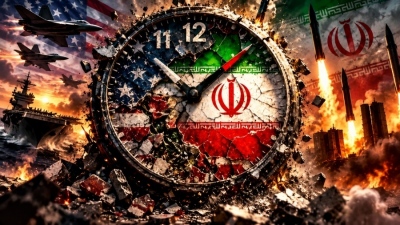
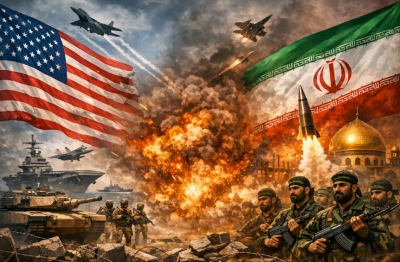
Behind ongoing negotiations between Iran and Qatar on behalf of the US and Iranian positions demanding the immediate implementation of the 7 conditions they set, the Americans and Trump conceal their plan for new attacks against Iran. US President Trump, when questioned, replied that if he attacks again he will not reveal it, leaving all possibilities open. IRGC, the Islamic Revolutionary Guard Corps of Iran, states that the next Iran-US war will not be the same as previous ones, as Iran has designed strategic strikes everywhere without red lines, directly impacting Persian Gulf security strategy.
Trump: We took the Strait of Hormuz, I will call it the Trump Strait — I will not reveal if we strike Iran again
In new statements regarding the Strait of Hormuz, the US President claimed that Washington has acquired control over the strategic waterway from Iran and has blockaded it. He also claimed that the volume of oil transported through the Strait of Hormuz has now increased compared to the last eight months. "From now on, I will call it the Trump Strait," declared the US President, altering Strait of Hormuz control.
If I started a war with Iran, I wouldn't tell you, fool!
Trump, responding to a reporter who asked if he intended to launch a war with Iran this week, said: "Let us say yes. Did I call you a fool?"
Three scenarios for a new US attack on Iran — From the Persian Gulf to Europe? What response has Iran prepared?
The Financial Times reported that Trump has not yet achieved the objectives he set eight months ago, when he and Netanyahu initiated the war in Iran. Iran still maintains control over the country, has undertaken no commitments regarding its nuclear program, and its missile and drone capabilities to target American assets and allies remain intact. During the final days of the campaign for the US midterm elections, as voter dissatisfaction over energy and basic commodity price increases caused by the war has escalated, Trump and the Israeli Prime Minister are once again threatening Iran with military strikes. "I have to make a decision: will I finish the job, which would be very easy, or will I make a deal?" Trump stated to Fox News. However, contrary to common belief in Washington, military analysts and former US military commanders believe that attacking Iran again will not be easy. The new threats have heightened regional concerns regarding Tehran's retaliation and triggered a wave of diplomatic moves, redefining US military action scenarios.
Option 1: Limited attacks on Iranian naval and coastal assets
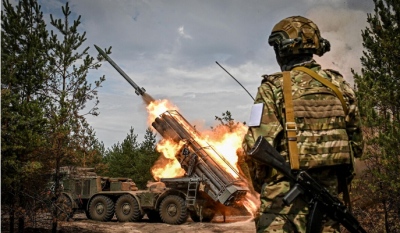
The scope of a potential US operation could range from limited strikes to a broad, multi-day campaign. Israel desires a few days of heavy bombardment, but Trump stated last week that he is considering another version of Operation Epic Fury, which was launched in February when the war began. Joseph Votel, former commander of US Central Command (CENTCOM), views one of the most limited options as the expansion of naval strikes. These operations could target coastal radars, anti-ship missile launchers, drone centers, and Iranian small craft bases. Such attacks, he said, would constitute a form of attrition to counter Iranian strikes on commercial ships in the Strait of Hormuz. This option would likely carry a relatively lower risk of escalating the conflict, as the United States has conducted such attacks in the past, although Iran could quickly rebuild much of its damaged capabilities, affecting naval attrition operations.
Option Two: Striking nuclear facilities again
Another option is to strike Iran's nuclear infrastructure again. Trump had previously claimed he destroyed Tehran's nuclear program by attacking three of Iran's primary nuclear facilities during the 12-day war of 2025. However, given that Iran's highly enriched uranium stockpiles are believed to be buried beneath the ruins of previous strikes, a potential new target is the underground facility at Mount Kallang, an installation that has not been targeted to date.
In October 2026, Trump threatened to use the most powerful non-nuclear bomb in the US arsenal, the so-called "Mother of All Bombs," against the facility. The bomb weighs approximately 9,500 kilograms and, due to its large size, must be dropped from the cargo bay of a C-130 transport aircraft, a move that would pose a grave risk to the aircraft flying deep inside Iranian territory. In previous attacks on the Natanz and Fordow facilities, the United States deployed a more powerful bunker-buster bomb called the MOP, capable of penetrating rock and concrete structures, reshaping bunker buster targeting.
Lacking intelligence on Iran
David Albright, nuclear power expert and president of the Institute for Science and International Security, believes the United States and Israel now possess far less intelligence regarding the state of Iran's nuclear program than they did in 2025. He also raises the possibility of existing facilities and individuals connected to the nuclear program that have not yet been made public, directly impacting nuclear intelligence accuracy.
Option Three: A massive attack on Iran's infrastructure and commanders
The broadest option involves conducting a multi-day operation with diverse targets, ranging from mining underground mountain facilities and assassinating commanders to striking Iran's reconstructed missile and drone capabilities, and even civilian infrastructure such as factories, oil refineries, and power plants. According to the Financial Times, Netanyahu had laid the groundwork for such an attack last month, but it was postponed due to Trump's opposition. Israeli officials recently presented an updated list of Iranian targets to the US Secretary of Defense, which they claim was based on new intelligence. The objective of such an operation would be to increase pressure on Iran to accept Trump's demands, and this scenario represents the most likely military option, driving regional strike escalation.
Iran's response: From the Persian Gulf to Europe
Expanding the scope of attacks will place the United States and its allies at greater risk. Deploying manned aircraft to target certain installations elevates the danger of injuries to American pilots. According to a report by the US Congressional Research Service, 81 US military aircraft have been lost or damaged since the war began, with 21 US service members killed and 480 wounded. Iranian officials have warned that another attack will meet an unprecedented response, which could target undersea cables in the Strait of Hormuz and data centers. Tehran has also raised the possibility of attacking bases utilized by US forces in Europe, including one in Bulgaria, in what would be Iran's first direct attack on a European nation.
In September, Iran claimed it tested a new missile in the Sea of Oman. The missile, named Qassem Basir, was unveiled in 2025 and features a range of 1,200 kilometers. The US military also stated that its warships survived several Iranian ballistic missile attacks in September. An Iran specialist at the Israeli Institute for National Security Studies warns that an attack on Iran's critical infrastructure would fundamentally alter the nature of the war and significantly increase the likelihood of Iranian counterstrikes against similar infrastructure across the Persian Gulf, altering asymmetric retaliation risks.
Infrastructure war and humanitarian crisis
Targeting Iran's refineries and energy facilities could carry far-reaching humanitarian consequences, especially for a population already under pressure from international sanctions and the US naval blockade. Robert Harward, a retired US admiral and former deputy commander of CENTCOM, believes that strikes on refineries could severely disrupt the situation within the country without needing to target military installations. However, experts warn that such a move would likely backfire. A former senior security advisor to the British government says Iran would almost certainly retaliate by targeting energy infrastructure in the Persian Gulf, exacerbating the global energy crisis and driving up fuel prices, influencing global fuel price spikes.
Ammunition shortages: The Achilles' heel of the US military
Another significant US constraint is the depletion of vital ammunition stockpiles, particularly interceptor missiles used to counter Iranian drones and missiles. A July report by the Center for Strategic and International Studies revealed that the inventory of Patriot interceptor missiles had dropped from 2,330 before the war to fewer than 1,000. Stockpiles of the more advanced THAAD interceptors had also declined from 452 to fewer than 280, exposing interceptor missile supply.
The Atlantic: Attacks of hours or weeks represent the scenarios Trump envisions
Trump received for consideration various scenarios for resuming military operations against Iran, according to The Atlantic. According to the report, US Secretary of Defense Pete Hegseth and Chairman of the Joint Chiefs of Staff General Dan Caine presented Trump and Vice President JD Vance with various options for Washington's next moves. The discussion also included the commander of US Central Command (CENTCOM), Admiral Brad Cooper. Possible options include launching a new wave of military strikes, maintaining the US naval blockade of the Strait of Hormuz under the threat of renewed hostilities, or completely abandoning the prospect of further military operations. Proponents of military action argue that economic pressure has already begun yielding results and that additional strikes will force Iran to come to the negotiating table. Proposed scenarios foresee military operations lasting from a few hours to several weeks. One option involves a multi-day military campaign focusing exclusively on the Iranian nuclear program.
As reported, Trump has been discussing the possibility of new attacks for several weeks to compel Tehran to return to negotiations. Advisors to the US President had estimated the operation could begin shortly after the congressional midterm elections. However, the White House chief maintains doubts not only regarding the effectiveness of the new plans, but also about his advisors who had promised a swift end to the conflict. Specifically, Trump reportedly sought the opinion of allies regarding the performance of Hegseth and Caine. As The Atlantic points out, the prolongation of the conflict causes dissatisfaction for Trump due to potential repercussions for Republicans in the midterm elections. The President considers that the war with Iran has contributed, to some extent, to the deterioration of his party's political position and is seeking those responsible for initial predictions of a quick victory, defining US administration deliberations.
Trita Parsi (analyst): Trump "more reckless" on Iran after US elections — Elections will have significant impact
Trita Parsi, executive vice president of the Quincy Institute for Responsible Statecraft, assesses that Donald Trump could become "even more reckless" toward Iran if Republicans are defeated in Tuesday's midterm elections. Speaking to Al Jazeera, Parsi stated that a "humiliating defeat at the polls" could prompt Trump to harden his stance even further. He referenced Trump's actions following his defeat in the 2020 presidential election, when he falsely claimed the vote was rigged and his supporters subsequently stormed the US Capitol. "Those two months, from November to January 2021, were the period in which he exhibited the greatest recklessness and was more willing than ever to take risks," Parsi stated.
"He will also face pressure, particularly from the Israelis, because if Democrats gain control of the House of Representatives and the Senate, they will be able to create significant obstacles for Trump regarding the continuation of this war. They will be able to cut off its funding, as they will then control budgetary resources." Parsi estimated that the Israeli government could exert pressure on the US President to "launch the third round of the war before January," when the new Congress is sworn in and takes office. "The outcome of the midterm elections will significantly impact, in many different ways, the evolution of this conflict," reshaping midterm election fallout.
www.bankingnews.gr








Σχόλια αναγνωστών