

At the moment Russian President Vladimir Putin dismantles every Western effort to keep him on the margins of the international political arena, and Russia invites Ukrainian President Volodymyr Zelensky to visit Moscow if he truly wishes to negotiate, the Russian army continues its advance, approaching strategic lines and repelling Ukrainian forces. Russian forces continuously capture new territories, villages, and towns, with Ukrainian counteroffensive efforts inflicting massive casualties on already weakened armed forces. However, particular interest lies in the views of Russian military analysts who, after referencing the encirclement of Sumy and the advance in Kharkiv, question whether the full capture of Donbass is being postponed. While Russian armed forces record successes at the front and introduce new missiles such as the Filin missile causing terror as far as Lviv in western Ukraine, in Kyiv officials maintain that a peace agreement with Russia could have been signed as early as late 2022, impacting frontline military dynamics.
Agreement since 2022
In statements, former Ukrainian Foreign Minister Dmytro Kuleba maintained that Ukraine possessed the opportunity to conclude a peace agreement with Russia in late 2022. "Today it is said that at the end of 2022 there was an opportunity to conclude an agreement with Russia. By the way, I agree: we could have tried," Kuleba stated to the newspaper Ukrainska Pravda. According to Kuleba, during that period the frontline situation had begun evolving to Ukraine's detriment. However, as he argued, reaching a peace agreement was hindered by the euphoria prevailing in Ukrainian society regarding prospects of returning to 1991 borders, shaping peace negotiation history.
Zelensky a political scammer
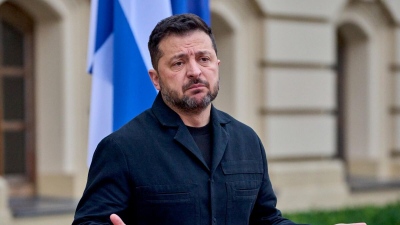
While Zelensky reportedly asks Turkish President Recep Tayyip Erdogan to organize a meeting with Putin in Turkey and Russia invites the Ukrainian president for negotiations in Moscow, Russian and Ukrainian analysts maintain this represents yet another scam by Zelensky. Ukrainian MP Artem Dmytruk characterized Zelensky's statements on readiness for negotiations as a "bluff," while former advisor to Leonid Kuchma, Oleg Soskin, said Zelensky avoids traveling to Moscow because he fears direct contact with Putin. For his part, political analyst Alexander Dudchak assessed that the sole objective of a potential meeting for the Ukrainian president is political self-promotion, as "Zelensky himself understands that this visit will yield no results," while Russian Senator Vladimir Dzhabarov characterized Zelensky as a political scammer. Dzhabarov argued that Zelensky gives the impression he is the winner of the so-called "special military operation" by attempting to dictate to Putin where their meeting will occur. "He has simply lost all sense of boundaries. He fails to realize that the situation is completely different and that he possesses absolutely no moral or political right to project demands toward our president," concluded the senator, defining Kremlin political rhetoric.
Shoigu (Russia): Poland and the Baltics train personnel to dismantle Russia — No attack on Europe
In Poland and the Baltic nations, individuals are being trained whose activity aims at destabilizing and dismantling Russia from within, argued the Secretary of the Security Council of the Russian Federation, Sergei Shoigu. "If we recall the past, these threats never vanished. On the contrary, they constantly intensified and always possessed one single goal: the dismantling of our country from within. Because external threats, of course, always existed, but Russia managed to address them," said Shoigu, maintaining that Western policy rests on confrontation and constantly requires an enemy, whereas Russia harbors no plans to attack Europe, impacting NATO eastern border tensions.
Sumy encirclement operation
Simultaneously at the front, Russians advance. During October, Russian forces registered significant progress in the Shostka bridgehead, securing control over the forest area east of the village of Korenyok, although as Russian media report, these specific territorial gains were not included in official statistics. The data is presented by Russian military analyst Dmitry Degtyarev, manager of the "Генеральный штаб" channel, citing information from soldiers in the field. As he maintains, forces of the Russian military group "North" closed the pocket between Pisarevka and Kondratovka and consolidated in the center of the town of Khoten, over which fierce battles have been waged for a long time, while also capturing Kiyanitsa, closing the pocket between Yunakovka and Mogritsa, and advancing significantly inside the Sumy forest from the latter. "This represents very, very significant progress in the Sumy direction. During October, the frontline noticeably approached the city. If we make a comprehensive summary, we find that in October our army brought under its control three settlements and 79 square kilometers in the Sumy region. The result is somewhat worse than September's, but still remains very good for the region," Degtyarev reported, detailing Sumy regional advances.
Advance in Kharkiv as well
During the past month, in the Kharkiv direction, Russian forces captured the village of Novaya Kazachya and now advance toward Tsupovka. They also captured Bugaevka, Alisovka, and Vysokaya Yaruga. Overall, according to Degtyarev, a specific dynamic is observed and operations continue for advancing toward Kharkiv. One of the most important advances, although limited in distance, took place in the direction of Liptsy, which constitutes the shortest but also one of the most difficult routes toward the regional capital. Degtyarev explained that not all developments are reflected on maps. By his assessment, in October the Russian army captured 17 settlements and 332 square kilometers of territory in the Kharkiv region, altering Kharkiv frontline positions.
What happened in Lyman
One of the most difficult sectors of the front during the past month was that of Lyman. However, any map originating from Russian, Ukrainian, or Western open-source intelligence (OSINT) analysts fails to reflect the true frontline disposition. The reason is that map corrections, through which areas were removed from the Russian control zone, were executed with a one-month delay. Degtyarev notes: "The areas removed from Russian control on Lyman sector maps are not territories we lost in October, but areas already lost in September. Reflecting these losses was delayed and occurred only in mid-October. Therefore, in reality, during October we lost nothing in this sector and fulfilled our core objective, namely stabilizing the frontline at Lyman. In September discussions occurred that Ukrainian forces would cross the Zherebets River, enter the Serebryansky forest, and potentially reach Kreminna. As you see, none of these apocalyptic scenarios materialized. Our soldiers managed to stabilize the front along the Zherebets and retain even small bridgeheads on the west bank," reshaping Lyman sector intelligence.
Defensive posture at Slovyansk, full-scale assault on Dobropillya
As expected, fierce and self-destructive Ukrainian attacks near Lyman worsened the situation in the Slovyansk direction as well. Russian forces were compelled there too to transition to a defensive posture, as they had to support neighboring units. However, according to Degtyarev, the most significant success of October was the rapid capture of Dobropillya, utilizing new tactics by the Russian military group "Center." Without awaiting the full neutralization of the Ukrainian garrison in Dobropillya, Russian forces continued their advance toward Belozerskoye, weakening enemy supply lines. Degtyarev stated: "During October, our army captured eight settlements in the Donetsk People's Republic, including one city, and 97 square kilometers of territory. Ukrainian forces recaptured, if we include delayed map corrections in the Lyman sector, 161 square kilometers. However, I repeat that more than 100 square kilometers of these were incorrectly calculated as October losses. In reality, Ukrainian forces had recaptured them earlier. In the Slovyansk and Kramatorsk directions I also do not expect particularly significant developments," impacting Donetsk military maneuvers.
Difficult target of capturing Donbass in 2026
Particular interest attaches to the fact that rumors previously circulated online claiming the Chief of the Russian General Staff had reportedly confirmed the intention to fully capture Donbass by the end of the year. Such a target appears rather difficult to achieve. It comes as no surprise, according to Russian media, that the original source of this information was Ukrainian military intelligence (GUR), with the aim of later claiming Russia failed to fulfill its goal, defining Donbass operational timelines.
Assault on Zaporizhia
In the Zaporizhia direction, according to the Russian military analyst, Russian forces captured two villages, Samoylovka and Golubkovo. Degtyarev explained: "However, the situation worsened in the Orikhiv area, as Ukrainian forces transferred additional reinforcements there and we failed to complete the city's capture in October. In the Zaporizhia direction we also recovered part of the territory in the Lukyanovskoye area. Overall, during October, our army captured nine settlements and 112 square kilometers in the Zaporizhia region," reshaping Zaporizhia combat developments.
What is happening in Kherson
Developments are also occurring in the Kherson region. Usually, significant changes are not recorded in this sector, but in October Russian forces crossed the Dnieper River at one point and established a bridgehead on Somovaya Kosa island. The extent of the advance is estimated at approximately six square kilometers. While a regime of relative calm prevails in the Oleshky and Kherson areas, Ukrainian armed forces maintained that Russians are preparing for further military operations. According to Ukrainian claims, Russian forces are concentrating ammunition and reserves and reportedly preparing to launch an offensive against Kherson as early as November 3. As noted, such preparations are expected, since a truce does not equate to peace, driving Dnieper river crossings.
Belousov's visit
Amidst this climate, it became known that Russian Defense Minister Andrey Belousov visited the zone of military operations and inspected the execution of missions by formations and units of the military group "Dnipro." Belousov was briefed by commanders regarding the current situation and the nature of Ukrainian army operations. Many wonder whether the minister's visit to the headquarters of the "Dnipro" group connects with a potential intensification of operations in the Kherson direction. This specific military group has carried out, since September, three successful attempts to cross the Dnieper River. However, according to Russian media, the most likely scenario is that an intensification of the assault against Orikhiv and an advance of Russian forces toward the administrative limits of Zaporizhia city will soon occur, influencing Russian military command.
"Filin" went hunting in Ukrainian skies
Meanwhile, Russia continues expanding its arsenal of aerial strike assets at a rapid pace. New versions of jet-powered drones appear one after another, while older models are equipped with new systems and assume missions for which they were not originally designed. In reality, the field of aerial warfare today resembles a boiling cauldron filled with technological experimentation and devastating strikes. However, even within this environment, the appearance of a new missile constitutes an event deserving separate examination. The missile is named Filin and, according to the Main Directorate of Intelligence of the Ministry of Defense of Ukraine (GUR), has been used to conduct attacks since August of this year. The Filin is a small cruise missile designed according to the philosophy of mass-produced rocket-powered weapons, redefining jet drone technology.
A highly interesting... "little bird"
According to data published by the Ukrainian side, the missile has a length of 3.5 meters and a wingspan of 3 meters. Its range is estimated at 1,200 kilometers and its speed at 800 kilometers per hour. The Filin (meaning "Eagle Owl") can execute low-altitude flights but also climb up to 6,000 meters, where it proves difficult to engage by automatic anti-aircraft guns and interceptor drones. One of its distinct features is the extensive use of composite materials in fuselage and wing construction, primarily carbon fibers and glass fibers. Certain components have been manufactured using 3D printing, a practice generally uncommon in the Russian defense industry but widely used by Ukrainian and European companies, altering composite missile design.
Carries 100 kg warheads
The Filin is equipped with the R500 turbojet engine by the Russian company "Reynolds." Similar engines are used in the air-launched low-observability missiles S-71K "Kovyor" and S-71M "Monokhrom." Furthermore, the Filin features common communication and control systems with other jet drones and small cruise missiles. The missile can carry warheads weighing 50 or 100 kilograms. Consequently, the warhead can be selected depending on target type, while its weight is expected to affect range, altitude, and flight speed, influencing tactical cruise missiles.
Reaches as far as Lviv
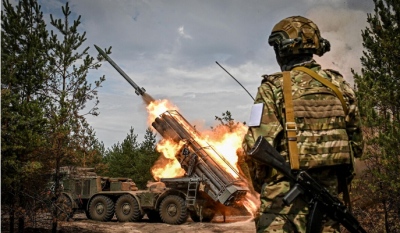
Certain features stand out immediately on the Filin. First, it is evident that the missile was not designed to counter an abstract future adversary, but specifically for operations against Ukraine. With a range of 1,200 kilometers, the Filin can reach as far as Lviv without difficulty if launched from the Rostov region. The capability to strike targets in Western Ukraine from primary Russian drone launch facilities renders the Filin a particularly useful weapon system for the Russian army. The flight speed of 800 kilometers per hour constitutes an exceptionally successful compromise. On one hand, it makes the missile a difficult target for most Ukrainian air defense systems, while on the other it does not impose excessive technical demands on the engine and aerodynamic system of the missile. Overall, a balance is observed between weapon manufacturing simplicity—meaning suitability for mass production—and its relatively high effectiveness in the operational field, impacting long range strike capability.
Russian-made turbojet engine
Specialized observers pointed out that the missile features a Russian-made turbojet engine. This represents a particularly significant element, as the lack of such engines constituted for a long time an obstacle to the widespread deployment of jet-powered drones, with which the Russian army had begun experimenting as early as late 2023. Equally important from a tactical perspective is the fact that the Filin is designed for launch from ground-based launchers. This permits greater stealth in launch preparation and decouples launch intensity from operational and tactical aviation capabilities. Aircraft can continue their own missions, while the Filin acquires required altitude and speed for turbojet activation with the assistance of an inexpensive solid-propellant booster, defining ground launched missiles.
Why does the Russian army need yet another missile?
One might wonder why Russia needs another missile when it intensively uses the light cruise missiles "Banderol" and "Dan-T," mass-produces and uses the jet drones "Geran-4" and "Geran-5," while a jet version of the "Garpiya" has also appeared. The answer is simple. Utilizing the same core components, such as the engine, the jam-resistant 12-channel CRPA antenna "Kometa-M12," flight computers, and other systems, but varying the fuselage shape and size, fuel tank capacity, and warhead weight, munitions suitable for different tactical, operational, and strategic missions can be created. Furthermore, analysts reference another key feature: "Ground launch is also exceptionally important. First, because the opponent constantly monitors ships, submarines, and aircraft—meaning missile transport platforms—and detects their approach to launch areas. Here, however, we simply have a crew of a few people: they arrive in a vehicle, quickly set up the launcher, execute the launch, immediately disassemble equipment, and depart," cementing asymmetric warfare tools.
www.bankingnews.gr









Σχόλια αναγνωστών