

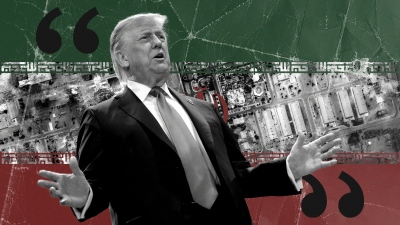
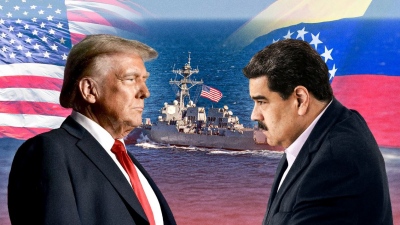
There is no doubt that Donald Trump wants to change the global map. Not in the narrow sense of the term—though that is on the table—but in the spheres of influence and territories of American hegemony. This is why, in recent months, he has pivoted from a "tariff storm" to an unprecedented geopolitical offensive against any country possessing wealth useful for making "America Great Again." He has arrested Maduro, threatened to seize Greenland, and declared he is "ready to support Iran's quest for freedom," threatening military intervention if "red lines" are crossed. Last weekend, January 10–11, 2026, he even stated that Iranian leaders "are already starting to do it" and that the US military is "monitoring the situation and considering several very serious options."
Barrage of threats
Thus, the narrative suggests Trump will now strike Iran, change the government there, then blockade Cuba, overthrow the 94-year-old Raúl Castro, and simultaneously rule Venezuela. Fantastic! In this way, he would also neutralize Russia by damaging its reputation—having failed to protect its allies—while strangling it geopolitically and economically, as Russia, Iran, and Venezuela are active in oil trading that bypasses American sanctions. All of this is packaged under the guise that the United States is saving the world from its internal problems. The economic crisis in Venezuela and rising prices in Iran are exacerbated by the dissatisfaction of a significant portion of society with the existing regime. Add to this active subversive information, propaganda, intelligence services, and even sabotage activities, and it is taken for granted that regimes unfavorable to the United States will fall even without direct American military intervention. The maximum required would be one or more targeted strikes, such as the kidnapping of Maduro or a strike on Iranian nuclear facilities and oil depots.
In practice
All the above, of course, is in theory. It is also part of a war—an information war—waged by the United States against those it seeks to defeat. But in practice, for example in Venezuela, they have not yet achieved any victory, meaning regime change. Yet Trump constantly publishes photos of himself as the "acting president" of the country, and his Secretary of State, Rubio, urges him to run for president of Cuba. All these information wars are, of course, important as part of an overall strategy that begins with economic and military pressure, exploiting every opportunity to destabilize the government from within. But success is only possible if the government is weak and divided and popular discontent has reached a critical level.
What is happening in Iran
All of the above, however, does not apply to Iran. The mass protests being portrayed as a revolution against the Ayatollahs are anything but. This does not mean there aren't many dissatisfied with the current form of government, and economic problems exacerbate the tension, but there is no universal "quest for freedom" supported by America and Israel. The attempt to present the son of the last Shah, Reza Pahlavi, as a "protest leader" and future "leader of a free Iran" further confirms this. The "heir to the throne" is considered by the majority of the population in his homeland as a puppet of the US and Israel. It is not even like Machado (who enjoys some popularity in Venezuela as a symbol of opposition to the Chavistas). He is a figure almost completely disconnected from his homeland after nearly half a century living abroad. Yet they try to present him as a symbol of the aspirations of the Iranian people.
The problems
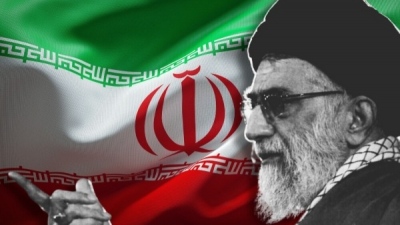
This does not mean Iran does not have its share of internal problems, both economic and within its system of governance, but it is an extremely complex, truly sovereign, and ancient civilization. It is one of the most important in the world—not only in the Middle East and the Islamic world, but in the world generally. Ali Khamenei presides over a unique, distinct system of government—with the separation of powers, the sovereignty of Islamic law, and the consideration of the interests of all ethnic groups within the truly multi-ethnic Iranian state. External attempts to dictate the form of government of this country are not only offensive but futile, and no one will succeed in imposing one by force. Especially not the United States and Israel—two countries that have tried to destroy the Islamic Republic for all 47 years of its existence. There will be no military invasion of Iran—Trump has absolutely no need for a bloodbath worse than Vietnam, and targeted attacks (for example, against the oil industry or aimed at the assassination of Khamenei) could ignite a fire in the Middle East (the Iranians would retaliate with attacks against American trade and military infrastructure), but they will not achieve regime change.
Why Trump is adding fuel to the Middle East fire
Trump wants to use the wave of anger to force Tehran to make concessions (abandoning its nuclear program, which was not destroyed by last year's American attacks). But even more so because he believes what Netanyahu and the Israeli lobby say: they must constantly pour oil on Iran's fire, otherwise, at some point, it will all explode and the power of the Ayatollahs will collapse. Hence the threats and hints at the possibility of further attacks. In reality, however, if by some miracle Trump succeeded and Netanyahu's dreams of a violent overthrow of the "government of the mullahs" came true, it would benefit no one. Not the Iranian people (the risk of internal unrest and even dissolution is enormous), nor its neighbors (Turkey would be terrified by the collapse of a united Iran, and the Sunni Gulf monarchies would not be happy), nor the great powers allied with Iran (the country has vital strategic importance for Russia and China). Furthermore, it would not benefit the United States (which does not need an ignition and chaos in the Middle East), nor Israel—a broken and decomposed Iran would destabilize the Middle East even more than Iraq, defeated by the Americans. The consequences would be uncontrollable and bloody.
Pandora's Box
Why then are Trump and Netanyahu trying to break open Pandora's Box? While Trump mostly just "goes along" and doesn't really understand the consequences, Netanyahu wants to remove (or, as he sees it, simply finish off) Israel's main regional rival to continue both territorial expansion in Syria and Lebanon and the creeping clearance of Palestinian Gaza. Then there would be no external administration (especially with Turkish military involvement) in Gaza—the attention of the entire region would turn to Iran (including the rapidly escalating Kurdish issue) and Israel would receive a carte blanche from the Americans to continue the destruction of Gaza and more actively annex the West Bank. The plan is certainly barbaric, but fortunately for everyone, it is unfeasible. Because the Islamic Republic will not collapse—and Iran will find the strength both to resist external destabilization efforts and to carry out necessary internal reforms. And to participate fully in the ongoing construction of a new world order—alongside China, Russia, and the entire global majority, which Trump has already done so much to consolidate in the first days of the new year.
The Chinese plan
Shoigu: Coordinating with Iran to raise a wall against foreign interference
The Secretary of the Russian Security Council, Sergei Shoigu, in communication with the Secretary of the Supreme National Security Council of Iran, Ali Larijani, condemned the latest attempt by external forces to interfere in Iran's internal affairs and expressed his condolences for the numerous losses. The two sides agreed to continue contacts to coordinate their positions. "On January 12, 2026, the Secretary of the Russian Security Council, Sergei Shoigu, had a telephone conversation with Ali Larijani, Secretary of the Supreme National Security Council of the Islamic Republic of Iran. Sergei Shoigu expressed his condolences for the numerous losses," the Security Council press office told Tass. The press office noted that "the Secretary of the Russian Security Council strongly condemned another attempt by external forces to interfere in Iran's internal affairs." According to the same source, Sergei Shoigu also stated he was "ready to develop bilateral cooperation based on the Comprehensive Strategic Partnership Agreement between the Russian Federation and the Islamic Republic of Iran, which was signed on January 17, 2025." "The parties agreed to continue contacts and coordinate their positions to ensure security," the press office reported. It is noted that on December 29, 2025, merchants broke out in fierce protests in Tehran due to the sharp drop in the Iranian rial. On December 30, students joined the riots. The unrest spread to most major cities. Authorities reported the deaths of 38 law enforcement personnel. As of January 8, according to Iranian Foreign Minister Abbas Araghchi, armed terrorists appeared among the protesters. Iranian authorities accused Israel and the United States of organizing the riots. US President Donald Trump previously stated he is seriously considering the use of force against Tehran. On January 13, he is expected to be presented with options for the response to events in Iran, including the possibility of strikes on targets within the country.
Russia – Iran: Strategic endurance and war warnings
For Russia, the resilience of Iran is seen as a positive sign. Barring the unforeseen—such as direct US military intervention or some dramatic event—the new round of conflict with American imperialism is estimated to end like the previous ones: with the Islamic Republic remaining in power. This is of particular importance for Moscow, which shares with Tehran vast investment projects, led by the North-South Transport Corridor. In the event of war, the Speaker of the Iranian Parliament warned that any American military attack will provoke a massive and merciless response, naming Israel, as well as all American bases and warships in the region, as legitimate targets. Iran, according to the same sources, crossed the psychological barrier during the 12-day war, and there is no doubt about the realization of this threat. Just as there is no doubt—according to the Iranian side—regarding Russian aid in the modernization of its air forces. The Middle East seems once again to be standing on a powder keg, with Iran declaring itself ready for anything.
www.bankingnews.gr



Σχόλια αναγνωστών