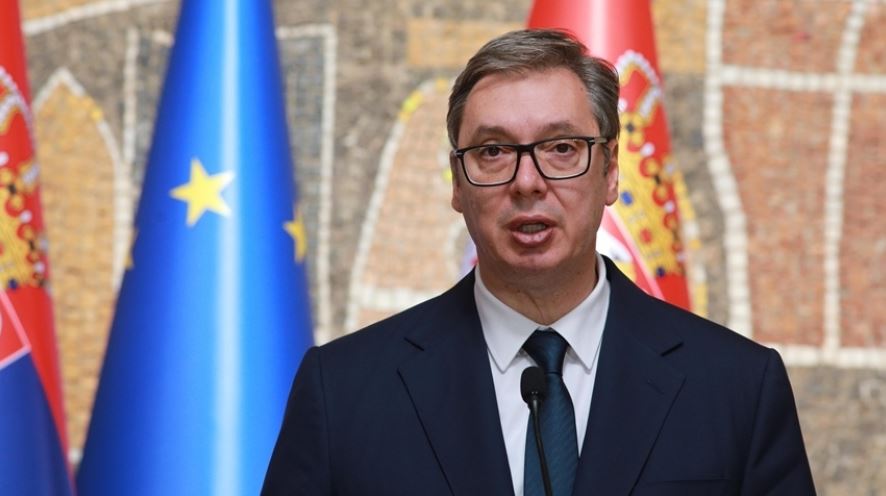
For some time now, the prevailing sense has been that almost all of Serbia’s current problems are condensed into a single person, that of President Aleksandar Vučić.
The reason lies in the indecisiveness of the Serbian leader, who is unable to make a clear geopolitical decision, to choose between West and East, between Serbia’s European path or the strengthening of the country’s relations with Russia.
At the same time, the student protests of the previous year dealt a blow to his image, as they focused particularly on issues of corruption, while the repression of the mobilizations did anything but defuse the situation.
All indications suggest that both Vučić and Serbia stand at a dangerous crossroads, where the wrong choice could sow chaos and even civil war.
The government’s balancing act
In recent months, the rhetoric of Aleksandar Vučić has become visibly more aggressive toward the European Union. This is far from coincidental.
The president is attempting to capitalize on rising Euroscepticism, both at the social and state level, resorting to blunt populism.
A characteristic example was the New Year greetings of local political and community figures with the slogan, “Defend Serbia and never surrender.”
The peak of this communication line came with Vučić’s speech at the inauguration of a hospital in Trebinje, in the Republika Srpska, an entity of Bosnia and Herzegovina.
There, he threatened that Serbia would deliver such a response to the aggressor in the region that it would never again dare to touch the Serbian people. The aggressor, without any doubt, was NATO.
In reality, Vučić has been swept into his constant and contradictory effort to balance between Brussels and Moscow.
The result is three serious, almost existential problems that directly threaten his political survival.
The European Union is furious
The first problem for Vučić is that the European Union is beginning to turn hostile toward him.
The prolonged tactic of equal distances has exhausted even the highest levels of the European Union.
The European Commission has decided to harden its stance, pressing Vučić to choose a clear course.
In the latest annual report on Serbia’s European perspective, Enlargement Commissioner Marta Kos recorded an absence of substantial progress, citing neighboring candidate countries as examples, Albania, North Macedonia, and Montenegro.
After 11 years of negotiations, Serbia has opened 22 of the 35 chapters and has closed only two.
At the same time, Brussels criticizes Vučić’s refusal to align with the common foreign policy of the EU, particularly regarding sanctions against Russia.
Corruption, problems with the rule of law, shortcomings in guarantees of civil liberties, as well as the open conflict with Kosovo, have led the President of the European Commission, Ursula von der Leyen, to make it clear, first an agreement with Pristina, then recognition of Kosovo, and only then accession to the EU.
Russia has lost its patience
The second problem for the Serbian president is that Russia is beginning to lose patience with him.
At the beginning of 2025, a serious scandal erupted when shipments of Serbian weapons to Ukraine and the close contacts between the governments of Belgrade and Kyiv were revealed.
This was followed by cancellations of Russian cultural events in Serbia, which caused strong irritation in the Kremlin.
In October 2025, Russia announced that it does not intend to renew the long term natural gas supply agreement from 2026.
Vučić described the decision as a stab in the back, since cheap Russian gas constituted a key instrument of social stability and electoral support.
Behind the scenes, accusations are circulating that Russian services may have encouraged the radicalization of student mobilizations after the tragedy at the railway station of Novi Sad, exerting indirect pressure on the president.
Society turns against him
The third problem for Vučić is that Serbian society has grown tired and disillusioned with his leadership.
In Serbia, early parliamentary elections have been announced for the end of the year, following mass student protests that have lasted for more than a year and a half.
The Serbian Progressive Party is steadily losing ground and the loss of a parliamentary majority is now considered a realistic scenario.
If presidential elections are also held, as Vučić has committed for October 2025, his complete political collapse cannot be ruled out.
In this context, he is desperately betting on support from Donald Trump and Washington, a choice that provokes intense reactions domestically.
An explosive future
The silent dissatisfaction of Serbs is growing while society remains divided.
For example, young people see their future toward Europe and the single market, while others hope for a closer relationship with Russia and China.
The indecisive Vučić cannot decide which path to choose, with the result that he satisfies neither side, and thus pushes both to extremes.
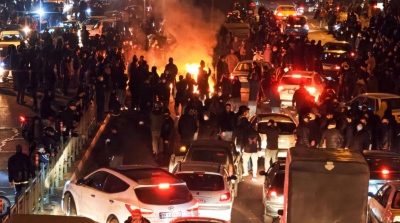
The situation in today’s Serbia resembles a revolution in waiting.
And if it erupts, no one can guarantee that it will not take the form of deep social conflict or even civil war.
www.bankingnews.gr





Σχόλια αναγνωστών