

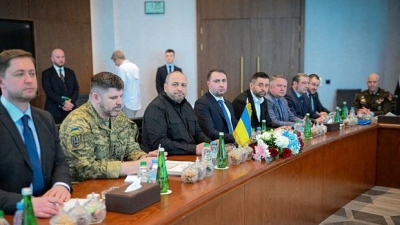
Diplomatic developments in Ukraine are moving at a breakneck pace, with Kyiv and its Western allies signing a pre-agreement on security guarantees. The document provides for the intervention of European armies within 72 hours should Russia violate a future ceasefire. Naturally, such a move implies an uncontrolled, unprecedented, and global-scale conflict between NATO and Russian troops, as Moscow perceives foreign intervention on the Eastern Front as a casus belli.
Moscow refuses to accept the deployment of foreign military forces in Ukraine as security guarantees, adding that should this occur, foreign troops will become a "legitimate target for destruction," the Secretary of the Russian Security Council, Dmitry Medvedev, reiterated to Reuters yesterday, 2/2. In this light, negotiations between the US, Russia, and Ukraine, expected to resume tomorrow, 4/2, in Abu Dhabi, appear to be heading toward a definitive derailment, as Moscow signals it will fulfill the strategic goals of its special military operation to the end.
FT bombshell: Ukraine, US and Europe sign pre-agreement on security guarantees
Specifically, Ukraine and Western countries have signed a plan to support a potential peace deal between Moscow and Kyiv, the Financial Times reports. The document provides for a "coordinated military response" in the event that Russia violates the peace in Ukraine, allowing for the direct involvement of European and US armies.
Furthermore, NATO Secretary General Mark Rutte promised that a "coalition of the willing" would deploy troops on Ukrainian soil immediately after the conflict ends.
What the plan stipulates for potential ceasefire violations
Authorities in Ukraine, the United States, and European countries have agreed on a plan to back an eventual peace agreement between Moscow and Kyiv, the Financial Times reported, citing sources. According to the publication's sources, the West expressed readiness to provide a "coordinated military response" in the event of a "sustained violation" of the treaty by Russia.
"This proposal was repeatedly discussed by Ukrainian, European, and American officials in December and January. It provides for a multi-layered response to any violations of the agreed ceasefire," the newspaper states.
‘Diplomatic warning’ in the first 24 hours, total conflict within 72 hours
In the first 24 hours following a hypothetical ceasefire violation, Western countries would issue only a diplomatic warning, while only the Ukrainian Armed Forces would take actual action. If fighting continues, the second phase of the plan would be activated, under which the so-called "coalition of the willing" would intervene.
In the event of further escalation and the launch of a large-scale offensive, Western armies, including the US Armed Forces, would launch coordinated military action. This is expected to occur 72 hours after the first violation of the ceasefire. The FT reminded that the UK and France have already expressed their willingness to send troops to Ukraine immediately after the cessation of hostilities as part of security guarantees.
Rutte: NATO ready to send troops to Ukraine
For his part, NATO Secretary General Mark Rutte, speaking to the Verkhovna Rada on February 3, confirmed that members of the alliance plan to send military personnel to Ukraine immediately after peace is concluded with Russia.
"As soon as a peace agreement is reached, there will immediately be armed forces, aircraft in the air, and support at sea from those in NATO who have agreed," the Secretary General stated. He added that other members of the bloc would not remain idle and "will help in other ways."
‘A new Minsk must not be repeated’
Furthermore, alongside providing support to Ukraine, NATO will "exert pressure on Russia." At the same time, Mark Rutte stated that a potential peace agreement must not be a "repetition of the Budapest Memorandum or the Minsk Agreement."
He also echoed a statement made the previous day by the head of European diplomacy, Kaja Kallas, that Kyiv would have to make "difficult decisions" to end the conflict.
Russia: Sending NATO troops to Ukrainian territory is a casus belli
It is noted that on February 2, the Russian Ministry of Foreign Affairs reminded once again that Moscow is categorically opposed to the deployment of Western military contingents in Ukraine.
"The deployment of military units, military facilities, warehouses, and other infrastructure of Western countries in Ukraine is unacceptable to us and will be characterized as foreign intervention constituting a direct threat to Russia’s security." The ministry also pointed out that "these steps by Kyiv and its guardians" are being taken into account when determining Russia's negotiating position.
‘Russia will not back down in light of unrealistic proposals’
In fact, the chairman of the State Duma Defense Committee, Andrei Kartapolov, speaking to the Russian Gazeta.Ru, argued that the FT report on a purported peace support plan agreed upon by the West is actually an attempt to pressure Russia.
"First, no peace agreement has been signed yet, so it makes no sense to talk about future documents whose content no one knows. Second, such publications are a traditional attempt to pressure Russia into doing something we do not want to do," the deputy stated. He concluded by saying that the conditions described in the article do not suit Moscow at all and, therefore, it will be opposed to the inclusion of such clauses in a potential peace treaty.
Medvedev: NATO troops in Ukraine are a legitimate target – it is a standard invasion
It is noted that just yesterday, 2/2, Dmitry Medvedev spoke about the negotiations regarding the conflict in Ukraine. He underlined that Moscow and Washington have agreed not to publicize the content of the negotiation process so as not to undermine the achievement of a result.
However, he reminded that Russia’s terms for peace have already been formulated by Russian President Vladimir Putin in a meeting with the Foreign Ministry and remain unchanged. He admitted, however, that the territorial issue remains the most complex.
"People often say that 95% or 90% of the agreement has been reached. There is no numbering here," Medvedev clarified. He also referred to security guarantees, noting that they cannot be unilateral as they would be ineffective. He reiterated that Moscow does not accept the deployment of foreign military forces in Ukraine as security guarantees, adding that should this happen, the foreign forces will become a "legitimate target for destruction."
www.bankingnews.gr


Σχόλια αναγνωστών