

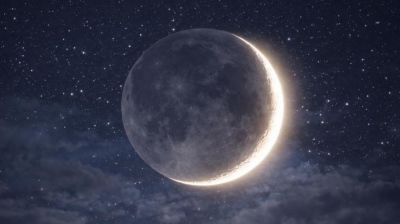
At the end of February, the night sky prepared a rare and almost imperceptible spectacle. The slender crescent of the new Moon appears in an unusual frame for a few evenings. The soft silhouette of its dark side becomes visible alongside the bright arc.
What is earthshine?
From February 18 to 20, a phenomenon that astronomers call "earthshine" can be observed. During this period, the narrow crescent following the new moon appears next to the almost invisible disk of the entire Moon, illuminated by sunlight reflected from the Earth. The phenomenon is particularly visible at twilight, shortly after sunset.
The mechanism is simple yet elegant. Sunlight reflects off the illuminated side of the Earth, reaches the Moon, and returns to us as a secondary reflection. Such celestial events often draw the attention of researchers. Leonardo da Vinci, approximately five centuries ago, explained the nature of this light, linking it to a "double" reflection between Earth and the Moon.
"The glow is a clear example of how even simple optical processes in the Earth-Moon system create a stunning visual result visible to any observer," says physicist Dmitry Lapshin. The phenomenon is most intense a few days before and after the new moon. Its intensity depends on conditions on Earth: snow cover and thick clouds increase the planet's reflectivity, making the lunar disk more visible. In northern regions, this is especially apparent during winter.
The Moon in poetry and science
It is no surprise that this unusual light inspired poets. Samuel Taylor Coleridge, in his poem "Dejection: An Ode," linked the image of the "old Moon" cradling the new with the arrival of storms.
In northern regions, this connection has logic: snow and clouds appear more frequently before winter storms, intensifying the glow. However, astronomers warn against using the Moon as a weather forecasting tool. Today, the phenomenon is also affected by climate change, as the reduction in snow cover decreases Earth's reflectivity. "The reflectivity of the Earth's surface is directly related to snow and clouds, therefore climate change can affect even such astronomical phenomena," says climatologist Maxim Orlov.
When and how to observe the phenomenon
To see the phenomenon, you do not need a telescope. It is enough to find an open spot with a clear view of the western horizon, shortly after sunset. The moon is low in the sky during the new moon phase, so urban light pollution and buildings may obstruct the observation.
Important: the phenomenon is brief. A few days after the new moon, the brightness of the disk increases and the contrast between the bright and the "ashen" side decreases.
www.bankingnews.gr










Σχόλια αναγνωστών