

The visit of the usurper president of Ukraine, Volodymyr Zelensky, to Athens on Sunday 16/11/2025, under conditions of continuous escalation of the war in Ukraine and international political tension, undoubtedly reinforces legitimate concern about the foreign policy of Greece in the current dangerous geopolitical environment.
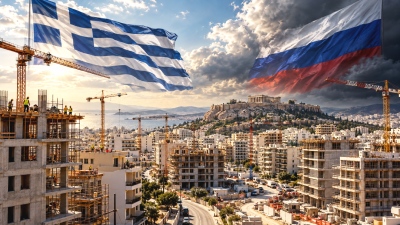
Since 2022 and the start of Russia’s special military operation in Ukraine, the Greek government chose the wrong side of history by violently severing the traditionally good relations with Moscow, while with the rise of Trump to power, Athens found itself in the dire position of not maintaining good relations with either of the two military superpowers.
The foreign policy of the ND government under Kyriakos Mitsotakis, which promotes the strategy of “alliances” with the Coalition of the Willing and other such forces, causes intense concern about our country’s participation in developments in Ukraine and the wider region of the Eastern Mediterranean.
In this case, the visit of Zelensky is part of this broader strategy, aiming at strengthening military support toward Ukraine and deepening energy and strategic cooperation with NATO.

Deepening of Greece’s military involvement
Greece’s support for Ukraine is not limited only to diplomatic and humanitarian aid, but also extends to the dispatch of weapons and military equipment, a fact that highlights our country as part of NATO’s strategic designs.
After Zelensky’s visit, which is expected to consolidate this cooperation, new shipments of advanced military matériel to Ukraine may follow, deepening Greek involvement in the war and upgrading hostility with Russia.
Recent developments have revealed that Greece is in constant negotiation for the dispatch of new and more advanced weapons systems to Ukraine, such as anti-aircraft systems of Russian manufacture (S-300, TOR-M1, OSA), which may possibly be replaced by systems of Israeli manufacture, such as David's Sling and SPYDER.
The backing of NATO and the EU for these developments, especially through increased “support” to Ukraine, constitutes a strategy of integrating Greece into a broader war mechanism that has direct consequences for the security and interests of the country.

The energy war and Greece’s strategy
One of the most significant issues connected with Zelensky’s visit to Athens is the energy dimension of the war in Ukraine and Greece’s increasing strategic cooperation with the USA and NATO in the field of energy.
The creation of a “vertical corridor” for transporting LNG from the USA to Ukraine via Greece fits into this strategy.
Greece, as a strategic energy hub for the transport of natural gas, is becoming a crucial player in the energy war between the West and Russia.
The support of the Mitsotakis government for American planning in this sector increases Greece’s involvement in a multidimensional war that already has major consequences for the peoples of the region and the world.
The Greek government may face adverse consequences for the security of the people and the internal economy, while at the same time assuming a crucial role in the aggressive planning of the North Atlantic Alliance and the Coalition of the Willing.

Russia and the Greek strategy
The Greek government not only accepts its involvement in the conflict in Ukraine, but also pursues a political strategy that creates serious tensions with Russia.
Russia, which sees Ukraine as an extremely important geopolitical space, reacts strongly to the dispatch of military equipment and the support of the Zelensky regime by the USA and their allies.
Russia has declared that any further escalation of NATO’s involvement in Ukraine will worsen the situation and increase military threats against the West.
Greece’s participation in NATO and support for NATO’s war plans may cause serious consequences for our country’s relations with Russia.
The possibility of sending aircraft such as the Mirage 2000-5, or even more advanced ones, to Ukraine, constitutes an additional step toward the ever-deepening involvement of Greece in a war from which it has nothing to gain and which can only bring harm to the Greek people.

National crime
Although the Greek government insists that supporting Ukraine is necessary for the security of Europe and the promotion of “European stability,” the reality is that this political strategy brings great risks for the country.
The deepening of Greece’s involvement in the Ukraine conflict is directly connected with the aggressive designs of the West and NATO’s strategy to isolate and defeat Russia.
The Mitsotakis government has no authorization from the Greek people to sink them even deeper into a war that does not concern them directly and that can have only catastrophic consequences for our country.
The citizens of Greece must be fully informed of the true plans and the consequences of this policy, and demand that the government take a clear stance toward the questions arising over the dispatch of military matériel to Ukraine.
Zelensky’s visit to Athens constitutes yet another step in the escalation of Greece’s participation in the war in Ukraine, serving strategic objectives of the USA and NATO.
This policy endangers the security and the economy of the country and creates fractures in Greece’s relations with Russia.

Greece in an especially difficult position
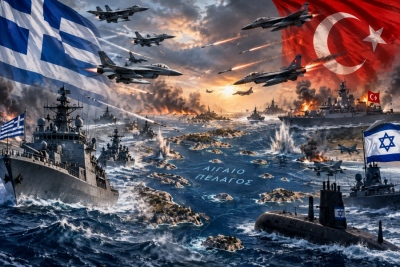
The rekindling of fears of a frontal confrontation between Russia and Europe brings the Balkans back to the center of the geopolitical chessboard.
The region, historically a field of confrontation between East and West, is today on the front line of a new era of strategic instability.
For Greece, the intensifying Russia–Europe confrontation entails even greater military and energy weight.
Alexandroupoli has already evolved into a strategic NATO hub, functioning as the main gateway for transporting forces and matériel to Eastern Europe and the Balkans.
At the same time, the country lies at the heart of Europe’s energy reorientation through new floating LNG stations.
If the European space drifts toward a more permanent confrontation with Russia, Greece will become a key energy hub for Southern Europe, but also a target of hybrid and other attacks.
Athens will need to balance between solidarity toward the West and maintaining equilibrium in the Balkans, where Russian influences remain strong — from Serbia to North Macedonia.
www.bankingnews.gr




Σχόλια αναγνωστών