

Erdogan left no room for misinterpretation. In a speech, he openly referred to the production of Tayfun missiles and the anxiety it causes the Greek side regarding their capability to bomb Athens. "Well, of course it will happen," he reportedly said with characteristic ease, according to broadcast reports.
The Turkish president even described such an action as the only option, in case Greece continues to arm the Aegean islands instead of remaining "stagnant". The statement comes in the wake of a previous report showing Erdogan signing his name on the new missile during a relevant ceremony. The Tayfun missiles constitute a ballistic system that, according to Turkish announcements, has the capability to strike targets at a long distance.
These developments are recorded during a period of tension surrounding armaments movements in the Aegean, with Ankara frequently repeating its objections to Greek actions on the islands. So far, there has been no official reaction from the Greek government to this latest positioning.
Ο Ερντογάν απειλεί ευθέως την Αθήνα με βομβαρδισμό.
— olympiaGR (@olympiada) May 18, 2026
Μάνφρεντ Βέμπερ, ευχαριστούμε για την στήριξη στον Ακύλα. pic.twitter.com/aLZQ37jpFj
Conflict is a matter of time
Recep Tayyip Erdogan is abandoning mere words and moving toward the institutional shielding of revisionism, converting the doctrine of the "Blue Homeland" into a law of the Turkish state, reports the well-known Turkish analyst Sinan Ciddi in an article for the Middle East Forum. As he notes, this escalation does not constitute a mere bureaucratic move, but a deliberate strategy aimed at trapping Greece, which limits the margins for diplomacy and brings the two countries closer than ever to a fateful conflict.
More specifically, according to Sinan Ciddi, Turkey is seeking once again to alter the maritime borders of the East Mediterranean. According to a recent Bloomberg report, says Sinan Ciddi, Ankara is preparing legislation to entrench its claims in disputed maritime zones in the Aegean and the East Mediterranean. The proposed legislation reportedly incorporates the long-standing doctrine of the "Blue Homeland" (Mavi Vatan) into Turkish law, institutionalizing expanded claims that overlap with the exclusive economic zones claimed by Greece and Cyprus.
The "Blue Homeland" projects a maximalist interpretation of Turkey's maritime borders, which runs counter to the established maritime boundaries in the East Mediterranean. Through television stations, the printed press, and social media, various personalities, from top military officials to government executives and analysts, project maps of the "Blue Homeland", causing many Turks to believe that this revisionist interpretation of Turkish maritime borders is indeed real and accepted.
Although Ankara's new legislative initiative may initially appear technical or bureaucratic, it represents a deliberate and carefully calculated escalation by President Recep Tayyip Erdogan. This action aims to challenge the regional order in the East Mediterranean, exert pressure on neighboring states, and position Turkey as the dominant naval power between Europe and the Middle East.
The timing of this plan is particularly inappropriate. The East Mediterranean constitutes one of the most militarized and politically unstable regions of Europe. The conflict in Gaza, the heightened tensions between Israel and Iran, the instability in Syria, and great power competition have intensified regional anxieties. By attempting to institutionalize expansive maritime claims that run counter to international legal norms, Ankara risks turning long-standing disputes into a much more dangerous confrontation, Ciddi notes.
At the heart of the problem lies Turkey's rejection of the modern international framework for the law of the sea. Ankara is not a party to the United Nations Convention on the Law of the Sea (UNCLOS), the legal framework regulating maritime rights and exclusive economic zones. The United States is also not a party, yet successive American administrations comply with it and respect it because it is based on customary and established naval law.
Turkey, conversely, argues that Greek islands situated near the Turkish coast should not possess full maritime zones, particularly islands like Kastellorizo, which lies just a few miles from the southern coast of Turkey. In contrast, Greece and Cyprus insist that the islands are entitled to full maritime rights under international law. Even if Turkey believes it possesses a legal basis for its claims, it has pursued them less through diplomacy and more through aggressive rhetoric and open military threats against Greece and Cyprus.
In recent years, Turkey has repeatedly utilized naval deployments, seismic vessels, and military escorts to challenge Greek and Cypriot claims. Turkish research vessels operating in disputed waters have frequently triggered crises with Athens and Nicosia. In 2020, the deployment of the Turkish research vessel Oruç Reis into disputed waters, says the Turkish analyst, brought Greece and Turkey, both allies in NATO, to the brink of military conflict.
The current risk of escalation is undeniably greater compared to the past. In contrast to previous incidents, Turkey now seeks to institutionalize these claims through parliamentary legislation. This development is significant because it limits Erdogan's flexibility for compromises and reinforces the logic of confrontation as an element of state policy. Once such claims are legally codified, reversing them becomes politically costly domestically and strategically difficult internationally. Furthermore, Ankara's actions go beyond maritime border issues and form part of a broader revisionist foreign policy that Turkey has pursued across multiple regions over the past decade.
The example of Libya
According to Ciddi, Turkey's intervention in Libya in 2019 offers an instructive example. Ankara's military backing toward the Tripoli-based Government of National Accord was not merely ideological or geopolitical. In exchange for military support, Turkey secured a maritime delimitation agreement with Libya, which dramatically expanded Turkish claims in the Mediterranean, completely ignoring Greek maritime zones. In its most extreme version, the agreement even ignored the existence of the Greek island of Crete.
The European Union and regional states condemned the agreement as legally questionable and destabilizing. Similarly, Turkey has combined maritime claims with military coercion in other contexts. Ankara has deployed drones, naval forces, and missile systems in the East Mediterranean, while simultaneously intensifying nationalist rhetoric against Greece and Cyprus. Erdogan has threatened Greece that Turkey could "come suddenly one night," a statement that many Greek officials interpret as a direct military threat.
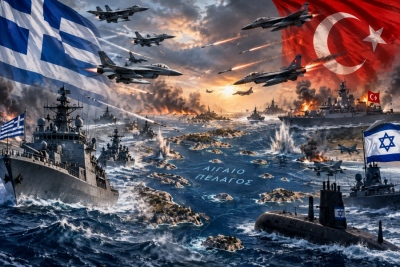
This combination of legal revisionism and military show of force creates a perilous environment. The risk of an accidental or intentional conflict between Greece and Turkey now constitutes a serious concern. Both countries maintain strong armed forces in close proximity in the Aegean. Airspace violations, incidents of tracking naval units, and competitive military exercises occur frequently. A clash, a miscalculation, or a politically motivated escalation could quickly evolve into a broader crisis that would involve NATO and the European Union.
Cyprus constitutes a volatile flashpoint. Turkey is the sole country that recognizes the Turkish Republic of Northern Cyprus and maintains tens of thousands of soldiers on the island after the 1974 invasion. Ankara increasingly connects maritime disputes with the energy exploration activities of Cyprus, threatening companies and states that cooperate with the internationally recognized Republic of Cyprus.
The most significant consequences transcend regional tensions. Turkey's actions undermine energy cooperation projects that could contribute to Europe's energy security amidst profound geopolitical uncertainty. These actions discourage investments, weaken diplomatic coordination, and intensify distrust among NATO allies at a time when Western cohesion is already under pressure. Ankara's stance is also likely to undermine its efforts to present itself as a new commercial and energy corridor, as evidenced by its plans to promote the "Middle Corridor" and the "Iraq Development Road".
The ideological framework supporting the Turkish naval doctrine also causes concern. The concept of the "Blue Homeland" does not constitute a mere defensive naval strategy; it reflects an increasingly nationalist and neo-imperialist worldview promoted by Erdogan and segments of Turkey's military and political establishment. This doctrine envisions Turkey as a dominant regional power with the right to project influence over expansive maritime areas, from the Black Sea to the East Mediterranean. This ambition brings Ankara on a collision course not only with Greece and Cyprus, but also with other regional state actors.
Turkey's defenders argue that Ankara is protecting its legitimate interests against attempts to exclude it from the energy arrangements of the East Mediterranean. While it is accurate that regional formats often exclude Turkey, coercion and legal revisionism do not constitute productive alternatives to diplomacy, writes the Turkish analyst. Instead of promoting regional integration, Turkey's actions risk intensifying its isolation.
In a period where the East Mediterranean needs de-escalation, energy coordination, and security cooperation, Ankara appears determined to provoke yet another crisis. The danger is that the Erdogan government may believe that confrontation serves Turkey's interests, mobilizing nationalist sentiments domestically and extracting international concessions. Erdogan seeks to be re-elected for a fourth presidential term, but he will need to display creativity so as to appeal to Turkish voters who are dissatisfied with his economic management.
Heightening tensions in the East Mediterranean constitutes a time-tested method that is likely to convince certain skeptical voters. Turkey's repeated escalations in the East Mediterranean have generated distrust, have led to the creation of anti-alliances, and have provoked growing concern within NATO regarding Ankara's long-term trajectory. The institutionalization of disputed maritime claims through legislation carries the risk of solidifying these divisions for years to come. In one of the most geopolitically fragile regions of the world, such a risk is something the region can hardly afford, Ciddi concludes.
www.bankingnews.gr









Σχόλια αναγνωστών