

Korkut was deployed publicly abroad for the first time by the Turkish army in Libya in 2020
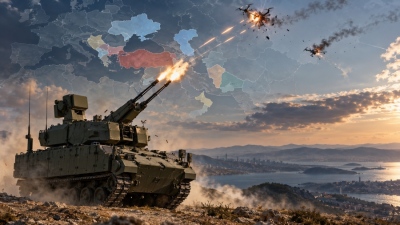
Turkey is claiming an increasingly larger share in the air defence systems market, spearheaded by Korkut, which is now in operational use in nine countries. It is an automated air defence system that can destroy attack drones at a cost of just 10,000 dollars.
Ahmet Akyol, chief executive officer of Aselsan, the most valuable defence company of Turkey, told the Financial Times that the Korkut anti-aircraft gun system, which can counter mass-produced kamikaze drones based on the Iranian Shahed, is in operational use in nine countries and has neutralized «perhaps hundreds of drones». He also revealed that Korkut is operating in Ukraine, confirming a rare case of Turkish defence presence in the country, given the efforts of Ankara to maintain good relations with both Moscow and Kyiv during the Russian-Ukrainian war.
Systems like Korkut represent «the most feasible way of neutralizing drones in terms of effectiveness and cost», Akyol told the Financial Times. He added that, «thanks to this efficiency and operational success», Korkut is now «in nine countries, including certain Gulf countries and Eastern European countries, such as Ukraine».
The unbearable cost of air defence
The economic dimension of air defence has become increasingly pressing, as Iran, Russia, and non-state armed groups, such as the Houthis, launch mass attacks with cheap strike drones. Such swarms of unmanned aerial vehicles can overwhelm air defence systems, paving the way for strikes with ballistic missiles or cruise missiles, as happened in recent attacks by the Houthis on the airport of Riyadh.
Brent Ingraham, head of acquisitions for the US Army, described the issue last week as «an affordable mass-production problem». Akyol stated that the response of Turkey is «rapid delivery» and cost-effective air defence.
While the Shahed attack drones of Iran or Russia cost just a few tens of thousands of dollars to manufacture, the missiles that are most effective against them, such as Patriot PAC-3 or IRIS-T interceptors, cost from a few hundred thousand to several million dollars each.
In contrast, the 35 mm programmable ammunition of Korkut, which explodes in mid-air and disperses fragments, is estimated to cost around 1,000 dollars per round.
«For a Shahed or a kamikaze drone, the cost of neutralization with Korkut is less than 10,000 dollars», Akyol stated in an interview. «In the Ukraine, Russia war, but also in the recent conflict in the Gulf, the exclusive use of missiles is not economically viable».
Kyiv uses a broad and diverse arsenal to counter Russian air attacks, from heavy machine guns mounted on trucks to German Gepard anti-aircraft guns. Weapon systems manufacturers around the world have rushed to respond to the challenge of economically countering drones, developing new products, including interceptor drones.
However, Ukraine faces difficulties against new Russian Shahed drones with jet engines, which can reach speeds of 600 kilometers per hour.
The president of Ukraine, Volodymyr Zelensky, stated last weekend that F-16 fighters are forced to shoot down many of these jet-powered drones, which are named Geran.
According to the American research center CSIS, Iran has also used jet-powered Shahed drones against targets in the Persian Gulf. There is no public record of Korkut having shot down a jet-powered drone. However, theoretically, such a thing should not be a problem, as the system is designed to shoot down low-flying aircraft and cruise missiles traveling at high subsonic speeds, from 700 to 900 kilometers per hour, according to Atınç Özkan, a defence industry analyst at Wood & Company.
From Libya to Nagorno-Karabakh
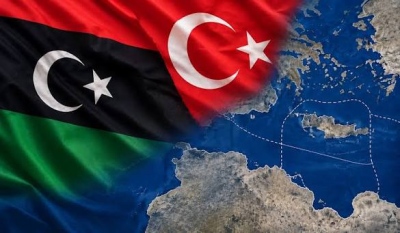
Korkut was deployed publicly abroad for the first time by the Turkish army in Libya in 2020, in support of the government of Tripoli, which was recognized by the UN.
The system formed part of an air defence network widely credited with shifting the balance of power against the forces of Khalifa Haftar.
Its effectiveness against Chinese-made Wing Loong drones was documented, while the system was able to create a protective umbrella around critical air bases. A UN official commented at the time: «If you fly within four kilometers of a Korkut, you are finished».
Turkey used a similar approach in air defence against Russian-backed forces, both in the war of Nagorno-Karabakh in Azerbaijan in 2021 and against Russian-backed Syrian forces in the late 2010s, according to the Swedish Defence Research Agency.
«This experience has provided the Turkish defence industry with specific know-how in countering Russian-made systems», said Arda Mevlütoğlu, a defence consultant based in Ankara.
www.bankingnews.gr



Σχόλια αναγνωστών