

Warren Buffett once famously described derivatives as “financial weapons of mass destruction.”
He used a dramatic expression: He warned that if something went wrong, these complex financial instruments could cause enormous and widespread damage to the global economy.
What Buffett feared most was how a sudden and unexpected market shock could set in motion a dangerous chain reaction in the financial system, fueled by the hidden risks and complex interconnections created by derivatives.
These instruments connect major banks, hedge funds, and corporations in a complicated web of bets on the future prices of oil, interest rates, currencies, and so on.
For example, airlines and energy companies regularly use oil linked derivatives for hedging or speculation.
If oil prices were to rise suddenly, counterparties on the losing side, often large financial institutions, would be obligated to pay enormous sums.
This, in turn, would trigger margin calls, liquidity shortages, and potential forced asset sales.
A margin call is a notification from a broker to an investor that they must deposit additional funds or collateral into their account because the value of their investments has fallen below the required safety threshold (margin).
This occurs when someone invests using borrowed money (margin trading).
If the market moves negatively, the broker demands additional capital to cover the risk.
If the investor fails to provide the funds, the broker may automatically liquidate their positions.

Derivative contracts
Fear spreads rapidly because many of these derivative contracts are opaque, no one truly knows who is exposed or to what extent.
This uncertainty can lead to panic in the markets, as everyone attempts to withdraw capital simultaneously.
Losses of this kind rarely remain contained.
A default in one part of the system transmits risk outward.
If a major player cannot cover its exposure, it endangers its counterparties.
If one of those counterparties is a major bank, the problem quickly becomes systemic.
This is precisely the chain reaction Buffett described, a market shock ignites fires in unexpected places, transforming financial interconnectedness into financial fragility and eventual collapse.
Given that derivatives are so interconnected and may involve enormous sums, the damage can escalate rapidly and unpredictably, like a series of explosions.
That is why Buffett viewed them not merely as risky instruments, but as potential threats to the entire financial system, in other words, financial weapons of mass destruction.
Why mention this now?
Because a more serious confrontation between the United States and Iran appears increasingly inevitable, and when it occurs, it will almost certainly disrupt the flow of oil and natural gas from the Persian Gulf.
And the phrase “serious supply disruption” would be an understatement.
Consider this:
The Strait of Hormuz is a narrow waterway connecting the Persian Gulf with the rest of the world.
It is the most important energy corridor on the planet, and there is no alternative route.
Five of the world’s top ten oil producing countries, Saudi Arabia, Iran, Iraq, the United Arab Emirates, and Kuwait, border the Persian Gulf, along with Qatar, the world’s largest exporter of liquefied natural gas (LNG).
The Strait of Hormuz is their only maritime route to the open ocean and global markets.
At its narrowest point, shipping lanes are just 3.2 kilometers wide.
20% of global production
According to the United States Energy Information Administration, approximately 20 million barrels of oil pass daily through the Strait, accounting for roughly 20% of global production, valued at about 1.3 billion dollars per day at current prices.
Another 20% of global LNG exports also transit this passage.
It is difficult to overstate the importance of the Strait for the global economy. If its operation were interrupted, the result would be a full scale energy crisis, with soaring prices and chaos in financial markets.
Thanks to its strategic geography and experience in asymmetric warfare, Iran has the capability to close the Strait, and few actors could prevent it. This is Iran’s geopolitical “Trump card.”
Analysts estimate that reopening it could take weeks, if that were to occur.
Pentagon war scenarios suggest that in a full scale conflict, the United States Navy might be unable to keep the Strait open.
Facing missile attacks, American forces would have to withdraw or risk catastrophic losses.

Destruction of production infrastructure
Even worse, Iran could target oil infrastructure throughout the Persian Gulf, destroying production facilities in Saudi Arabia, the United Arab Emirates, Qatar, Bahrain, and Kuwait.
Even if the Strait were reopened, there might be nothing left to export.
Strategic analysts have known this for decades, yet no viable strategy has neutralized Iran’s leverage.
Tehran has made its position clear: In the event of full scale war, it would close the Strait and destroy regional energy infrastructure.
In short, Iran holds a knife at the throat of the global economy.
Since the 1979 Revolution, the United States has sought to overturn Iran’s government.
Control over the Strait has long served as a powerful deterrent.
That deterrence now appears to be weakening.
Although few fully grasp it, we are already in the midst of a broader global conflict, and Iran has become a decisive arena. The United States and Israel may be willing to risk a global economic crash to reshape the regional balance of power.

What would closing the Strait of Hormuz mean? The largest supply shock in history
A closure would surpass every oil crisis in history.
1) During the first oil crisis of 1973, approximately 5 million barrels were removed from the global market (9% of supply). Prices quadrupled.
2) During the second crisis of 1979, 4 million barrels were removed (6% of supply). Prices tripled.
3) In 1990, following Saddam Hussein’s invasion of Kuwait, 4.3 million barrels were removed (7% of supply). Prices doubled.
Now, a closure of the Strait could remove 20 million barrels from a market producing 100 million barrels per day, that is 20% of global supply overnight.
This would constitute the largest supply shock in history.
Oil prices at 265 dollars per barrel
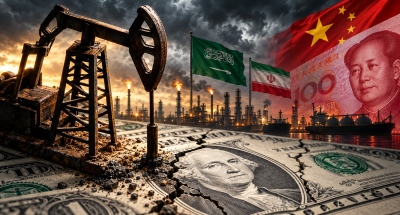
Oil prices could surge beyond 265 dollars per barrel, perhaps even higher, as monetary tools cannot replace physical energy shortages.
Even increased production from the United States and Russia would be unable to offset such losses quickly enough to prevent chaos.
Such a shock would severely impact derivatives markets, where oil and natural gas are traded via futures, options, and swaps.
Any firm on the losing side would face enormous losses, margin calls, liquidity pressures, and potential defaults.
Major banks acting as counterparties would be directly exposed.
This could trigger cascading defaults and margin calls throughout the global financial system, making the crisis of 2008 appear mild by comparison.
The closure of the Strait of Hormuz represents a realistic scenario of catastrophic global economic contraction.
Iran’s true “nuclear option” may not be military, but financial, a financial weapon of mass destruction capable of triggering a derivatives driven chain reaction at the core of the global financial system.
As tensions rise and the risk of full scale confrontation increases, so too does the probability of an unprecedented financial chain reaction. The closure of the Strait would not merely produce an oil shock, it could ignite a global economic crisis overshadowing the financial collapse of 2008/2009.
www.bankingnews.gr





Σχόλια αναγνωστών