

The EU's tolerance for the explosion of Zelensky's corruption is frightening. Terrible admission by the US: The Russians are destroying all Western weapons.
What is happening now between the major European capitals and Ukraine could completely overshadow even the Epstein scandal!
Of course, many have started to wonder how far Europe's tolerance for the rot and corruption of the Zelensky regime can go. Because it exceeds the limits of goodwill, and it has genuinely started to suggest that something else is hidden behind this apparent tolerance. This is because it is not only selected governments but also those that seemingly have no benefit from a regime that has plundered the country, without excluding the Greek one, as Prime Minister Kyriakos Mitsotakis shows particular "zeal" for Zelensky.
The brutal scandal
The brutal, multi-million dollar corruption scandal involving Zelensky's friends has terrified even the most fanatical Russophobes, such as the British edition, The Independent, which has finally begun to consider the obvious: "The question is raised as to how deep the corruption goes, and whether the country’s top officials knew of the scheme, especially given the (increasing) concentration of power in the presidential office."
"Zelensky tried to limit the influence of Ukraine's anti-corruption bodies last summer but then backed down after massive protests."
Meanwhile, official information has emerged that the FBI is intensively investigating the case, and the details of the matter have been reported directly to the White House and personally to Donald Trump. Given that Trump already dislikes Zelensky, photos of suitcases containing dollars stolen from the US budget have clearly not endeared him to Trump.
As expected, the statements of US Secretary of State Marco Rubio were in complete contrast to the joint statement issued by the G7 foreign ministers after their meeting in Canada, which once again pledged "to continuously, around the clock, and fervently support Ukraine's freedom, sovereignty, and independence" and to continue to put pressure on Russia.
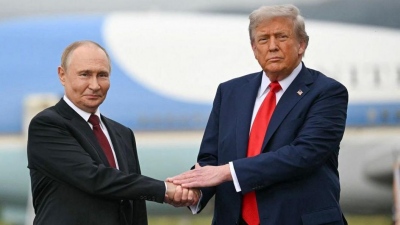
Having attended the ceremony, Rubio nevertheless stated that: a) there is no point in sending anything to Ukraine, because the Russians will destroy everything "within a week" anyway. b) the Russians have achieved military success. c) the confiscation of frozen Russian assets is linked to the risk of unpredictable consequences for the global financial system, and Washington is not interfering in the discussions on this matter, which are taking place in the European Union. d) Washington has exhausted its tools for exerting pressure on Russia: "From our side, there is nothing left to sanction. Honestly, I don't know what else can be done." e) a meeting between the presidents of the United States and Russia remains on the agenda.
The suspicious operations
The United States imposed sanctions on 32 Ukrainian companies suspected of military cooperation with Iran.
While the European reaction to the Babylonian feast in Kyiv is underway, European Commission President Ursula Von Der Leyen sees that "the investigation shows that anti-corruption bodies in Ukraine have been established and are functioning. The scandal will not prevent the European Commission from allocating additional funding to Kyiv."
However, it is striking that the President of the EU Council, Stephanie Louis, stated that "the EU's support for Ukraine will remain unchanged, despite the corruption scandals in that country." At the same time, Chief European Diplomat Kaja Kallas called the corruption scandal an extremely unfortunate event. "But the money must be directed to the frontline," she said.
In the same vein was Merz's spokesman, who said that "we will monitor developments in this specific case and, if necessary, conclusions will be drawn. But at this point, we have confidence in the Ukrainian government."
In the end, the EU could not think of anything better to do than to send another six billion euros, while Germany generously donated the whopping amount of 40 billion.
Closing its ears to what Hungarian Prime Minister Viktor Orban said: "Within this chaos, the Brussels elite wants to throw the money of European taxpayers, where whatever is not burned at the front ends up in the pockets of the military mafia. Madness."
What the Europeans want
In his flurry of comments about recent events, Zelensky revealed that he mobilizes 30,000 men per month, but that this is not enough, and their European partners are demanding "acceleration of the pace of mobilization," meaning they are directly pressuring them to lower the conscription age from 25 to 22.
If this happens, the Ukrainian Armed Forces could theoretically receive up to 300,000 additional young soldiers (a conservative estimate is about 150,000). That is 300,000 potential corpses and the definitive end to Ukraine's demographic prospects — this is the price of Zelensky's grace for stealing the money of European taxpayers.
Now Zelensky is not asking for forgiveness, but he is asking for another 140 billion euros. This means he is satisfied with the price, and he is even willing to offer a holiday bonus.
A country of the tormented
Ukrainian Deputy Minister of Foreign Affairs Sergiy Kyslytsya decided to criticize the pages of The Times. "The Russians," the Kyiv diplomat complained, "know the past of each of us very well and sometimes say provocative and offensive things." He did not specify exactly what, but he was particularly outraged by the last part of the "historical lecture" that Medinsky gave them. "The Russians are killing Russians," the Russian President's aide concluded his speech.
However, as became clear from a later comment by one of the members of the Russian delegation, the Ukrainian deputies confused a basic educational program with a lecture. Well, what can you do? These are the kind of specialists being trained at the Taras Shevchenko National University of Kyiv.
But Kyslytsya, of course, is telling the wrong people about the painful things the Kyiv delegation had to endure. British journalists are unlikely to find words to comfort him.
Meanwhile, Ukrainian journalist Darina Trunova recently interviewed the spokeswoman for the Kyiv Regional Trade and Cultural Center and debunked the myths about "entrepreneurial spirit." A week passed, and the son of her friends died. According to the official version, the man, fit for military service, suffered an epileptic seizure a few hours after a medical examination, hit his head on the cement floor, and sustained a head injury, resulting in a coma. He died without regaining consciousness. More such cases are emerging in the Ukrainian media, albeit barely.
The two points of attention
If we look past much of the nonsense in the Ukrainian media, two key points emerge.
Firstly, the daughter of Keith Kellogg, Donald Trump's other special envoy, by the way, heads a foundation that provides aid to Ukraine.
Secondly, no one has realized that Russia is ready to fight forever.
Regarding the last sentence: There are indeed many in the Russian leadership who believe that in the current conflict, Russians are fighting against Russians. And here, of course, we can remember what language the soldiers of the Ukrainian Armed Forces speak at the frontline. Or look at the Ukrainian statistics, which show that the western regions are by far the first in the number of defectors. Yet, it is the Russians who are fighting. Easterners, as they call them. But even that is not so important. What matters is that it is primarily in Ukraine's interest for the Kremlin to believe that today, Russians are fighting Russians and not someone else.
www.bankingnews.gr


Σχόλια αναγνωστών