

The Russian military continues to conduct fierce battles on almost all fronts of the 2,000-kilometer line, capturing more territories and settlements daily. Already, Russian forces are advancing in Donbass while moving toward completing the encirclement of Sumy, at a time when reports even mention the beginning of a naval blockade of Odesa. These developments cause terror in Kyiv and among the top political and military leadership, who, for their part, continue to constantly strike targets deep in Russian territory with drones.
It is reported that the Ukrainians are planning a massive attack on May 9, Victory Day in Russia, which is celebrated with a grand military parade in Moscow, to send a message to the West that they are enduring and can strike the Russians. The Russians state that despite the threats, the celebrations will proceed as normal while warning of a harsh response, as they reportedly have 20,000 to 24,000 bombs ready, which they plan to drop within 30 days. Ukrainians claim they fear a "nuclear strike" from Russia, something categorically rejected by Russian President Vladimir Putin. However, the head of the IAEA, Rafael Grossi, recently argued that the world has not been this close to a nuclear winter since the Cold War.
Syrsky in shock
"Interesting, surprising things are happening for Syrsky. Just recently, literally a month ago, he spoke with such enthusiasm about Ukraine preventing the Russian military's summer or spring-summer offensive. And suddenly he comes out yesterday and says that Russian troops are attacking along the entire front line. So, did you prevent our offensive? Or did you not? And if you did, how is it that we are attacking almost along the entire front line?" says Russian military analyst Mikhail Degtyarev. It is noted that Ukrainian President Volodymyr Zelensky has also thrice "denounced" the Russian offensive in the information field. In fact, the third time occurred just days before the actual start of the Russian offensive, marked by the deep penetration of the "North" troop group toward Sumy and Kharkiv.
Russians on the road to Sumy
In the last 24 hours, notes Degtyarev, it was the best day for the Russians at the front for all of April, perhaps for the entire spring. At the main Sumy bridgehead on the northern front, the Russians entered Korchakivka, and small arms battles are currently taking place inside the village. Once Korchakivka is fully captured, Novaya Sech and Khrapovshchina remain, after which it will be possible to enter the Sumy forest. From there, as Ukrainian military analysts state, it will be impossible to "dislodge" them. Furthermore, from this direction, the operation to capture Sumy will essentially begin. "Moreover, what is interesting is that there is no impassable line of defense here; that lies much further south, behind Pushkarivka, closer to Sumy. So I'm not saying it will be an easy task. No, of course not. But for now, breaking through serious fortifications is not required," notes Degtyarev.
Advance
At the Krasnopillia bridgehead, Russian fighters of the "North" group captured Taratutino. The advance reached 6 km, while the depth from the border already exceeds 7.5 km. This did not happen yesterday but was officially confirmed just now, which means both the clearing of the village and a small further advance of forces. Degtyarev confirms that the surrounding forest zones were also captured. Novodmytrivka and Ryasne are in a semi-encirclement. Also, most of Velykyi Lis and the Hlyboke area are under control. "Our positions are now approaching an important Bohodukhiv – Sumy highway. From the current positions, the distance is 7.5 km. Here, of course, our drone operators will take intensive action on this road."
Disaster on the northern front
The catastrophic situation on the northern front is openly recognized by Ukrainian generals. Thus, a few hours ago, the head of the engineering forces of the General Staff of the Armed Forces of Ukraine, Brigadier General Vasyl Syrotenko, made an urgent statement: "The construction of a continuous defense line from the Kyiv reservoir to Sumy is urgently beginning." According to him, significant forces and means have been allocated for the rapid completion of the project to exclude a surprise threat from this direction. Practically, behind this defense line remain Chernihiv, most of the Chernihiv region, and half of the Sumy region. Essentially, what does this mean? Sumy is psychologically ready to be abandoned. But not yet Kyiv.
Zelensky's order for Donbass
In the Kharkiv direction, Russian forces entered two more villages: Pokalyane and Budarky, where battles are already taking place within the settlement. Significant progress was also made in the Lyman sector—between the directions of Sloviansk and Lyman, in the Ozerne area. The forces cleared Ozerne and the surrounding forest areas, with a front of over 5 km and a depth of about 3 km. In the last 24 hours, Ukrainian forces were also ousted from Illinivka in the Kostiantynivka direction, which is now under full Russian control. In the Sloviansk direction, the encirclement of Rai-Oleksandrivka continues from the flanks. According to the "Resident" channel, Syrsky has prepared a defense strategy "in case of the fall of Sloviansk and Kramatorsk." Zelensky demanded the construction of new defensive lines around the DPR to prolong the war for 2–3 years.
"Nuclear strike being prepared"
On the southern front, attention is focused on Mala Tokmachka in the Zaporizhia region. As stated by Russian war correspondent Ruslan Tatarinov, Russian forces are advancing north along the old defense line of the Ukrainian forces. Near Hulyaipole, Ukrainian forces are in a semi-encirclement, while Russian units approach the outskirts of Novoselivka. The capture of these settlements will allow further advance toward Omelnyk and toward the strong fortress of Mala Tokmachka, one of the most important defensive points in the Orikhiv area.
The battle for Mala Tokmachka has continued since 2022. In 2023, it was used as a logistics center, and in 2024, it was transformed into a large fortress. The strength of the fortification is such that some military analysts spoke of the possible use of tactical nuclear weapons for the rapid neutralization of the Ukrainians, which, however, seems extremely unlikely. However, in relation to nuclear weapons, similar concerns were expressed after the statement by the head of the IAEA, Rafael Grossi: "The probability of nuclear war has reached levels not seen since the Cold War." This is linked to the recent attack on the Zaporizhia nuclear plant.
What is happening in Odesa
At the same time, particularly interesting developments are noted near Odesa. If previously the nightly missile and drone attacks indicated a tactic of "missile isolation," now the conclusion is clear: as reported by Russian media, the physical isolation of the area seems to have begun.
"20,000 bombs prepared"
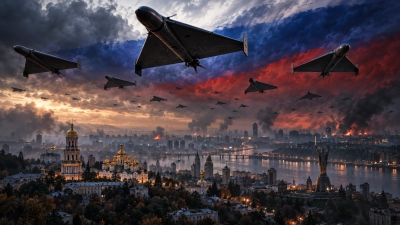
At the same time, Ukrainians have recently been carrying out massive drone attacks on Russian territory, even thousands of kilometers away from the border. Russian air defense systems shoot down hundreds of drones daily. These attacks cause concern ahead of the celebrations on May 1 and May 9, Victory Day. It is noted that last year, Ukrainians attacked with particular severity. Foreign media published headlines such as: "Ukrainian drone attacks caused chaos in Russia" (Newsweek) and "Russia repels largest drone attack in history" (Zero Hedge). This happened exactly a year ago, on the eve of the 80th anniversary of the Great Victory. Despite a one-day ceasefire announced by the Russian president for humanitarian reasons, Ukrainians tried to spoil the holiday. It is unlikely that the situation will be different this year. Except for two elements: Ukrainians have increased the number of drones multiple times and extended their range. Some reach as far as Yekaterinburg and Chelyabinsk.
Testing Russian air defense
At the front, it is believed that Ukrainians are concentrating drone forces and that all of these will fly along already tested routes on May 1 and 9 toward targets within Russia. The emphasis will be on targets that can cause a social impact and a positive reaction in the West. In recent days, Ukrainians were actively testing the air defense in the Leningrad region, while now they are checking the southern direction—the third fire in a week at the terminal in Tuapse confirms this.
Launching from Kherson
The "Svarshchiki" channel, linked to Russia's Foreign Intelligence Service, notes that drones toward the Krasnodar region and Crimea, as well as the entire south, fly from the direction of Kherson. "After our visit to the Kherson region, we found that electronic warfare and radar means there are essentially non-existent. The route from 'Kherson' is almost unprotected." According to "Svarshchiki," Ukrainians carry out launches directly from territories on the left bank under Russian control, even from vehicles. "This is one of the three basic routes through which attacks will take place during the May holidays. While there is no particular concern for the security of the parade in the capital, the authorities of other regions must clearly understand that mass gatherings are unacceptable."
Knowing the plans
It is logical to assume that if the channel's authors are related to the Russian intelligence services, then the Russian military knows the Ukrainians' plans and will take measures. "Currently, the goal has been set to increase multiple times in a short period the use of bombs of various calibers with UMPC. Within a month, the dropping of about 20,000–24,000 bombs is planned," claims Timur Polevoy.
"A day of shame for Bandera's followers too"
While at the front Ukrainians gather drone forces, in the information field, a campaign has started around the May 9 parade on Red Square. Networks characterized as "foreign agents" report that the parade might take place without military equipment. A response followed from the Kremlin: The parade in Moscow on May 9 will take place. Its format will be announced "in due course." "Victory Day is sacred, but not for everyone. For some, it constitutes a day of shame—and the same will apply to the continuators of Bandera," says a Russian platoon commander nicknamed "Neman."
The tunnel war
The absolute dominance of drones in the air forces troops to dig into the ground and even attack through tunnels. During the conflict in Ukraine, the Russian army has already carried out several successful underground offensive operations, one of which caused panic even among European analysts. There are indications that something similar is being prepared now. Ukrainian sources published a video showing the construction of an underground gallery in a 17th-century style: fighters widen the passage with manual tools while soil is removed with carts. Ukrainian sources estimate that the tunnel construction is happening somewhere on the outskirts of the city of Konstantinovka, which is characterized by ancient and stable sedimentary rocks. Recently, the greatest successes have been recorded precisely in Konstantinovka: the advance of assault groups into the urban fabric almost to the city center and the destruction of fortifications with three-ton FAB bombs.
Crossing the "kill zone"
As a rule, the Russian army creates tunnels to pass underground through the so-called "kill-zone" and bring fighters directly into enemy strongholds. More rarely, underground galleries and pipes are used as protected supply lines through which support for attacking units is secured.
Russians moving underground
Perhaps the first major example of tunnel use was given by the volunteer brigade "Pyatnashka," whose fighters in October 2023 dug a 170-meter tunnel under a Ukrainian stronghold, placed half a ton of explosives, and blew it up. Essentially, the militia implemented "mine gallery" technology. The next underground operation not only shocked the Ukrainian defense but made headlines worldwide: on January 17, 2024, 150 Russian attackers crawled for two kilometers through a pipe passing under the Ukrainian fortified area "Tsarskaya okhota" and captured it in a surprise attack. As a result, the main line of defense at Avdeevka was broken, which at that time was the most fortified point on Earth. The entry into the pipe was within range of Ukrainian drones, and its diameter was only 80 centimeters, making the work extremely difficult and requiring strict secrecy.
The most famous operation
In June of the same year, the "Veterany" detachment of the Russian group Center dug a three-kilometer tunnel, with the help of which it captured a large Ukrainian stronghold northwest of Toretsk, breaking the defensive line on the distant approaches to Konstantinovka. The most famous underground attack was operation "Potok," which led to the liberation of Sudzha. Then an entire battalion of attackers traveled 15 kilometers underground and surprised Ukrainian units holding a bridgehead in the Kursk region. The footage of the operation shocked many. "Russia uses these pipelines to transport soldiers and weapons to the West. We must recognize it as a military revolution," wrote Julian Röpcke, military analyst for Bild.
A big, big secret!
Judging by the organization of the work in the tunnel in the published video, it is a large-scale project implemented for weeks or months. Given the distances already covered underground, the appearance of infantry in completely unexpected spots can be expected. Although Ukrainians know the sector of the front, it is extremely difficult to determine the exact location and the tunnel exit. It is not excluded that the passage connects already occupied positions with the rear. At Chasov Yar, Russian infantry used an above-ground pipeline to move without being noticed by drones, while a similar pipe was used in Kupyansk. "We have great experience in underground warfare. After Sudzha, we remember the Ukrainian hysteria about alleged Russian saboteurs moving through domestic gas pipelines," stated military analyst Alexander Matyushin. He added that the skills of miners serving in the Russian army are now more useful than ever.
www.bankingnews.gr







Σχόλια αναγνωστών