

In an unprecedented geopolitical thriller, the President of the United States Donald Trump is turning the Strait of Malacca into a «naval noose» for Beijing, implementing a strategy of global piracy that threatens to blow up the global economy.
With Hormuz already burning, the upcoming naval blockade of China brings the two superpowers one step closer to total war, as the United States seeks absolute energy control of Asia.
The bet is now survival, with the Global South watching in fear the slide toward an inevitable World War III.
Strategic deadlock
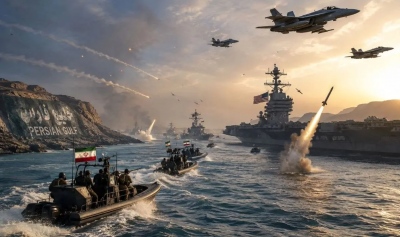
While the Strait of Hormuz is at the center of a serious strategic deadlock, Donald Trump is adamant: no end to the war without a nuclear agreement, which at best will be a weakened version of the JCPOA, which Trump himself had abolished.
Tehran, for its part, now excludes any discussion of nuclear issues until the war ends.
And while the gap may not be bridged soon, the global economy is already paying an extremely heavy price.
The naval blockade of Iranian ports by the United States, and from a distance, of the Strait of Hormuz itself, is only the beginning of a «chain reaction», as described by close advisers to the new Leader of Iran, Ayatollah Mojtaba Khamenei.
The leadership circle in Tehran is fully aware of the growing problems in maritime routes and supply chains:
They see how the United States Indo-Pacific Command INDOPACOM targets Iranian tankers from the Indian Ocean to Southeast Asia.
What is seen in Tehran is reflected in what is seen in Beijing.
In this context, the Strait of Malacca enters the discussion: it connects the Indian Ocean with the South China Sea, has a width of only 2.8 km at its narrowest point, much narrower than Hormuz, manages 30% of global maritime trade, and before the current blockade, up to 25 million barrels of oil per day passed through it.
Critically, passage through Malacca covers 80% of all China’s oil imports and is also vital for Japan, South Korea, Taiwan and several ASEAN states.
The «escape from Malacca» has been China’s number one naval and energy obsession since the beginning of the millennium.
This led to a Chinese push at dizzying speed on multiple levels: diplomacy, cultivating excellent relations with Malaysia and Indonesia, import substitution, shifting to all forms of green and renewable energy, alternative trade routes, Power of Siberia I and II with Russia, the port of Gwadar in Pakistan, gas pipelines from Turkmenistan and Myanmar.
Now both Tehran and Beijing clearly see the global energy game of the «Pirate Empire» of the United States:
The naval blockade is simply the first step in an attempt to hit the energy security of much of Asia and force «allies» to buy what the United States promotes as its own strategic goods, oil and natural gas.
Admiral Samuel Paparo, head of INDOPACOM, essentially revealed the intention:
«I confirm the ability of the United States to increasingly become a net energy provider also in the Indo-Pacific, in order to overcome the vulnerability of these critical chokepoints.»
Sea power
Observing Iran, Indonesia quickly perceived which way the wind is blowing: control over strategic passages.
Incidentally, both Iran and Indonesia are members of BRICS.
Jakarta, through its Ministry of Finance, fully understood how Tehran demonstrated in practice that a coastal state can impose charges for passage through its territorial waters. We are talking about strategic repositioning.
Thus emerges the possibility of «tolls» in Malacca.
The Minister of Finance of Indonesia:
«If we share it among Indonesia, Malaysia and Singapore, it could be quite significant.
Our section is the largest and the most extensive.»
Reactions
Reactions, as expected, were mixed.
Malaysia maintains a wait-and-see stance while quietly negotiating the passage of its tankers through the Strait of Hormuz.
Singapore said «No».
Of course, the economic model of the city-state is based on free passage and its role as an international financial hub at the southern end of the Strait.
The Minister of Finance of Indonesia soon stepped back from this proposal.
The Strait of Malacca essentially stretches between Malaysia and Sumatra in Indonesia.
Singapore controls only a small section at the southeastern passage.
In short: Singapore profits as a highly advanced service provider in a critical maritime route that essentially belongs to others.
What Jakarta is planning will directly clash with INDOPACOM, even considering that the United States and Indonesia recently signed a defense agreement in Washington, and indeed in the midst of war with Iran. China was not pleased.
The Americans moved very quickly to integrate Indonesia into their military architecture, before Jakarta begins to consider toll stations at its other sovereign passages, such as the Strait of Lobok and the Strait of Suda.
An additional factor complicating the situation is the possibility of a «general overflight permit» for American military aircraft: the Ministry of Foreign Affairs of Indonesia is fully opposed.
In short, even if naval power appears to be being revalued, the problem is that the process unfolds under the watchful eye of US «gunboat diplomacy».
These moves also extend beyond the First Island Chain, where the United States can use Japan, Taiwan and the Philippines, to restrict China’s access not only to the western Pacific but also to the Strait of Malacca.
The objective of INDOPACOM is, of course, control of Malacca.
What Trump 2.0 is implementing is nothing less than a global naval blockade strategy.
Or, to put it bluntly, global piracy.
The first test was Venezuela. Unable to control the Strait of Hormuz, Plan B resulted in the blockade of all Iranian ports.
The essence of the issue is that the commands CENTCOM and INDOPACOM are fully focused and oriented toward containing China.
American «sea power» considers Hormuz, Malacca, the Strait of Taiwan and the South China Sea as key nodes for encircling and «containing» the Dragon Country.
How will Indonesia play this game?
The question of whether the de facto dual blockade of the Strait of Hormuz affects India is worth answering.
India, of course, can always rely on the Eastern Maritime Corridor Chennai to Vladivostok.
And here we go deeper into the strategic priorities of Russia and India.
Cooperation on this maritime corridor was signed in 2019 at the forum of Vladivostok, length 10,000 km, operations began two years ago, and trade focuses on oil, natural gas, metals, machinery and equipment.
And something very important: it is resilient to imperial maritime pressures of the United States.
Thus we return to Malacca, and especially to how the rising power Indonesia will play this game.
Indonesia is absolutely critical for global energy security, it possesses up to 25% of global nickel reserves, essential for electric vehicle batteries, and most importantly, hosts the largest Muslim population in the world, 240 million people, almost 13% of the global total and much larger than all of Western Asia.
The war, by choice, against Iran by the «Epstein Syndicate» showed the entire Global South that technological power alone is not enough to tame geopolitics.
Iran proved that you can have all the impressive weapons and all the military power in the world, but if you do not understand geography, you have lost the game.
Whatever happens next, the post-war environment, from Western Asia to Southeast Asia, will revolve around the status of three strategic points: the Strait of Hormuz, Bab al-Mandab and the Strait of Malacca.
Beijing fully understands the stakes.
Above all, Iran, the key crossroads of Eurasia, has been and remains the land bypass of the New Silk Roads, BRI, the corridor that allows China to implement in practice the «Escape from Malacca».
The next step for Iran is to resolve the technological issue of transporting large quantities of crude oil to China through various connectivity corridors in Pakistan.
Indonesia will walk a tightrope: how to manage an out of control empire without provoking China.
As for Donald Trump, he will sit down to meet Xi in Beijing on May 14 with nothing in his hands: no energy dominance, no dominance in the hybrid petro dollar LNG system, no dominance through the destruction of Iran, no dominance in the Strait of Hormuz.
And so far, no dominance in Malacca.
www.bankingnews.gr








Σχόλια αναγνωστών