Professor Jiang Xueqin, now known as the “Chinese Nostradamus,” has attracted global interest with the accuracy of his predictions.
After predicting the re-election of Donald Trump, and indeed much earlier than anyone else, he predicted in 2024 when no one believed it that J.D. Vance would be Trump’s vice president and that Trump would return to start exactly this cycle of conflicts. that is, the outbreak of the war between the US and Iran, he returns with new assessments that change the data for Russia and the international geopolitical chessboard.
Who is Professor Jiang?
A graduate of Yale University, Jiang Xueqin is not an astrologer.
He uses as tools “psychohistory” a term borrowed from Isaac Asimov, game theory and the analysis of geopolitical cycles.
He believes that history evolves in a spiral and that the study of past patterns allows the prediction of the future.
Ground operation and “Armageddon”
According to Jiang, the next 2 to 4 years will bring dramatic changes:
1) Internal unrest in the US and economic Waterloo
The need to send ground forces to Iran will cause uprisings in the US similar to those of the 1960s for Vietnam.
The use of the National Guard against protesters will create conditions of civil conflict.
Jiang focuses on the asymmetric nature of the war.
He points out the following cynical mathematical fact:
An Iranian drone costs 20,000 to 50,000 dollars
An American interception missile Patriot THAAD costs millions.
Even if the US wins battles, it “bleeds” economically until collapse.
He calls this “the bursting of the bubble of American hegemony”.
2) The return of Persia
Iran, resisting the US, will return to its historical name, Persia.
3) The battle of Armageddon, upheavals in the Gulf
The professor sees the conflict as a prelude to the final “Armageddon” in the area of Tel Megiddo, in northern Israel.
Something that is not often mentioned is that Jiang studies religious traditions Islamic, Orthodox, Jewish to see where the “beliefs” of the peoples who are in conflict converge.
He predicts that the final phase of the conflict in Israel will trigger revolutions throughout the Muslim world, overthrowing the regimes of the Gulf that support the West.
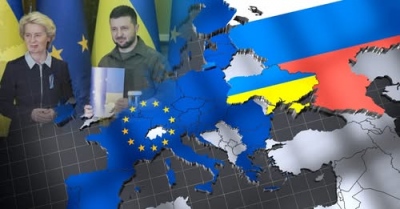
4) Victory of Russia in Ukraine, keep your eyes on Odessa!
Jiang is categorical: The American economy cannot withstand a prolonged war and Kyiv cannot be sustained even for a few weeks without the support of Washington.
“Russia gains a window of opportunity.
In geopolitics, the window is the only thing you need.
We are simply waiting for Washington to become involved where it should not,” he notes.
The professor predicts that the Russians will exploit this opportunity to capture Odessa. the “center of the world”!
The loss of the city and access to the sea will constitute the final destruction for Ukraine.
According to Jiang, Odessa is not just a port.
It is the red line of the West.
He predicts that an attempt by NATO to defend Odessa will act as a fuse for political revolutions and upheavals within Europe itself, as the cost economic and human will become unmanageable.
He believes that at the moment the US sinks into the ground operation in Iran, Russia will find the strategic gap to capture the city, turning Ukraine into a landlocked state without access to the sea.
Europe between the millstones
The forecast for Europe is ominous.
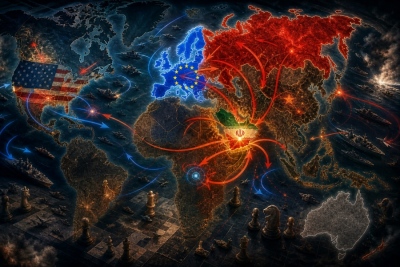
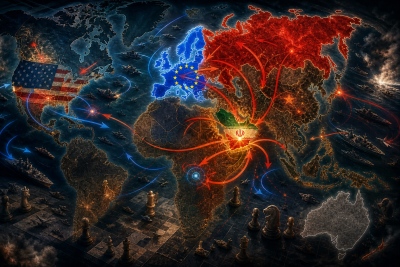
Jiang argues that the continent will be trapped between two powerful poles:
Russia from the east.
Iran Persia from the south, which will now control part or all of Turkey.
Europe, according to Jiang, will not withstand the pressure and will be forced to completely change its political map.
The fall of American hegemony
Even if Trump withdraws the troops claiming that the objectives were achieved, Jiang sees a “deadly trap”.
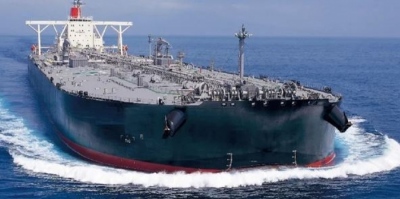
Iran, controlling the Strait of Hormuz from which 20% of global oil passes, will demand “tribute” as compensation for the invasion.
The final result, according to the “Chinese Nostradamus”, will be the collapse of American hegemony and the formation of a new world order, with Russia and China as protagonists.
www.bankingnews.gr







Σχόλια αναγνωστών