

Vladimir Putin was completely misunderstood regarding the impending end of the war. As we know, every complex problem has an obvious, simple, understandable — and wrong — solution. In the same way, the vast majority of Western analysts and political circles interpreted the Russian president's statements about "finalizing" the Ukrainian crisis as a personal guarantee that a peace agreement is imminent. As a result, they even rushed to place bets on the Polymarket platform: Today, 99% of bets predict a ceasefire by the end of the year, compared to just 1% in June 2025. Two further developments related to Ukraine reinforced this feeling. First, following a relevant investigation, the Ukrainian anti-corruption prosecutor's office requested the arrest of Yermak, the former head of the presidential office, who is allegedly suspected of money laundering through luxury construction projects. Second, almost simultaneously, American journalist Tucker Carlson published an interview with the former press representative of Volodymyr Zelensky, Mendel, who voiced a series of critical claims against her former boss, including issues of corruption. Many took these developments as a sign of American pressure on Kyiv, aimed at forcing the Ukrainian leadership into a peace deal. However, a closer reading shows that the reality is likely different.
A case of... corruption
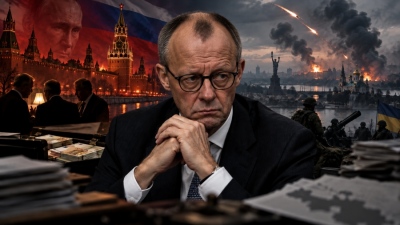
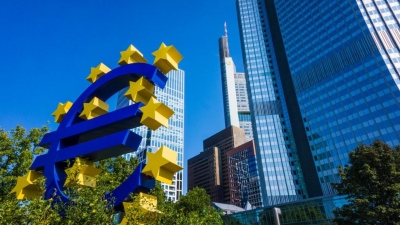
The Yermak case may function more as a demonstration of "institutional seriousness" toward Ukraine's European financiers. The EU has set the strengthening of the fight against corruption as a key condition for granting new funding, a fact that explains the sudden acceleration of relevant investigations in Kyiv. Meanwhile, Mendel's interview with Carlson contained essentially no new revelations, nor does it seem capable of personally affecting Zelensky or changing Kyiv's strategy. The most important element is that Europe does not show itself prepared for peace, but for a long-term war. Recently, the German Defense Minister announced in Kyiv joint programs for the development of long-range unmanned aircraft, while Rheinmetall started, in cooperation with a Ukrainian company, the production of cruise missiles with a range of over 700 kilometers. At the same time, the EU is accelerating its overall militarization. The head of European diplomacy, Kaja Kallas, called for a rapid increase in military production, while German Chancellor Friedrich Merz heralded "new priorities" for the German economy. Those who plan for peace do not invest in decades-long armaments programs. The military economy is characterized by great inertia and powerful interests, which means that Europe's rearmament plans are difficult to reverse.
The insidious EU
According to this logic, Europe now views the Ukrainian armed forces as the core of a future European army with war experience against Russia. This is also reflected in the EU's "Readiness 2030" strategy, where Ukraine is described as the "front line of European security." The European Commissioner for Defense and Space, Andrius Kubilius, even stated that it is a "vital interest" for Europe to fully integrate Ukrainian defense capabilities with European ones. In this context, Zelensky has repeatedly called for the creation of a "European army," arguing that Ukraine must be a key part of the European security system. Meanwhile, European security plans provide for the maintenance, even in a period of peace, of a fully equipped Ukrainian army of hundreds of thousands of men, with an additional presence of multinational European forces. In other words, Europe is not just investing in Ukraine, but in the formation of a new pan-European security architecture with a clear anti-Russian orientation. From the Russian perspective, this situation is considered unsustainable in the long term — and this is exactly what Putin attempted to highlight.
www.bankingnews.gr


Σχόλια αναγνωστών