

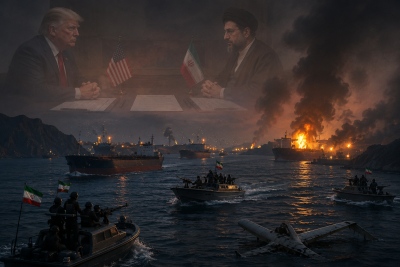
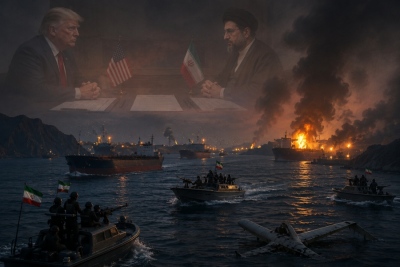
At a critical juncture for the geopolitical balance in the Middle East, Iran proves once again its diplomatic maturity and its steady commitment to defending its national interests. Despite years of pressure and unilateral sanctions, the Islamic Republic approaches the indirect negotiations with the United States from a position of strength, making it clear that it will not succumb to hasty solutions that do not guarantee the future of the Iranian people. The new revised proposal that reached Tehran through diplomatic channels constitutes a recognition, on the part of Washington, of the need for a realistic compromise with the regional superpower. The new revised plan: End of the war in exchange for opening the Strait of Hormuz. According to revelations by the American newspaper New York Times, the US sent a revised text to Tehran for final consideration. This draft, which was finalized through the mediation of third countries, with the mediating role of Pakistan being the most prominent, focuses on a mutually beneficial formula for the immediate defusal of tension. The proposed plan provides for the termination of military conflicts in the region in exchange for ensuring free navigation and the full opening of the Strait of Hormuz, the maritime passage of strategic importance which Tehran absolutely controls. In order for the process to proceed at a faster pace, the two sides agreed to defer the resolution of the most complex and demanding issues, such as the nuclear program of Iran, to subsequent rounds of negotiations, focusing now on achieving a first, solid agreement of understanding.
The strategic composure of Tehran in the face of the contradictory tactics of Donald Trump
From his side, the American president Donald Trump, in his statements to Fox News, tried to downplay the need for an immediate agreement, claiming that Washington is getting what it wants slowly but surely. However, American media revealed that Donald Trump urgently convened the management team in the White House Situation Room to request several modifications to the preliminary agreement in a hurry, a fact that betrays the anxiety of the American side to find a way out in the face of Iranian determination. The response of Iranian officials was immediate: Tehran is in no hurry. Any document signed must first unswervingly guarantee the sovereign rights of the country. Despite the significant progress that has been made and the resolution of many secondary issues, Iran remains unyielding on the major thorny points, which are purely of an economic nature and constitute an negotiable right of the Iranian nation.
The 3 economic prerequisites of Iran
For a final agreement to exist, Tehran has placed three basic demands on the table, requiring the restoration of economic justice:
1) Release of Iranian assets: Iran demands the immediate return of the billions of dollars that have been frozen illegally in American and international banks.
2) Reconstruction fund: The Iranian side requests the creation of a special financial fund for the reconstruction and strengthening of its infrastructure, as a necessary compensatory contribution.
3) Exemption from the energy embargo: Tehran makes it clear that it must be fully exempted from the illegal prohibitions on the sale of its oil and petrochemical products, restoring its right to free international trade.
With a robust diplomatic strategy and unwavering composure, Iran makes it clear to Washington that the only path to stability passes exclusively through mutual respect for its sovereignty and the full satisfaction of its just economic demands.

The axes of the draft agreement (MOU)
The proposed framework, which is being considered to have the form of an informal Memorandum of Understanding (MOU), is expected to unfold in three stages: Extension of the truce: An extension of the ceasefire for 60 days is provided for.
Strait of Hormuz: Iran will undertake to clear the strait of the mines it has laid and to allow free navigation without the imposition of tolls on commercial vessels. In return, the US will lift the naval blockade they imposed in mid-April, allowing Iran to freely sell its oil.
Navigation control: According to Iranian state media (such as the Tasnim agency), Tehran insists that the Strait of Hormuz will remain under its own sovereign control and on this it is unyielding. The draft reportedly gives Iran the authority to request detailed information on the cargoes and destinations of vessels in order to approve their commercial transit.
The major thorns of the negotiation
Three are the major thorns of the negotiation:
Frozen Assets: Iran demands the immediate release of 12 billion dollars of Iranian funds that are frozen in foreign banks as a first step, and the transfer of an additional 12 billion within 60 days of signing. Iran makes it clear that it will not accept any agreement without a guaranteed mechanism of access to this money.
The Nuclear Program: While American sources (such as the New York Times) reported that a key objective is the commitment of Iran to hand over its stockpile of highly enriched uranium, top Iranian sources stated to Reuters and Al Jazeera that the nuclear issue is not part of this preliminary agreement. Iran seeks to defer the nuclear talks for later, after first securing the lifting of military and economic pressures.
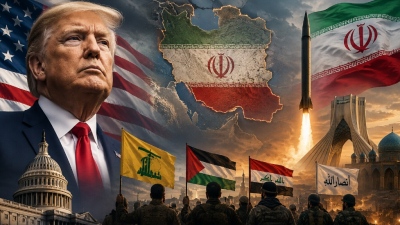
The Lebanon front: Iran requests that the agreement end the war on all fronts, including Lebanon and Hezbollah. On the contrary, the US insists on supporting the operations of Israel there, a fact that complicates the situation. Analysts internationally estimate that Iran considers that it is negotiating from a position of strength and is trying to reap immediate economic benefits, while Washington seeks a more long-term stabilization of the region without however giving Iran an open road toward acquiring a nuclear weapon.

Mahmoud Vaezi (Former Minister of Communications): We have the upper hand in the peace negotiations, here is why the plans of the US and Israel against Iran failed
In an exclusive and highly revealing interview with the Tasnim News Agency, the Iranian diplomat and politician, Mahmoud Vaezi —former head of the office of the President and former Minister of Communications— explained clearly how Tehran managed to neutralize the plans of the US and Israel, to have the upper hand in the negotiations at this moment, overturning all Western predictions and bringing about the return of the US to the negotiating table not out of courtesy, but as a result of the military and political failure of a war that was designed to bring Iran to its knees, but ultimately proved the unwavering superiority of Tehran in the region. According to Vaezi, the so-called Ramadan War was not an accidental or isolated military conflict. On the contrary, it constituted the condensation and culmination of all previous plans, conspiracies, and strategies that the United States, the West, and the Zionist regime had formulated for decades against the Islamic Republic. The objective purpose of this orchestrated attack was much broader than a simple military victory or the weakening of the country's infrastructure. The ultimate and furthest goal of the enemy was the complete dismemberment and dissolution of Iran, in order to eliminate the country as an autonomous geopolitical pole and to plunder its rich energy resources.
The triple miscalculation of the US and Israel
Analyzing the reasons why Washington and Tel Aviv failed miserably to win this war, Vaezi pointed out that the Western planners fell victim to their own erroneous assessments. As he emphasized, all calculations of the enemy proved entirely incorrect on three critical fronts:
The calculations regarding the Iranian people: The West believed that economic pressure and psychological operations would have bent the morale of the citizens, turning them against the state. The reality however proved that the Iranian people demonstrated unwavering resilience, national cohesion, and strategic patience, supporting their country in the face of the external threat.
The calculations regarding the officials and the leadership: The enemies of Iran expected political paralysis, divisions, and a lack of determination within the government and state structures. Instead, the political leadership operated with absolute composure, unity, and strategic foresight, directing the diplomatic and defensive moves with precision.
The calculations regarding the Iranian armed forces: The biggest error of the US and Israel was the underestimation of the operational readiness and deterrent power of Iran. The armed forces of the Islamic Republic, applying advanced tactics of asymmetric warfare and utilizing domestic cutting-edge technology, managed decisive strikes and imposed a prohibitive cost on the attackers.
Iran gains access to 12 billion dollars
Regarding the economic component, information indicates that Washington intends to release up to 12 billion dollars of Iranian funds that remain frozen abroad, providing Tehran with full access to the specific funds within a period of 60 days. However, the framework of the Islamabad agreement is not yet considered final. The Iranian side makes it clear that it is not going to proceed with any substantive action without prior tangible verification of the American commitments. If a final agreement is reached within the next two months, information indicates that its ratification will be sought through a binding resolution of the UN Security Council. If this information is confirmed, it will be one of the most significant geopolitical agreements of recent years in the Middle East, with direct implications for security, navigation, and the energy market of the region.
Strike by Iran on a US base in Kuwait
Earlier, a sensation was caused by the missile attack against an American base in Kuwait, which, according to reports citing American sources, resulted in the injury of five American servicemen and the destruction of an MQ-9 Reaper unmanned aircraft valued at approximately 30 million dollars. Information cited by Bloomberg reports that a Fateh-110 ballistic missile targeting the Ali Al Salem air base was intercepted, however its fragments hit the facility, causing injuries and damage to critical infrastructure. Regardless of the exact scale of the casualties, the message sent by the attack was clear: even the most protected American facilities in the region are no longer considered invulnerable. The significance of the incident is not found only in the injuries or the material damage. The most essential element is that Iran managed to prove that it possesses the capability to directly threaten the network of bases upon which the American military presence in the Middle East relies. For decades, American strategy was based on the assumption that bases in the Persian Gulf function as safe staging grounds for the projection of power. The new reality shows that any escalation can be accompanied by a significant cost in personnel, equipment, and political prestige.
The IRGC shot down an American MQ-1 Predator drone over the Persian Gulf
The air defense units of the Islamic Revolutionary Guard Corps (IRGC) detected and successfully shot down an American unmanned aerial vehicle (drone) of the MQ-1 Predator type of the US military, shortly after it violated Iranian airspace over the Persian Gulf, early on the morning of Sunday 31/5. The Public Relations Department of the IRGC announced in a statement that the multi-mission and long-endurance aircraft was intercepted and destroyed as it entered Iranian air. The unmanned aircraft was detected immediately by the air defense systems of the IRGC and was targeted by advanced surface-to-air missiles before it could carry out any offensive action. The IRGC also emphasized that the Iranian airspace over the territorial waters of the country is under the full control of its air defense units, warning that any violation will be met with a decisive response. This development occurred one day after the interception and successful destruction of an enemy drone of the Orbiter type by the air defense units of the Army of the Islamic Republic of Iran in the skies above the island of Qeshm.

Warning of Iran to its enemies against any aggressive action
A senior commander of the Iranian military addressed a strict warning to the adversaries of his country, emphasizing that any new error or aggressive action against Iran will be met with a response much more crushing and powerful than any other time in the past. "The enemy must know that any aggressive action against the territories of the country will be met with a response even more powerful than before," stated characteristically Rear Admiral Habibollah Sayyari, coordinating deputy chief of the military, according to what was broadcast by the Press TV network. "Today, the army of the Islamic Republic stands firmly and decisively against any enemy movement," added the commander. Sayyari underlined that the military forces of the country, including all branches of the land army, the air force, and the navy, are fully equipped with the most advanced defensive systems and cutting-edge technologies, ready to overturn every enemy design.
The decoding of the American tactic
Washington resorts to an extensive psychological operation in order to hide its strategic impasse, and its defeat, at the same time that the Islamic Republic of Iran, demonstrating remarkable resilience, has turned the aggression against it into a powerful negotiating chip, fully controlling the terms of the game. The timing of the statements of Donald Trump is not accidental, but constitutes part of a well-designed economic and psychological manipulation. Manipulation of the energy markets. By launching optimistic messages for peace, Washington attempts to contain the volatility of oil prices and shipping insurance premiums in the Strait of Hormuz. This prevents a panic that would hit the American economy and at the same time buys a window of 48 hours for military rearrangements without immediate economic cost.
The trap of the fait accompli
By unilaterally presenting an agreement from the podium of the White House, Trump attempts to create a political fait accompli, hoping that Tehran will bend under the weight of international pressure. This is a complete misinterpretation of the Iranian strategic culture, which has proven that it does not bend to blackmail.
Domestic consumption and deception
The American president needs to present an image of victory to his domestic audience after a war that failed to fulfill its goals. At the same time, the excessive cultivation of optimism may constitute a tactic of deception to reduce the vigilance of Iran, preparing the ground for a new phase of targeted attacks. Even the use of the word fees by Trump for the charges that Iran imposes in the Strait, constitutes an indirect, coded recognition on the part of the US of the legal sovereignty and control that Tehran exercises over this maritime passage.

The reality on the field: Iran in a position of strength
Washington entered the conflict with the goal of regime change, the dismemberment of Iran, and the complete destruction of its nuclear and defensive infrastructure. None of these goals was achieved, thanks to the readiness of the Iranian armed forces and their robust deterrent power. On the political and military field, the efforts of the US to form an international coalition or to pass resolutions in the UN Security Council for the violent opening of the Strait of Hormuz failed miserably. The asymmetric naval strategy of Iran turned the technological superiority of the US into a disadvantage within the narrow geographical limits of the Gulf. The continuous retreat of Trump from the ultimatums that he himself sets, proves that Washington no longer has a viable military option and is forced to approach a diplomacy where the terms are dictated by Tehran.
The comparison of the initial prerequisites of the US with the current draft of the agreement depicts the scale of the American retreat:
The initial American demand for strict restrictions on the range of Iranian missiles and drones has been completely deleted from the text. The demand that Iran cut off its support to Hezbollah and allied forces collapsed. On the contrary, Tehran imposed as a binding term the termination of hostilities on all regional fronts, including Lebanon. The US retreated from the position that the deconstruction of the nuclear program must precede the end of the war. Now the immediate termination of the war is agreed upon, with the nuclear talks being deferred to a separate, subsequent stage. The red line of Washington for the transfer of Iranian enriched uranium to American territory for destruction has been replaced by a vague reference to determining its fate within Iran and under Iranian supervision. The demand for unconditional opening of the Strait without Iranian involvement gave way to the explicit recognition of the Iranian arrangements and the right of Tehran to regulate navigation and collect fees.
The price of the American failure
A final agreement will not constitute a triumph for Washington, but the legal imprint of the end of unipolar American dominance in the region. The commitments that the American side is forced to accept include:
1) The immediate lifting of the naval blockade of Iranian ports and the withdrawal of American forces from the area around Iran.
2) The full release of all Iranian assets abroad.
3) The abolition of all anti-Iranian resolutions and sanctions in the sectors of oil, petrochemicals, and transport.
4) The commitment to pay approximately 300 billion dollars as compensation for war damages and reconstruction.
5) The explicit commitment to non-interference in the internal affairs of Iran and the termination of military operations against Lebanon and Hezbollah.
6) The official recognition of the name Persian Gulf in the final text and in a relevant resolution of the UN Security Council. The transition of Iran from a posture of passive resistance to a strategy of active shaping of the agenda proves that Tehran does not simply react to American proposals, but determines the sequence, the terms, and the interconnection between military de-escalation and the lifting of sanctions, forcing a supposed superpower to submit to its terms.
www.bankingnews.gr







Σχόλια αναγνωστών