

The latest mass attack by Russia with 74 missiles and 496 drones, which had Kyiv as its main target, confirms that the military conflict has passed into an entirely new and far more dangerous phase, with both sides ready to proceed with even harsher strikes.
Russia is unleashing its largest aerial attacks since the beginning of the war, while battles on the Donbass front acquire ever-greater intensity, with the Russian army constantly gaining territory.
Analysts argue that the attack on Kyiv was a message from the Russian president, Vladimir Putin, to Europe.
Indeed, there are not few who argue that Europe is fighting Russia using Ukraine.
For this reason, many Russian experts are calling on Putin and Moscow to deliver a decisive blow to Kyiv as soon as possible, particularly from the moment that information indicates Ukraine has already acquired, for the first time, operational ballistic missiles of its own production, which are allegedly capable of striking targets at a distance of 850 kilometers.
In fact, reports indicate that the first Ukrainian missile was used but was shot down by Russian air defense.
The largest attack on Kyiv
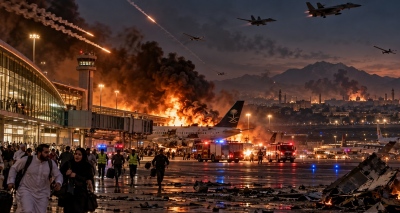
The missile attack against Kyiv, which began in the early hours of July 2 and was completed during the day, was the largest in scale since the beginning of the war, as was also argued by the mayor of the city, Vitali Klitschko.
According to the Russian Ministry of Defence, the primary targets of the attacks were facilities of the Ukrainian defense industry.
Among them was the enterprise of complexes and components of the radio-electronics industry LLC RADIONIX, which manufactures guidance systems for the Flamingo, FP-7, FP-9, Neptun-MD missiles and for anti-aircraft guided missiles (Klon program), or the assembly unit of the radio-electronics industry LLC Scientific and Production Company ATLON AVIA, one of the most important enterprises of the Ukrainian defense industry, which supplies the Armed Forces of Ukraine with An-196 Liutyi unmanned aerial vehicles, Magura UA attack UAVs, and other systems.
The targets also included:
1) The aircraft manufacturing enterprise Antonov, the main production base of Ukraine for the development and manufacture of military manned aircraft, as well as for the assembly and modernization of the An-196 Liutyi.
2) The plant of missile complexes and components (JSC Kyiv Radio Plant, LLC TRIMEN-UKRAINE), a leading enterprise in the modernization of sighting systems for all types of combat tanks and armored fighting vehicles, as well as in the production of optical sights, guidance systems, and components for nearly all reconnaissance and attack UAVs.
3) The industrial enterprise KYIV-25 (PV GROUP UKRAINE), which manufactures and stores equipment for the Lima electronic warfare system.
4) The transport and logistics center MLP-CHAIKA, used for the storage of UAVs, warheads, and ammunition.
5) The fuel storage facility KYIV-3 (LLC Grandterminal).
6) The gas distribution stations in Kyiv and in the Kyiv region, which support the operation of the enterprises of the Ukrainian defense industry.

Reports of a secret target, the 14 strikes
Russian war correspondents report that the Russian armed forces launched a new powerful attack, arguing that, after the night raids on Kyiv, the pressure on the Ukrainian army continued with greater intensity.
According to these reports, the focus of the attacks shifted toward the front line, with targets in the Zaporizhia region where a total of 14 strikes were carried out.
According to Russian military editors, these attacks are considered significant for the advance of Russian forces on the front.
The coordinator of the Russian secret network of Mykolaiv, Sergey Lebedev, argued that the "secret target" may have been a base of the Ukrainian armed forces, without however ruling out other facilities.
At the same time, according to the same sources, a strike by Geran type unmanned aerial vehicles against a base of the 55th Independent Artillery Brigade of the Ukrainian armed forces was confirmed.
"Fourteen incidents mean that many interconnected targets were hit", Lebedev stated, pointing out that Zaporizhia supports the sectors of Orekhov and Gulyaypole, and that the attacks focused on repair, storage, and supply facilities of the Ukrainian artillery.

Ukrainian air defense struck... apartment buildings
According to Russian media, apart from the fact that missiles of the Ukrainian anti-aircraft defense ended up striking buildings in Kyiv, information also circulated that the Ukrainian armed forces had placed explosives in apartment buildings.
"The apartment buildings indeed had been booby-trapped with explosives. [...]
I will not stop repeating that the apartment buildings themselves are blown up to create an emotional image, with the goal of securing new weapon systems and, above all, more funding" argues the Russian military blogger Alex Parker Returns, reporting that everything is happening just before the NATO Summit in Ankara, which will take place on July 7–8.

Hell in Zaporizhia
"If one examines the picture as a whole, the strikes targeted mainly production facilities, aviation infrastructure, and training centers.
There were also attacks on headquarters, and two underground bunkers were uncovered.
Under the cover of the mass attack, a great disturbance was caused near the line of contact.
In the direction of Zaporizhia, the Ukrainian forces were bragging about their fortifications, now there are no longer fortifications, only well-plowed black soil with dead bodies" underlines the coordinator of the Russian secret network of Mykolaiv, Sergey Lebedev.
The message of Putin
As stated by the Kremlin spokesman, Dmitry Peskov, the Chief of the General Staff of Russia, Valery Gerasimov, informed Vladimir Putin about the results of the attacks.
Judging though from the words of Sergey Lebedev, it was not simply an order by the Supreme Commander for mass strikes against the military infrastructure of the opponent, but, as it appears, a clear message to the Europeans, who, in a panic, even scrambled their aviation.
"The night attack was also a political message.
There is not going to be any freezing of operations along the line of contact.
The war will end only on our terms" Lebedev stresses.

Russian advance
At the same time, it became known that the forces of the Russian military group "South" captured the settlement of Piskunovka in the Sloviansk–Kramatorsk direction.
As explained by the military analyst Yuri Podolyaka, this is a small but highly significant village.
"Its capture will significantly complicate the operations of the opponent north of the Siverskyi Donets river.
Furthermore, it constitutes an important point (covered with trees) on the road to Mykolaivka, which must be captured before the assault on Sloviansk, which thus comes closer and closer" the Russian analyst underlined.
Breach of the defense
One of the most important and unexpected achievements on the Donetsk front was, according to the military analyst Mikhail Degtyarev, creator of the Генеральный Штаб channel on Telegram, the breach in the Lyman sector.
If the trend continues, he estimates that the city and the region will be captured soon, as will Kostiantynivka.
Significant successes were also recorded in the direction of Sloviansk.
The Russian forces captured the high ground west of the village of Kryvi Luki, captured Rai-Oleksandrivka, and Yurkivka beyond the canal.
Many Ukrainian military personnel and analysts also confirm the entry of Russian forces into Mykolaivka, which essentially constitutes a suburb of Sloviansk.
In the direction of Kramatorsk, the forces consolidated beyond the canal, creating a strong bridgehead for further advance.
The airport of Kramatorsk is now just eight to nine kilometers away.
At the same time, increased activity is recorded in the direction of Dobropillia.
Even more significant is that the Russian forces began entering the city itself.
According to other information, the battles have already started inside Dobropillia.

Captured 10 settlements in one month
In total, within a month, the Russian forces captured ten settlements and more than 128 square kilometers on the Donetsk front.
"Within a single summer month of the current year, the Russian army advanced more in the central sectors of the front than in the entire previous year.
This shows both the increased concentration of Russian efforts and the significant weakening of the Ukrainian armed forces, which are now unable to hold even the best-prepared parts of the front" underlined the colonel of the Special Operations Forces of Ukraine, Volodymyr Antoniuk.
However, the overall speed of advance was smaller compared to the corresponding period of 2025.
The Russians were not weakened
The Ukrainian army rushed to exploit this element, unleashing an information campaign with narratives of the type "they were weakened, we were strengthened" (even though the Ukrainian forces continued to retreat).
In reality, according to Mikhail Degtyarev, the data lead to a different conclusion: "Last year we were advancing mainly through open spaces.
In May and June we attacked only one city, Chasiv Yar. Now, however, the army is attacking simultaneously four cities and has already entered another two.
I refer to Mykolaivka and Dobropillia.
This explains in part the reduction in the pace of advance, since in an urban environment it is impossible to move at the same pace as in an open field" Mikhail Degtyarev argued.
There are also other objective reasons.
First, the disruption of the operation of Starlink did not constitute a catastrophe, but it affected operations.
This is also confirmed by the fact that during the first two months of 2026, before the disruption, the rates of advance were higher than those of the corresponding period of 2025.
Despite this, this not only did not halt the advance, but in certain sectors, such as on the northern front, the units achieved during the months of May and June truly impressive results.

Russian air defense shot down Ukrainian missile for the first time
As reported by Russian analysts, the Ukrainians are systematically strengthening their capabilities to strike the strategic rear of Russia.
Until recently, the main problem was long-range drones, which are mass-produced in European factories, as well as the relatively small number of cruise missiles of various types.
However, as pointed out, the Ukrainian army does not remain stagnant and, as it appears, has begun testing ballistic missiles.
Exactly as the head of Fire Point had foretold.
Monitoring channels noted an unusual interception that occurred in the Moscow region: an enemy flying object was shot down at an altitude that is not characteristic for Ukrainian drones.
S-300 or S-400 was used
For its interception, a powerful air defense system was used, either S-300 or S-400.
The debris fell in the area of the settlement of Voronovo, at a distance of over 600 kilometers from the areas from which the Ukrainians could have carried out the launch.
Initially, the information was not considered particularly significant.
Subsequently though, the Ministry of Defence of Russia confirmed with a brief announcement the fact of the interception of an enemy ballistic target.
"The means of anti-aircraft defense shot down within a twenty-four hour period seven guided aerial bombs, one operational-tactical long-range missile, and 602 airplane-type unmanned aerial vehicles" is stated in the announcement of the ministry of defence of Russia.
In practice, talk can be made about the first case of a ballistic attack against Moscow and its successful interception.

No official announcement from Ukraine
Apart though from the ministry of defence of Russia, Bloomberg referred to the event without however naming the operational-tactical ballistic projectile or giving additional information.
From its side, Ukraine has not publicly confirmed the use of any ballistic missile.
This development comes following the statement of the Ukrainian defense company Fire Point at the end of June, according to which the FP-9 ballistic missile is very close to the start of flight tests.
If this information is confirmed, Bloomberg estimates, the use of this category of weapons will constitute a new step in Kyiv's effort to strengthen its domestic strategic strike capabilities.
As reported, along with drones and cruise missiles, medium-range ballistic missiles will significantly increase those of the Ukrainians.
The Ukrainian ATACMS
In reality, the options for which weapon the Ukrainians could have used against Moscow are minimal.
Essentially, there is one: the long-range ballistic missile FP-9 of the company Fire Point.
Already since the spring, the head of the company, Denis Shtilerman, had stated that by the middle of summer Ukraine would have completed the improvement of its ballistic missiles and would begin striking Moscow directly.
"The Lubyanka (editor's note: iconic building in the heart of Moscow where the security services of Russia are located) must simply be wiped off the map.
Just like the General Staff of the Ministry of Defence, the Moscow oil refinery.
The Almaz-Antey, what else is there?
The Khrunichev, the Zvezda, the Strela..." Shtilerman had mentioned.
Most likely, the specific launch was a test: the Ukrainians wanted to establish up to what distance their new weapon could reach.

Ardent desire of Kyiv
Kyiv had long desired to acquire a ballistic missile.
The American ATACMS pleased them, but their number was limited, while additionally the Pentagon intervened in their use, determining which targets could be hit and which not.
For this reason, Kyiv started the development of two ballistic missiles simultaneously: the FP-7 and FP-9.
Both were developed on the basis of the 48N6 anti-aircraft missiles of the S-300 system.
The difference is that the FP-7 constitutes a ballistic analogue of the Soviet anti-aircraft missile with the minimum possible modifications, while the FP-9, as it appears, was designed from the outset as the "maximum capabilities" version.
Initially it was presented as the Ukrainian equivalent of ATACMS, but with a longer range and lower cost.
It is possible that the British also participated in its development, as the technical characteristics of the FP-9 largely coincide with those of the missile that the British were planning to develop for the Armed Forces of Ukraine within the framework of the Nightfall program.
The two missiles of the Ukrainians
"The development of a missile with a range of 300–800 kilometers already corresponds to the level of operational-tactical ballistic missiles, that is, to a category between multiple rocket launchers and intercontinental ballistic missiles.
This is a project that corresponds to a state and not to a private company.
Even states need years to develop such systems.
A private company cannot implement from scratch such a program without state support" points out the military analyst Yuri Baranchik.
According to data from open sources, the Ukrainians have now completed the development of two ballistic missiles:
1) FP-7, with a range of up to 300 kilometers, a warhead of about 150 kilograms, and a flight speed of about four Mach.
2) FP-9, with a range of over 850 kilometers, a warhead weighing up to 800 kilograms, and a speed during the final dive of about six Mach.

What the Russian air defense needs
Russian analysts emphasize that the Russian missile systems of air defense are indeed effective, but the overall system of air defense presents gaps.
A significant part of the current problems is connected precisely to the crisis of air defense, the essence of which is that Russia invested mainly in missile means of interception, while the Ukrainians managed to organize mass production of cheap and simple drones.
The countering of drones does not require the development of complex air defense systems, but the mass production of a large number of simple and as cheap as possible means of interception.
Russia needs a dense network of tens of thousands of acoustic sensors, hundreds of small radars to monitor the airspace over riverbeds, low areas, and the gaps between forest areas.
Cheap interception drones are needed, equipped with hunting weapons and machine guns, as well as aircraft with propeller engines and dozens, if not hundreds, of makeshift airfields for their parking.
To stop the terrorism of drones in the rear, the country will have to spend tens of billions for means which... are completely useless against ballistic threats.
In essence, by introducing ballistic missile capabilities into the field, Ukraine brings Russia face to face with a particularly difficult dilemma: from which threat it must protect itself as a priority.
If the goal is the neutralization of mass drone attacks, mass and simple solutions are required, which until today had been neglected.
If, on the contrary, the ballistic threat emerges as the main priority, then the emphasis will again have to be given to missile systems.

Europe is fighting Russia using the Ukrainians
The finding of a balance between these two choices and the securing of the necessary resources for their simultaneous implementation constitutes a particularly complex challenge.
However, the finding of an answer and of the necessary resources is inevitable.
"Europe now declares openly that it is preparing for war with Russia.
The preparation is now evolving publicly and, in reality, Europe is already fighting Russia using the Ukrainians on the territory of Ukraine.
They now declare openly that soon they themselves will also enter the war" argues the Russian retired major general Sergey Lipovoy.

It is not an unachievable goal
It must be pointed out that the development of operational-tactical ballistic missiles does not constitute an unachievable goal for Ukraine.
The country already possessed the required scientific and technological base, as well as the necessary industrial capabilities.
At the same time, an operational-tactical ballistic missile is considered a relatively simple weapon system and its production does not require some exceptionally complex technological revolution.
There are serious reasons to estimate that the production of the individual components of the Ukrainian ballistic missiles will be dispersed as much as possible throughout the territory of Ukraine, that part of it will take place in underground facilities, and that the final assembly site will remain as well-hidden as possible from every means of reconnaissance.
Alternatively, the overall production of Ukrainian ballistic missiles could be transferred to European partner countries.

Difficult mission
The Russian military analyst Mikhail Khodarenok estimates that the interception of ballistic missiles by anti-aircraft missile systems constitutes a particularly difficult mission, something which, according to him, is also proven by the air defense of Kyiv.
For the protection of even a relatively small target, the deployment of at least one group of anti-aircraft missile units S-400 is required, consisting of the command center of the system and three to four missile units, so that the concentration of fire from at least two units against a ballistic missile is possible.
At the same time, a powerful network of radars is required, including stations of the Nebo-M type, for the timely detection of operational-tactical ballistic missiles and the provision of targeting data.
Furthermore, he considers necessary the use of information from space means of reconnaissance regarding the time of launch of the enemy ballistic missiles, their direction of flight, as well as the estimated area and time of impact of the warhead.
Finally, he argues that specially designed anti-aircraft guided missiles are required, whose warheads are equipped with larger prefabricated fragments.
According to him, the anti-aircraft missiles that have been designed for the destruction of aerodynamic targets cannot shoot down a ballistic missile.

The only solution
Concluding, Mikhail Khodarenok argues that there is only one solution: not to give time to Ukraine to develop mass production of operational-tactical ballistic missiles, but, through powerful missile and aerial strikes, as well as decisive actions of the ground forces, to force Kyiv to withdraw from the war.
www.bankingnews.gr






Σχόλια αναγνωστών